
A graduate joins a product team and discovers that two engineers with the same electronics degree can be doing very different work. One is debugging firmware on a motor controller. Another is verifying a chip block. A third is connecting industrial sensors to a cloud dashboard.
All three may be called electronics engineers, but their salary paths can diverge because they solve different business problems, work with different constraints, and carry different kinds of risk.
This can make career advice feel confusing. A programming language, a chip-design tool, or an IoT certification is not automatically a salary ticket. The value comes from being able to use those skills to ship reliable products.
For students choosing a specialization and professionals planning their next move, the better question is not simply “Which field pays more?” It is: which combination of technical depth, product exposure, and domain knowledge makes an engineer difficult to replace?
🧭 Salary Is a Market Signal, Not a Fixed Score
Electronics engineering pay depends on location, industry, company size, years of experience, and the specific role. A VLSI engineer at a semiconductor company, an embedded engineer at a medical-device firm, and an IoT engineer at a systems integrator operate in different markets.
Titles can also hide major differences. “Embedded engineer” may mean writing simple microcontroller code in one company and designing safety-critical real-time software in another. Compare responsibilities, not titles alone.
🏗️ What Employers Actually Pay For
Employers pay more when a skill helps them reduce a costly failure, shorten a product cycle, meet a difficult requirement, or build a capability that competitors lack.
For example, an engineer who can locate an intermittent electromagnetic interference problem may save a product launch. Someone who can close timing on a complex digital design may prevent an expensive silicon respin. These outcomes matter more than a long list of tools on a résumé.
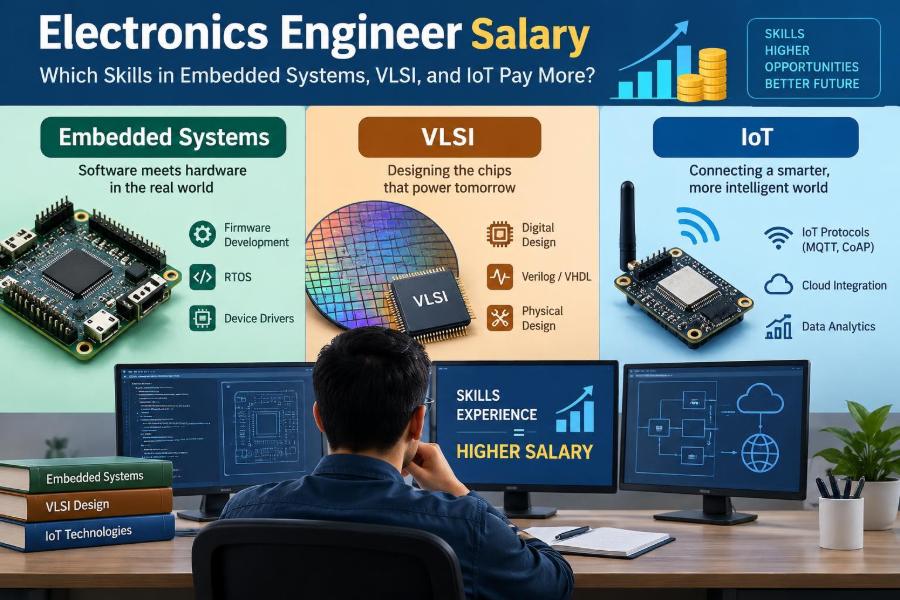
⚖️ The Three Career Tracks at a Glance
| Track | Core work | Typical value driver | Common challenge |
|---|---|---|---|
| Embedded systems | Hardware-near software and device control | Reliable, efficient products | Debugging across hardware and software |
| VLSI | Integrated-circuit design, verification, and implementation | Complexity reduction and correct silicon | Steep tool and design-flow learning curve |
| IoT | Connected devices, gateways, and data paths | Scalable deployment and useful device data | Security, interoperability, and operations |
None is universally “best paid.” VLSI roles often reward deep specialization; embedded roles reward broad system ownership; IoT roles reward the ability to connect device engineering with networking, security, and deployment.
🧠 Why Scarcity Raises Compensation
A scarce skill is not merely uncommon. It is uncommon and needed by organizations that can afford to pay for it. A niche may be technically impressive but have limited local demand.
The strongest salary position usually comes from a skill that takes time to develop, is difficult to assess quickly, and affects high-cost decisions. Examples include advanced verification, functional safety engineering, RF-aware product integration, and low-power optimization.
🔧 Embedded Systems: The Product-Shipping Advantage
Embedded engineers make physical products behave correctly. They write software for microcontrollers, processors, sensors, displays, motors, batteries, and communication modules.
This work is valuable because the code must handle realities that desktop software can often ignore: noisy signals, limited memory, startup timing, power loss, heat, manufacturing variation, and field updates.
💻 C and C++ Still Matter in Embedded Work
C remains central in many embedded environments because it gives direct control over memory, registers, timing, and hardware interfaces. C++ is increasingly useful where teams need safer abstractions, reusable architecture, or more complex application logic.
Knowing syntax is only the entry point. Higher-value capability means understanding pointers, memory layout, interrupts, concurrency, undefined behavior, build systems, and how compiler choices affect a target device.
⏱️ Real-Time Systems Create a Valuable Specialty
A real-time system must respond within a required time window. In a motor drive or brake controller, a response that arrives eventually may still be a failure if it arrives too late.
Engineers who can design task priorities, interrupt handling, timing analysis, and predictable communication are valuable in automotive, industrial control, aerospace, robotics, and medical applications. An RTOS, or real-time operating system, is useful knowledge, but the real skill is reasoning about deadlines.
🐞 Hardware-Aware Debugging Separates Engineers
Many difficult embedded failures sit at the boundary between code and electronics. A sensor reading may be wrong because of a firmware scaling error, an unstable reference voltage, a poor ground path, or a timing mismatch on a bus.
Comfort with oscilloscopes, logic analyzers, debuggers, serial logs, and schematics makes an engineer faster at finding root causes. This is a practical salary lever because teams remember the person who resolves problems that keep everyone else blocked.
🔋 Low-Power Design Has Clear Business Value
Battery life affects customer experience, enclosure size, maintenance cost, and sometimes product feasibility. A device that consumes a little too much current in sleep mode may miss its intended operating life by a large margin.
Useful skills include measuring current correctly, choosing sleep states, controlling peripherals, reducing radio activity, and understanding leakage. These are especially relevant in wearables, meters, asset trackers, and remote sensing.
🧩 Board Bring-Up Builds Broad Credibility
Board bring-up is the process of turning a new PCB into a working system: checking power rails, clocks, reset behavior, programming interfaces, peripheral buses, and basic firmware.
It is often messy and highly educational. Engineers who can move from schematic review to first boot build a broad view of the product, which can lead toward technical leadership and system architecture roles.
🛡️ Safety-Critical Embedded Skills Command Attention
Where failures could harm people or cause major operational losses, engineering work includes stronger processes for requirements, testing, traceability, and review. The exact standards and obligations vary by sector and region.
Competence in safety-oriented development is valuable because it combines technical work with disciplined evidence. However, avoid claiming expertise after reading a standard; meaningful competence comes from working within a real development process.
🧱 VLSI: Why Depth Can Be Rewarded
Very-large-scale integration, or VLSI, covers the creation of integrated circuits containing large numbers of electronic elements. The work may involve architecture, RTL design, verification, physical design, test, or design-for-test.
A chip error can be exceptionally expensive once silicon is fabricated. That risk makes engineers who prevent errors, find corner cases, and improve implementation quality especially valuable.
📐 RTL Design Is More Than Writing Verilog
Register-transfer level, or RTL, describes digital hardware behavior using languages such as Verilog, SystemVerilog, or VHDL. Good RTL design requires thinking in parallel hardware operations rather than sequential software instructions.
High-value designers understand clock-domain crossings, reset strategy, timing intent, synthesis implications, and how a block will be verified. Clean, maintainable RTL reduces downstream friction across the team.
✅ Verification Often Has a High Ceiling
Verification asks whether a design does what it is intended to do across normal and unusual conditions. A verification engineer may create testbenches, constrained-random tests, assertions, coverage plans, and formal checks.
This work rewards persistence and precise reasoning. Finding a rare bug before tape-out, the stage when a design is released for fabrication, can protect a major schedule and budget. SystemVerilog and UVM are useful tools, but verification thinking matters more than memorizing a framework.
⏳ Timing Closure Is a Specialized Problem
Digital signals do not travel instantly. Timing closure is the work of ensuring paths meet clock-related timing requirements after synthesis and physical implementation.
It combines logic understanding, constraints, implementation knowledge, and careful analysis. Because relatively few engineers become genuinely strong at interpreting timing reports and making correct trade-offs, this can be a well-regarded specialization.
🗺️ Physical Design Connects Logic to Silicon
Physical design transforms a logical circuit into a layout that can be manufactured. Activities can include floorplanning, placement, clock-tree construction, routing, power planning, and signoff checks.
The role is demanding because electrical effects become more visible as designs grow and processes become more complex. It suits engineers who enjoy optimization, tool-driven workflows, and constraints that interact in non-obvious ways.
🔍 DFT and Test Engineering Reduce Manufacturing Risk
Design-for-test, commonly called DFT, adds features that make chips easier to test after manufacturing. Test engineering then helps turn those features into efficient, effective production tests.
This work matters because a technically correct design still needs to be screened for manufacturing defects. Engineers who understand both design intent and test economics can contribute in ways that directly affect yield, quality, and cost.
📡 IoT Is a System, Not Just a Connected Sensor
The Internet of Things includes devices that sense, act, communicate, and often report to a service. The useful unit of work is usually the whole system: device firmware, connectivity, gateway behavior, backend interfaces, dashboards, updates, and support operations.
A connected temperature sensor is not successful merely because it sends one reading. It must keep working through network loss, battery limits, malformed data, credential changes, and future software updates.
🌐 Connectivity Knowledge Must Be Practical
IoT engineers may work with Wi-Fi, Bluetooth Low Energy, cellular, Ethernet, LoRaWAN, or other connectivity options. The right choice depends on range, energy budget, data rate, coverage, latency, cost, and regulations.
Higher-value decisions explain the trade-off. For example, a low-data-rate remote meter has different needs from a factory camera. Selecting a protocol because it is familiar rather than suitable creates expensive redesigns.
🔐 Security Is an Engineering Skill, Not a Feature List
Every connected device expands an organization’s attack surface. Useful IoT security work includes secure boot, signed firmware, protected key storage, authentication, encryption used correctly, access control, and a safe update process.
Security is never a one-time checkbox. Threats, libraries, credentials, and operating environments change. Engineers who can make practical security choices without making a device impossible to service are increasingly valuable.
🔄 Device Management Makes IoT Deployable
Managing one prototype is easy; managing thousands of deployed devices is different. Fleet operations may require provisioning, configuration, health monitoring, remote diagnostics, staged updates, rollback plans, and asset records.
This is where IoT work gains operational value. An engineer who designs for serviceability helps reduce truck rolls, support effort, and downtime after deployment.
☁️ Cloud Knowledge Helps, but Boundaries Matter
IoT roles often benefit from understanding APIs, message brokers, data storage, and event processing. This knowledge helps device engineers build interfaces that are reliable and observable.
Still, no engineer needs to own every layer. A stronger approach is to know the boundary well: what the device guarantees, how it handles failures, what data it sends, and how backend teams can detect problems.
🏭 Industry Domain Can Outweigh a Generic Tool
Tools change. Domain knowledge accumulates. An engineer who understands power conversion in renewable-energy equipment, wireless constraints in healthcare devices, or field maintenance in industrial automation can make better design decisions earlier.
That knowledge is often earned through exposure to real customers, compliance needs, failure modes, and operating conditions. It can make a general electronics skill set substantially more valuable.
📈 The Highest Value Often Sits at Intersections
Strong career profiles frequently combine two areas rather than trying to be equally expert in everything. Examples include embedded firmware plus functional safety, RTL design plus verification, or IoT device design plus security.
These intersections solve handoff problems. A firmware engineer who understands PCB constraints communicates better with hardware teams; a verification engineer who understands architecture writes more meaningful tests.
🎓 Degrees, Courses, and Certifications Have Different Roles
A degree provides fundamentals and signals formal preparation. Courses can help build focused skills. Certifications may be useful when an employer recognizes a particular ecosystem or when they structure learning.
None substitutes for demonstrated engineering judgment. Hiring managers often learn more from a clear project explanation than from a certificate list: what failed, how it was measured, what changed, and why the final design was reliable.
🧪 Build a Portfolio That Shows Engineering Evidence
A useful portfolio is not a gallery of blinking LEDs. It shows decisions, constraints, tests, and results. Remove proprietary information from professional work and use personal or academic projects where appropriate.
- Document a small embedded device with a block diagram, power measurements, and fault handling.
- Show a digital design with a verification plan, assertions, and coverage reasoning.
- Build an IoT prototype that includes provisioning, secure update considerations, and network-loss behavior.
- Explain one bug you found, the evidence collected, and the root cause.
Clear documentation also signals communication skill, which becomes more valuable as engineers take ownership of larger systems.
🗣️ Communication Raises the Value of Technical Work
Engineering decisions need to be understood by hardware designers, software developers, project managers, manufacturing teams, and customers. A technically correct idea can still fail if its assumptions and risks are not communicated.
Practice writing concise bug reports, design notes, and test summaries. Explain trade-offs without jargon when speaking to non-specialists, while preserving the details that technical reviewers need.
🚫 Common Salary-Planning Mistakes
A frequent mistake is chasing the newest keyword without building fundamentals. Another is treating tool familiarity as proof of competence. Both can produce a résumé that looks broad but does not demonstrate ownership.
- Choosing a field only because it seems popular, while ignoring local opportunities and personal fit.
- Learning multiple programming languages but avoiding debugging, testing, and version control.
- Calling an IoT prototype secure because it uses encryption, without considering keys or updates.
- Studying VLSI syntax without learning timing, verification, and hardware behavior.
- Waiting for a “perfect” project rather than completing and documenting a modest one.
🧭 Choose a Track That Fits Your Working Style
Embedded systems may suit people who enjoy hands-on debugging and seeing software control physical hardware. VLSI may suit people who enjoy deep digital logic, systematic analysis, and highly structured flows. IoT may suit people who like connecting disciplines and thinking about deployment at scale.
Interest matters because expertise takes sustained practice. A slightly less fashionable field where you become unusually capable can be a better long-term choice than a fashionable field you dislike.
🪜 A Practical Learning Sequence
Start with foundations: circuits, digital logic, programming, version control, basic measurement, and data structures. Then select one primary track and build a project that forces you to use its real workflow.
- Learn the underlying concepts before relying heavily on frameworks and generated code.
- Use professional habits early: source control, issue tracking, reviews, tests, and readable documentation.
- Measure behavior rather than assuming it: timing, memory use, current draw, coverage, or network reliability.
- Seek feedback from engineers who can challenge your assumptions.
- Expand into a complementary skill after your primary area has real depth.
🤝 Job Changes Should Increase Scope, Not Just Title
When evaluating a role, ask what you will own and what problems you will learn to solve. Exposure to design reviews, lab work, production failures, customers, and cross-functional decisions can accelerate capability.
A role with a modest title but excellent mentorship and product responsibility may create stronger future options than a better-sounding role limited to repetitive tasks. Compensation matters, but learning environment is part of career economics.
💬 How to Discuss Compensation Professionally
Prepare by understanding the responsibilities, location, work arrangement, benefits, growth path, and the skills expected. Describe your value in terms of outcomes: reduced debug time, improved test coverage, reliable releases, or ownership of a difficult interface.
Avoid inventing competing offers or making claims you cannot support. Honest discussion is more durable, especially in technical fields where your future colleagues may assess your work closely.
🧠 The Core Principle: Build Useful, Verifiable Depth
Embedded systems, VLSI, and IoT can all offer strong salary growth. The difference is rarely a single language, tool, or credential. It is the ability to handle difficult constraints and produce evidence that a design works.
Build depth in one core discipline, add a complementary capability, and learn the industry context around the product. That combination makes you more effective in interviews, more trusted on projects, and better positioned when opportunities appear.
The skills that pay more are usually the skills that help a team deliver reliable electronics under real-world constraints—not merely the skills with the most fashionable names. Choose a path you can practice deeply, document what you learn, and let demonstrated engineering judgment compound over time. 🔌🧠📈