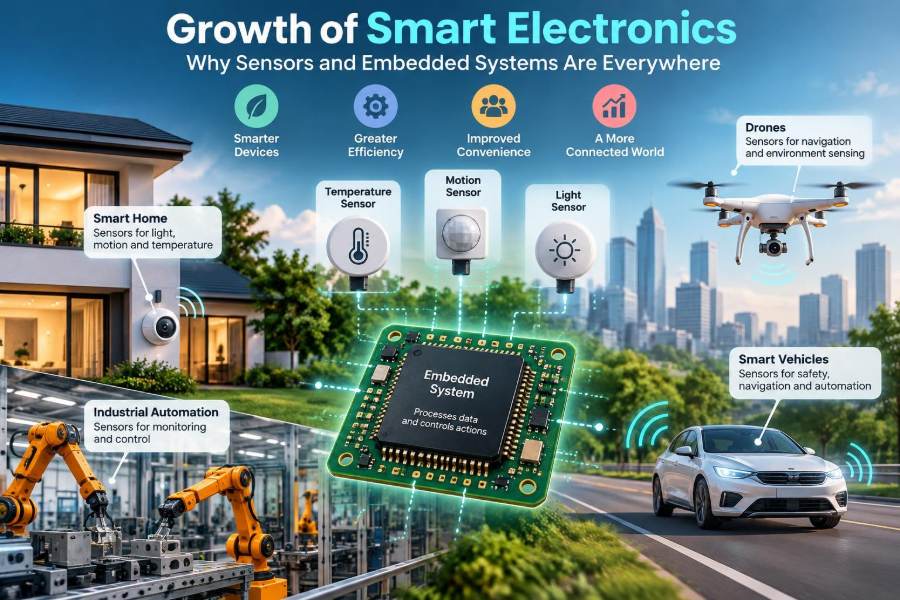

A thermostat notices a room cooling before anyone reaches for a dial. A smartwatch turns tiny changes in motion into a step count. A car warns its driver about an obstacle that may be outside the driver’s view.
These experiences feel ordinary because the electronics behind them are increasingly small, affordable, and capable. Yet each one depends on a carefully engineered chain: something senses the physical world, a controller interprets the signal, and a system takes or recommends an action.
That chain is now built into appliances, factories, farms, medical equipment, transport, buildings, and consumer devices. It is changing what electronics engineers design and what users expect from products.
The spread of smart electronics is not simply a story about putting everything online. It is about making physical systems able to measure, decide, communicate, and operate safely within real constraints.
🧠 What Makes Electronics “Smart”?
Smart electronics combine sensing, computation, and action. A conventional lamp may only need a switch and power supply; a smart lighting controller can measure ambient light, follow a schedule, detect occupancy, and adjust brightness.
The word smart does not require artificial intelligence or an internet connection. A locally controlled washing machine that weighs a load indirectly through motor behavior and adapts its cycle is already using embedded intelligence.
What matters is the feedback loop: observe a condition, process information, and respond according to programmed logic.
📡 Sensors Turn Physical Conditions into Signals
A sensor is the system’s connection to the real world. It converts a physical quantity—such as temperature, pressure, acceleration, light, sound, humidity, or magnetic field—into an electrical signal that a circuit can process.
A temperature sensor may produce a changing voltage, resistance, or digital data value. An accelerometer measures acceleration along one or more axes, letting a device infer tilt, vibration, impact, or motion.
Sensors do not directly deliver perfect truth. They provide measurements affected by their design, mounting, environment, calibration, and electrical noise.
⚙️ Embedded Systems Provide the Decision-Making Core
An embedded system is a computer designed into a larger product to perform a dedicated function. Unlike a general-purpose laptop, it often runs a focused program with limited memory, power, processing capacity, and user interface.
Its controller might read a sensor every few milliseconds, compare the result with a threshold, drive a motor, record an event, or send data to another device. This concentrated role allows embedded hardware to be small and efficient.
Common controllers include microcontrollers, system-on-chip devices, and digital signal processors. The right choice depends on timing, interfaces, power use, cost, and software complexity.
🔁 The Sense-Decide-Act Loop
Most smart products can be understood as a repeating control loop. A smart fan is a simple example: measure temperature, decide on a speed, command the motor driver, then measure again.
- Sense a physical condition.
- Condition and convert the signal into usable data.
- Apply logic, a control algorithm, or a learned model.
- Drive an output such as a display, valve, relay, motor, or alarm.
- Check the next measurement and correct if necessary.
This loop is central to automation. Its quality depends on more than code: slow sensors, noisy measurements, delayed communications, or poorly chosen thresholds can produce poor behavior.
🔌 Why This Growth Is Happening Now
The underlying ideas have existed for decades, but practical adoption has accelerated because key building blocks are easier to obtain and integrate. Many sensor modules now include signal conditioning, analog-to-digital conversion, and digital interfaces in compact packages.
Microcontrollers offer useful processing capability at low power, while mature software tools reduce development effort. Wireless modules, cloud platforms, and mobile apps can add connectivity without every team designing a radio system from scratch.
Falling component cost helps, but it is only one factor. Better integration and reusable development ecosystems often matter just as much.
📦 Miniaturization Changes Product Possibilities
When a sensor, processor, power circuit, and antenna fit inside a small enclosure, designers can place intelligence near the point where data is created. That enables wearables, instrumented tools, compact medical monitors, and distributed industrial nodes.
Smaller hardware creates new constraints too. Heat has less area to escape, batteries have limited capacity, antennas may perform poorly near metal or the human body, and repairs can become difficult.
Compactness is valuable only when the complete system remains reliable and manufacturable.
🔋 Power Efficiency Is a Design Requirement
Many smart devices spend most of their time waiting. Battery-powered sensor nodes commonly use sleep modes, wake briefly to sample or transmit, then return to low-power operation.
Engineers evaluate current in active, idle, and sleep states rather than looking only at a processor’s headline performance. A radio transmission can consume far more energy than a short calculation, so sending less data can extend operating life.
Power budgeting should begin early. A design that works on a bench supply may fail its intended battery life once the display, sensor warm-up, radio retries, and temperature effects are included.
📶 Connectivity Extends the System Beyond the Device
Connectivity lets devices share measurements, receive updates, coordinate actions, or provide remote status. Depending on range and power needs, a product may use wired industrial networks, Bluetooth, Wi-Fi, cellular links, or low-power wide-area networks.
Connection is not automatically useful. A local water-leak detector that sounds an alarm may protect a home during an internet outage; adding remote notifications can be valuable, but should not replace the essential local function.
Good architecture asks what data must leave the device, how quickly it must arrive, and what the product should do when communication disappears.
🌡️ Smart Homes Make the Technology Visible
Homes offer familiar examples: thermostats, smoke alarms, robotic vacuums, smart meters, video doorbells, lighting controls, and air-quality monitors. Their sensors turn everyday conditions into measurable inputs.
A heating controller should not react wildly to every brief temperature fluctuation. It may use averaging, timing rules, occupancy schedules, and hysteresis—a deliberate gap between switching on and switching off—to avoid rapid cycling.
This illustrates a broader lesson: the useful part is rarely the sensor alone. It is the engineering that makes the response stable and appropriate.
🏭 Industrial Automation Demands Reliability
Factories use sensors to detect part position, monitor pressure and temperature, track machine states, and inspect products. Embedded controllers coordinate equipment with precise timing and often operate continuously for long periods.
Industrial environments add electrical interference, vibration, dust, moisture, wide temperature ranges, and safety requirements. A consumer-grade sensor module may be unsuitable even if it measures the right variable.
Engineers consider enclosure ratings, isolation, fault detection, connector durability, electromagnetic compatibility, and maintainability alongside measurement accuracy.
🚗 Vehicles Are Distributed Embedded Systems
Modern vehicles contain many electronic control units connected through vehicle networks. Controllers manage areas such as powertrain functions, braking support, airbags, battery systems, lighting, infotainment, and driver-assistance features.
Automotive electronics face demanding conditions: voltage transients, temperature extremes, vibration, and long service life. Some functions are safety-related, so engineers must analyze faults and ensure the system moves toward a safe state when failures occur.
A sensor reading is only one input to a vehicle decision. Robust designs check plausibility, compare redundant information where needed, and account for degraded operation.
🏥 Medical Devices Raise the Stakes
Embedded electronics support devices such as patient monitors, infusion equipment, diagnostic instruments, and wearable health trackers. They can improve observation and usability, but the consequences of error depend strongly on the application.
Consumer wellness measurements should not be treated as clinical diagnoses. Measurement accuracy can vary with placement, movement, skin contact, environment, and the algorithm used to interpret the signal.
For equipment used in care decisions, development requires careful verification, risk management, documentation, and compliance with applicable regulations. Engineers must be explicit about intended use and limitations.
🌾 Agriculture Benefits from Local Measurements
A field is not uniform. Soil moisture, temperature, light, and irrigation conditions can vary across relatively short distances. Sensors can help operators observe those variations rather than relying solely on a fixed schedule.
For example, a hypothetical irrigation controller might open a valve only when soil readings, weather conditions, and timing rules support watering. Its benefit depends on correctly placed probes and an understanding of the crop and soil—not merely on collecting data.
Outdoor systems must also withstand water ingress, sunlight, animals, corrosion, and intermittent network coverage.
🏙️ Buildings Use Data to Manage Resources
Commercial buildings use occupancy, carbon dioxide, temperature, airflow, and light sensors to inform heating, ventilation, lighting, and access systems. The goal is often comfort, safety, and efficient operation rather than automation for its own sake.
One occupancy sensor should not necessarily control an entire floor. Sensor placement, zone design, and the time delays chosen by the control strategy determine whether the system feels helpful or frustrating.
Building systems also need override options. A well-designed control system respects unusual conditions that a fixed rule may not anticipate.
📈 Raw Data Is Not Yet Useful Information
A stream of readings becomes useful only after context is added. A motor vibration value may be normal at high speed and concerning at low speed; a room temperature reading means little without knowing the target range and sensor location.
Embedded software often filters noise, removes impossible values, calculates trends, and detects events. More advanced systems may classify patterns, but their output is limited by the relevance and quality of input data.
Data interpretation is an engineering problem, not a dashboard feature.
🎯 Accuracy, Precision, and Resolution Are Different
These terms are often mixed up. Accuracy describes closeness to the actual value; precision describes how consistently repeated measurements agree; resolution is the smallest change the system can distinguish.
| Term | Practical meaning | Example concern |
|---|---|---|
| Accuracy | Closeness to the real condition | A thermometer consistently reads too high |
| Precision | Repeatability of readings | Readings jump around while conditions are stable |
| Resolution | Smallest detectable increment | A converter cannot distinguish a small change |
A highly resolved reading is not automatically accurate. Calibration, drift, mounting, and interference may still make the value misleading.
🧪 Calibration and Validation Keep Measurements Honest
Calibration compares an instrument with a known reference and adjusts or characterizes its response. Some sensors are calibrated during manufacture; others need field checks because aging or installation conditions affect results.
Validation asks a broader question: does the complete system perform its intended job in realistic conditions? A sensor may pass a bench test but fail when mounted near a heat source, exposed to vibration, or installed with a long noisy cable.
Testing must include normal cases, boundary conditions, expected faults, and plausible misuse.
📐 Signal Conditioning Bridges Sensor and Processor
Real sensor outputs may be tiny, nonlinear, noisy, or incompatible with a controller input. Signal conditioning uses circuits and software to amplify, filter, isolate, offset, or otherwise prepare the signal.
For an analog sensor, an analog-to-digital converter samples a voltage and represents it numerically. Reference-voltage stability, grounding, layout, sampling rate, and filtering all influence the result.
Ignoring this interface is a common beginner mistake. A capable sensor and capable microcontroller can still form an unreliable measurement system.
⏱️ Real-Time Behavior Separates Embedded Design
In many applications, a correct answer delivered late is not useful. A motor controller, protective relay, or airbag-related subsystem must meet defined timing behavior; it cannot wait unpredictably for background tasks.
Real-time design involves scheduling, interrupt handling, worst-case execution time, communication latency, and safe handling of overload. Not every embedded product needs a formal real-time operating system, but every product needs realistic timing analysis.
Cloud processing can add capability, yet critical local actions should not depend on uncertain network delay.
🛡️ Security Must Include the Physical Device
A connected device can be attacked through its network interface, update mechanism, mobile app, debug port, or poorly protected stored credentials. If it controls a lock, pump, camera, or industrial process, cybersecurity becomes connected to physical consequences.
Useful practices include unique credentials, encrypted communications where appropriate, access control, secure software updates, disabled production debug interfaces, and a plan for vulnerability maintenance.
Security is not a single feature added at the end. It is a set of design decisions that must be maintained through the product’s operating life.
🔒 Privacy Depends on Data Choices
Sensor data can reveal routines, occupancy, location, activity, audio patterns, or equipment usage. Even data that appears harmless in isolation can become sensitive when collected continuously and combined with other information.
Data minimization is a practical engineering principle: collect only what the function needs, retain it only as long as necessary, and protect it during storage and transmission. Local processing can sometimes avoid sending raw data elsewhere.
Clear user controls and understandable explanations help users make informed choices about connected products.
⚠️ Failure Modes Need Deliberate Design
Every physical system encounters faults: a cable breaks, a sensor freezes at one value, a battery drains, a relay sticks, a packet is lost, or software enters an unexpected state. Assuming a component will always report failure neatly is unsafe.
Engineers use methods such as watchdog timers, range checks, timeout detection, redundancy, self-tests, and fault logging. The suitable response depends on the hazard: a failed garden monitor and a failed machine safeguard require different levels of protection.
Fail-safe behavior means identifying what the system should do when confidence in its inputs or operation is lost.
🧰 Hardware and Software Must Be Designed Together
Smart electronics are often described as software products, but software inherits the realities of the circuit. Pin assignments, sensor interfaces, memory limits, reset behavior, power sequencing, and electromagnetic noise all influence firmware architecture.
Likewise, hardware decisions should account for diagnostics and updates. Adding test points, status indicators, current measurement options, and a reliable programming path can save significant time during development and service.
Early collaboration prevents costly situations where each discipline assumes the other will solve a limitation.
🧩 Edge Computing Reduces Dependence on the Cloud
Edge computing means processing data near where it is generated rather than sending every raw measurement to a remote service. A camera might detect an occupied parking space locally and transmit only the result.
This can reduce bandwidth, improve response time, support operation during outages, and limit data exposure. It also places more processing, memory, thermal, and update-management demands on the device.
The best split between device and cloud is application-specific. Historical analysis may fit a remote service, while immediate protection usually belongs close to the equipment.
🔄 Updates Are Part of the Product Lifecycle
Firmware updates can correct defects, improve reliability, support new sensors, and address security issues. But a failed update can also disable a device, especially if power is lost at the wrong moment.
Robust update strategies verify authenticity, protect against corrupted files, preserve a recovery path, and avoid replacing known-good software until new software is validated. Products expected to operate for years need a realistic maintenance plan.
A device is not finished when it leaves the factory; its support model is part of its engineering quality.
🧑🔧 Skills That Matter for Engineers
Students and professionals entering this field benefit from a broad foundation. Circuit theory and programming are essential, but so are debugging discipline, measurement practice, documentation, and system-level thinking.
- Read sensor datasheets beyond the first specification table.
- Use oscilloscopes, logic analyzers, and multimeters to test assumptions.
- Learn basic analog design alongside digital interfaces.
- Practice C or C++ and understand timing, memory, and state machines.
- Build small projects that include power, enclosure, and fault handling.
Projects become far more instructive when they are tested outside ideal desk conditions.
🚧 Common Design Mistakes to Avoid
A frequent mistake is treating a development-board demonstration as a finished product. Breadboard wiring, laboratory power, short cables, and controlled temperatures hide problems that appear in deployment.
Other recurring errors include selecting parts without supply-chain consideration, transmitting data too often, trusting one unverified sensor, leaving debug access exposed, and designing an interface that gives users no clue when data is stale or invalid.
Requirements should describe operating conditions, failure responses, update needs, service life, and user expectations—not just the main feature.
♻️ Smarter Should Also Mean More Sustainable
Extra electronics can reduce waste or energy in some applications, but they also require materials, manufacturing, batteries, and eventual disposal. A poorly designed connected product may become e-waste when its service ends or its app is abandoned.
Longer-lived designs use efficient power management, repairable or replaceable parts where practical, durable enclosures, documented interfaces, and maintained software. Choosing a sensor simply because it is available can be less sustainable than selecting one suited to a long service life.
Environmental thinking is strongest when it considers the full product lifecycle, not only energy use during operation.
🧭 Choosing When Smart Features Are Worthwhile
Before adding sensors and connectivity, ask what decision will improve. A useful feature should solve a real uncertainty, reduce an avoidable task, improve safety, or provide information that someone can act upon.
If a manual control is clearer, cheaper, safer, and just as effective, automation may add little value. Conversely, remote monitoring can be highly valuable when an asset is inaccessible, conditions change quickly, or failures need early attention.
The goal is not maximum intelligence. It is an appropriate amount of intelligence for the problem.
🚀 Where Smart Electronics Are Headed
Future products will likely integrate more sensing, local processing, and communication into ordinary objects. Advances in low-power computing, better sensor fusion, and more capable embedded software will expand what small devices can infer from their surroundings.
However, wider adoption will also increase the need for interoperable designs, secure update practices, responsible data handling, repairability, and engineers who understand both physical systems and software behavior.
Technical capability alone does not determine whether a smart product succeeds. Trust, maintainability, and useful real-world performance matter just as much.
✅ The Core Principle Behind Smart Electronics
Sensors and embedded systems are everywhere because they give products a practical way to respond to changing conditions. They turn passive equipment into systems that can observe, adapt, assist, and report.
But the value comes from the whole design: meaningful measurements, sound electronics, dependable software, appropriate connectivity, safe failure behavior, and respect for the people affected by the data.
For engineers, the key question is not “Can we add a sensor?” It is “What reliable decision can this measurement support, and what happens when the system is wrong?”
Smart electronics work best when sensing, computation, and human needs are engineered as one dependable system—not as separate features. That mindset will remain useful whether the next device lives in a home, factory, vehicle, clinic, or field. 🔌📡🛠️