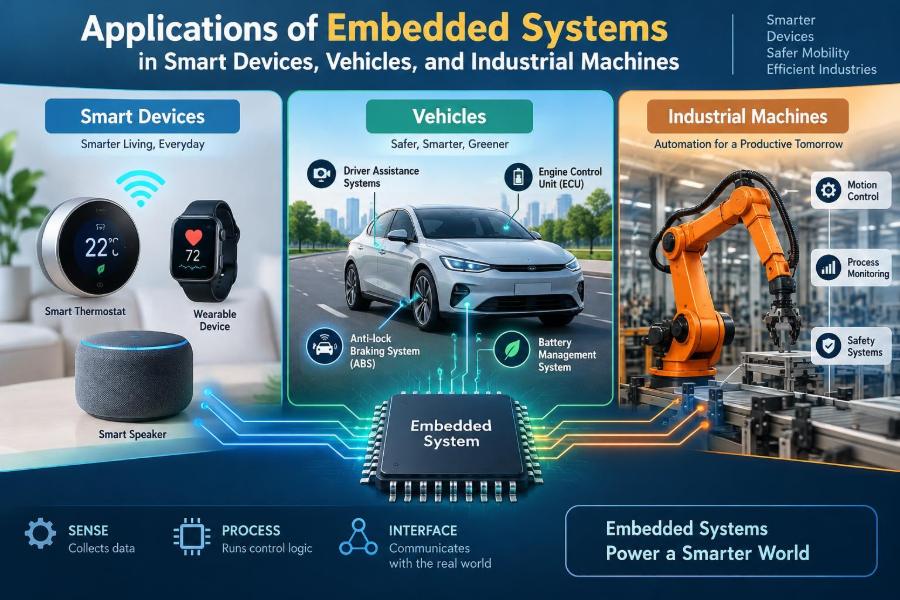

A smartwatch vibrates just before a meeting. A car applies braking force when it senses a possible collision. A packaging line stops when one bottle is missing its cap. These actions feel immediate because a small, dedicated computer is continuously sensing, deciding, and controlling.
That computer is usually an embedded system: electronics and software designed to perform a defined function inside a larger product. Unlike a general-purpose laptop, it may have no screen, no keyboard, and very little spare memory, yet it can be responsible for highly time-sensitive decisions.
Embedded systems sit at the meeting point of electronics engineering, programming, control theory, and product design. They turn sensor readings into useful behaviour, from adjusting a home thermostat to managing a motor drive in a factory.
Understanding their applications also explains why designing them is more than selecting a microcontroller. Engineers must consider timing, power, safety, reliability, connectivity, cost, and the consequences if a device makes the wrong decision.
🧠 What Makes a System Embedded?
An embedded system is a combination of hardware and firmware built into a host product. Firmware is software stored in non-volatile memory, such as flash memory, so it is available when the device powers on.
A washing machine controller is a useful example. It reads water level and temperature, operates valves and a motor, accepts user selections, and responds to faults. Its computing resources serve that appliance rather than a wide range of user-installed programs.
🧩 The Basic Building Blocks
Most embedded products contain a processing unit, memory, input circuits, output circuits, and a power supply. The processing unit may be a microcontroller, a microprocessor, a programmable logic device, or a combination of these.
- Sensors convert physical conditions such as light, pressure, motion, or temperature into electrical signals.
- Actuators create physical action through motors, relays, valves, heaters, displays, or speakers.
- Interfaces carry data to other chips, devices, or networks.
- Firmware coordinates the system’s intended behavior.
The value comes from the complete feedback path: sense a condition, interpret it, act, and verify the result where possible.
🔄 The Sense-Decide-Act Loop
Many embedded applications follow a control loop. A sensor provides an input, the controller compares it with a target or set of rules, and an output changes the system state.
Consider a refrigerator. A temperature sensor reports the compartment temperature; the controller decides whether cooling is required; then it switches a compressor or fan through suitable power electronics. The cycle repeats, often with filtering and timing rules to prevent rapid switching.
This is why embedded design is closely tied to physical behavior. No amount of elegant code can compensate for a noisy sensor, poorly chosen actuator, or unsafe power stage.
⏱️ Why Real-Time Behavior Matters
A system is real-time when correctness depends on both the answer and the time at which it is produced. A delayed music recommendation is inconvenient. A delayed motor shutdown or airbag decision can be unacceptable.
Real-time does not always mean “extremely fast.” It means meeting a defined deadline consistently. A greenhouse controller may need to check humidity every few seconds, while a motor-control loop may require much more frequent, predictable execution.
Engineers therefore analyze worst-case timing, interrupt latency, processor load, and communication delays rather than relying only on average performance.
📱 Smart Devices: Computing Close to the User
Smart devices bring embedded intelligence into objects people use directly: phones, wearables, appliances, speakers, cameras, lighting controls, and home energy equipment. They combine user interfaces with sensor processing and network access.
A smart thermostat, for example, can read temperature locally, follow a schedule, display status, and communicate with a phone application. Its core heating or cooling decisions should not necessarily depend on a distant server being available.
That local capability is called edge processing: computation near the source of data or action. It can reduce response delay and preserve basic function during a network outage.
⌚ Wearables and Low-Power Design
Wearables illustrate a strict embedded constraint: limited battery energy. A fitness tracker may sample motion, measure optical signals, update a display, maintain wireless communication, and still be expected to run for extended periods between charges.
Power-conscious firmware spends as much time as possible in low-power sleep modes. It wakes on a timer, a motion event, or a communication request, performs a short task, then sleeps again.
Designers also select sensors with suitable standby current, use efficient voltage regulation, and avoid unnecessary radio transmissions. A feature that is technically possible may not be practical if it dramatically changes battery life.
🏠 Connected Appliances and Home Automation
Embedded controllers make appliances more adaptive and diagnosable. A dishwasher can estimate wash progress from temperature, water flow, and motor activity; a robotic vacuum can use proximity sensors and wheel feedback to navigate a room.
Home automation adds another challenge: devices from different vendors may need to coexist. Communication protocols, pairing procedures, and update mechanisms must be designed so that an ordinary user can set up the system without understanding network engineering.
Convenience should not remove manual control. A wall switch, local button, or safe fallback mode remains valuable when a phone is unavailable or the home network fails.
🎙️ Audio, Cameras, and Local Signal Processing
Many smart products process signals continuously. Microphones capture sound waves, image sensors create streams of pixels, and embedded processors filter, compress, classify, or transmit that information.
A noise-cancelling headset, for instance, must sample microphones and generate an opposing audio signal with very low delay. Camera systems may adjust exposure, focus, and white balance before storing or transmitting a frame.
These tasks often use digital signal processing (DSP), which applies mathematical operations to sampled data. The required processor depends on the algorithm, sample rate, precision, and acceptable energy use.
🔐 Privacy and Security in Smart Products
A connected device can expose more than its owner expects. Usage schedules, audio commands, camera images, energy patterns, and location-related data may all have privacy implications.
Security begins with basics: unique credentials, encrypted communication where appropriate, restricted debug interfaces, and validated firmware updates. A product also needs a plan for what happens when a vulnerability is found after deployment.
Security is not a feature that can be added only at the end. An unprotected update path or a default password can undermine otherwise capable hardware.
🚗 Vehicles as Networks of Embedded Controllers
Modern vehicles contain many electronic control units, often called ECUs. Each may handle a focused function such as engine operation, braking, steering assistance, body electronics, battery management, infotainment, or climate control.
These controllers exchange information over in-vehicle networks. A wheel-speed measurement can be relevant to braking control, stability functions, dashboard displays, and driver-assistance features.
Separating functions into controllers can simplify development and allow systems to evolve. It also creates integration work: messages must arrive reliably, software versions must remain compatible, and one fault should not spread unnecessarily.
🛞 Powertrain and Motor Control
In combustion vehicles, embedded control manages fuel injection, ignition timing, emissions-related subsystems, and thermal conditions. It uses sensor feedback to adjust operation across changing loads, temperatures, and driver demands.
In electric vehicles, controllers regulate traction motors, inverters, charging, and regenerative braking. Motor control commonly uses feedback from current, voltage, rotor position, and speed to command switching devices precisely.
High-voltage systems add isolation, thermal, and fault-handling requirements. The controller must not only optimize performance; it must detect abnormal conditions and move toward a safe state.
🔋 Battery Management Systems
A battery management system, or BMS, monitors rechargeable battery packs. It measures cell voltages, current, and temperatures, estimates operating state, and may control contactors, cooling, heating, or balancing circuits.
Cells in a pack do not behave identically. Small differences in capacity, temperature, and aging can accumulate. Cell balancing helps limit imbalance so that one cell does not reach a voltage limit significantly before the others.
Battery state estimates are models, not direct measurements. Accuracy depends on sensing quality, calibration, battery chemistry, temperature, aging, and the estimation method used.
🧭 Driver Assistance and Sensor Fusion
Driver-assistance systems can use cameras, radar, ultrasonic sensors, and other sensing technologies. Each has strengths and limitations: lighting affects cameras, reflective surfaces can complicate ranging sensors, and weather may degrade performance.
Sensor fusion combines inputs to build a more useful estimate than a single sensor may provide. For example, one sensor may detect distance well while another helps classify the object.
These systems require careful validation because the road environment is variable. Engineers must account for sensor faults, uncertain detections, unusual objects, and clear communication of system limits to drivers.
🛑 Functional Safety in Automotive Electronics
A failure in a vehicle controller can have very different consequences depending on its function. A malfunctioning cabin-light controller is not equivalent to a malfunctioning braking-related controller.
Functional safety engineering identifies hazards, evaluates how faults could lead to them, and defines measures to reduce risk. These measures can include monitoring circuits, redundant sensing, diagnostic checks, watchdog timers, and controlled shutdown behavior.
Redundancy is not simply duplicating a component. Two channels can share the same power source, sensor weakness, or software defect. Independence and fault coverage matter as much as the number of parts.
🏭 Industrial Machines: Embedded Control at Work
Industrial machines use embedded systems to perform repeatable, measurable operations. Examples include conveyor systems, machine tools, pumps, robotic cells, heating equipment, elevators, and packaging machines.
Here, the controller must often coordinate sensors, pneumatic valves, motors, and safety devices in a defined sequence. It may also record alarms and production data for maintenance teams.
Industrial environments can be electrically noisy, hot, dusty, wet, or subject to vibration. Hardware that works on a laboratory bench may need substantial protection before it is dependable on a factory floor.
⚙️ PLCs, Microcontrollers, and Industrial PCs
A programmable logic controller (PLC) is widely used for industrial automation because it is designed for robust input/output handling, maintainability, and predictable control. Microcontrollers are common inside dedicated drives, sensors, instruments, and compact machines.
Industrial PCs may be chosen when an application needs a richer interface, data processing, vision algorithms, or more complex software. The right choice depends on required timing, lifecycle support, serviceability, cost, and environmental demands.
| Platform | Typical strength | Common application |
|---|---|---|
| Microcontroller | Low cost, low power, dedicated control | Sensor node, motor controller, smart actuator |
| PLC | Rugged I/O and maintainable automation logic | Conveyor, process sequence, machine interlocks |
| Industrial PC | Complex software and data-heavy tasks | Machine vision, supervisory control, analytics |
🤖 Robotics and Motion Coordination
Robots depend on embedded control to move accurately and safely. The system reads position feedback from encoders, calculates the required motor commands, and coordinates axes so a tool follows the intended path.
A pick-and-place robot must also synchronize with conveyors, grippers, guards, and upstream equipment. Small timing errors can produce missed picks, collisions, or inconsistent output.
Motion systems are tuned around the mechanics they drive. Load inertia, backlash, friction, sensor resolution, and structural vibration all influence control performance.
🌡️ Process Control and Closed-Loop Regulation
Industrial process control manages quantities such as temperature, pressure, flow, level, and chemical concentration. The objective is often stable operation around a target setpoint rather than rapid movement alone.
A common approach is PID control, named for proportional, integral, and derivative terms. In simplified terms, it responds to present error, accumulated past error, and the rate at which error changes.
PID settings that are too aggressive can cause oscillation; settings that are too slow may allow large deviations. Good tuning also requires trustworthy sensors and actuators sized for the process.
🧯 Machine Safety and Fail-Safe Design
Machine safety systems may use emergency stops, guard switches, light curtains, safety relays, or safety-rated controllers. Their purpose is to reduce the chance that hazardous motion continues when people could be exposed.
Fail-safe design means that a predictable fault leads, where feasible, to a safer condition. For example, a loss of a safety signal may cause drive power to be removed rather than permitting uncontrolled operation.
Safety requirements vary with the machine and application. They require a structured risk assessment and appropriate engineering review; a generic circuit pattern is not enough to establish that a machine is safe.
📡 Industrial Connectivity and Remote Monitoring
Connected machines can report operating state, alarms, energy use, cycle counts, and selected sensor data. This supports maintenance planning and lets engineers investigate recurring faults without waiting beside the machine.
However, connecting operational equipment also expands the attack surface. Segmentation, access control, controlled remote access, logging, and patch planning are practical parts of industrial cybersecurity.
Remote monitoring should not become remote dependence. Local operators need clear indications and safe means to run, stop, and recover equipment when external services are unavailable.
🧱 Hardware Interfaces Shape Reliability
The boundary between a processor and the physical world is often where failures occur. Sensors may provide millivolt-level signals while motors, relays, and switching power supplies generate electrical noise and voltage transients.
Useful measures include filtering, shielding where justified, correct grounding strategy, transient protection, isolation, and carefully routed printed-circuit-board traces. Input conditioning can prevent false readings; output drivers protect the processor from loads it cannot drive directly.
Interface design should be tested under realistic cable lengths, load conditions, and disturbances, not only with ideal bench instruments.
🔌 Power Management and Energy Integrity
Every embedded controller depends on stable power. A brief voltage dip can reset a processor, corrupt a memory write, or create confusing intermittent behavior that is difficult to reproduce.
Power design includes regulator selection, decoupling capacitors close to integrated circuits, startup sequencing, brownout detection, and protection against reverse polarity or surges when relevant. Battery-powered products additionally need efficient sleep and wake behavior.
Power integrity is a system issue. A motor starting, a radio transmitting, or a display backlight changing can affect the supply seen by sensitive digital circuitry.
🧪 Verification Requires More Than a Working Prototype
A prototype that performs its main task once is a starting point, not proof of a reliable design. Embedded products need testing across temperature, supply voltage, communication failures, sensor disconnections, rapid user inputs, and unusual startup states.
Testing should include normal operation, expected faults, and misuse that is reasonably foreseeable. Fault injection—such as simulating a missing sensor message—can reveal whether the software detects and handles bad conditions as intended.
For high-consequence applications, verification is supported by requirements, traceability, reviews, and disciplined change control. The goal is evidence that the product behaves acceptably within defined conditions.
🐛 Common Firmware Mistakes
Many embedded failures stem from ordinary software errors made more serious by limited resources and physical consequences. An unchecked buffer, incorrect unit conversion, or shared variable accessed unsafely can create failures that appear only after long operation.
- Blocking delays that prevent urgent tasks from running on time.
- Assuming sensor data is always valid or communication always succeeds.
- Ignoring integer overflow, timing rollover, or memory exhaustion.
- Writing error handling that logs a fault but does not place the machine in an appropriate state.
Clear state machines, defensive checks, code review, and testable module boundaries make these problems easier to find before deployment.
🔄 Firmware Updates and Product Lifecycles
Firmware updates can correct defects, improve compatibility, and address security issues. But an interrupted or unauthenticated update can leave a device unusable or compromised.
Robust update designs commonly verify the received image before installing it and preserve a recovery path. Some products retain a known-good software image so the device can return to it if the new version fails to start.
Lifecycle planning matters especially in vehicles and industrial equipment, which may remain in service far longer than consumer gadgets. Component availability, documentation, and support responsibilities should be considered early.
💰 Engineering Trade-Offs Are Unavoidable
An embedded design is a set of compromises. More processing capability may support better algorithms but increase cost, heat, board area, and power use. More sensors may improve observability but add calibration and failure modes.
Likewise, a simpler design may be easier to validate, while a highly connected design may offer better diagnostics but require stronger security maintenance. The best solution is not the one with the most features; it is the one that meets the actual requirements with credible margins.
Writing measurable requirements early prevents a common mistake: optimizing an impressive feature before establishing reliability, safe behavior, and manufacturability.
🧰 A Practical Design Workflow
Strong projects begin by describing the physical problem before choosing components. What must be sensed? What action must occur? How quickly? What happens if a reading is wrong, a cable disconnects, or power is lost?
- Define functions, operating conditions, and unacceptable outcomes.
- Choose sensors, actuators, processing hardware, and interfaces with margins.
- Partition hardware and firmware into testable functions.
- Prototype critical risks early, including timing, noise, thermal behavior, and power.
- Validate the integrated product in realistic conditions and document the result.
This workflow applies to a simple connected appliance as well as a complex industrial controller, although the depth of analysis changes with the consequences of failure.
📚 Skills That Matter to Embedded Engineers
Embedded engineers benefit from fluency across disciplines. Circuit analysis, digital electronics, C or C++ programming, debugging tools, communication protocols, and basic control concepts are common foundations.
Equally valuable are practical habits: reading datasheets carefully, measuring signals with an oscilloscope or logic analyzer, using version control, writing clear test cases, and documenting assumptions. A system rarely fails because one field was ignored entirely; it often fails at the boundary between fields.
Students can build these skills with modest projects such as a data logger, closed-loop fan controller, or sensor-driven motor system. The learning comes from diagnosing real imperfections, not only from making an LED blink.
🌐 Where Embedded Applications Are Heading
Embedded devices are gaining more local intelligence through efficient processors and specialized acceleration for tasks such as signal analysis and pattern recognition. At the same time, engineers are paying greater attention to secure updates, energy use, repairability, and dependable operation.
More capability does not eliminate engineering fundamentals. A product still needs accurate sensing, sound power design, understandable failure modes, and testing that reflects its actual environment.
The most useful future systems will likely be those that combine connectivity and automation with clear limits, local resilience, and responsible handling of data.
✅ The Core Principle: Purposeful, Dependable Control
Smart devices, vehicles, and industrial machines look very different, but their embedded systems share a central job: connect computation to the physical world in a controlled way. They observe conditions, make constrained decisions, and command real outputs.
For engineers, the defining question is not merely whether the code runs. It is whether the complete system behaves correctly under normal conditions, foreseeable faults, environmental stress, and changing requirements.
When sensing, timing, power, interfaces, safety, security, and lifecycle planning are treated as one engineering problem, embedded systems become dependable tools rather than fragile collections of features.
Embedded systems succeed when purposeful hardware and well-tested firmware make physical products respond reliably, safely, and usefully. That principle applies whether the product is worn on a wrist, driven on a road, or operating on a factory floor. 🔌⚙️🚗