
A repair technician opens two pieces of equipment that appear similarly complex: a home router and an industrial motor drive. One contains a microcontroller that costs only a few dollars in volume. The other uses an isolated gate driver that may cost far more, despite being physically much smaller.
For students, this can make a bill of materials feel arbitrary. For working engineers, it becomes a practical design issue: a component that seems inexpensive during prototyping can dominate production cost, become unavailable, or require a major redesign.
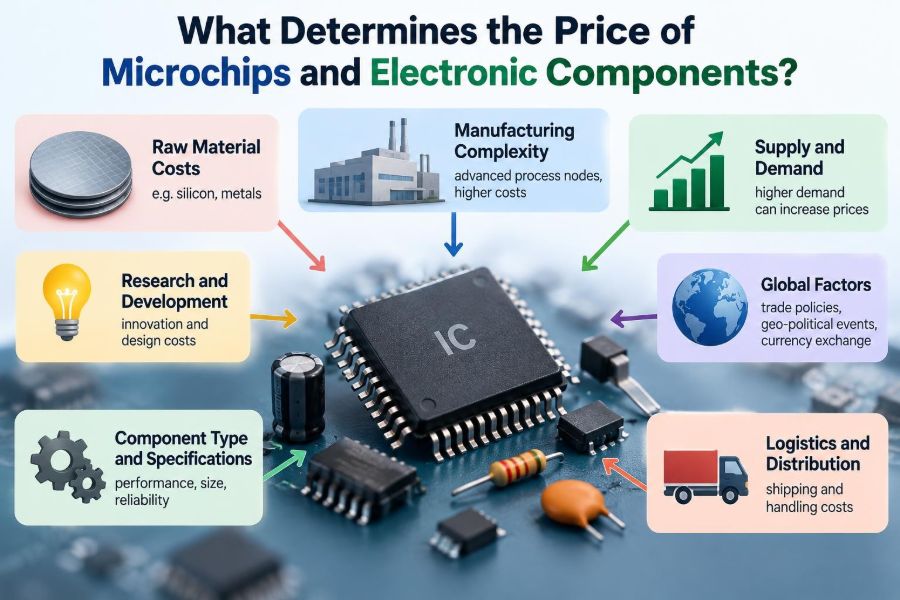
Electronic component prices are not determined by transistor count alone, package size, or what the part did cost last year. They emerge from manufacturing physics, supply-chain economics, testing, qualification, demand, and the risk a buyer expects a supplier to carry.
Understanding those forces makes quotations easier to interpret and helps engineers choose parts with a more realistic view of total product cost.
🧩 Price Is More Than the Physical Part
The listed price of an integrated circuit includes much more than the silicon die inside its package. It represents a share of design work, wafer fabrication, assembly, testing, distribution, inventory, and support.
A resistor may contain little material, yet a precision, high-reliability resistor can be costly because it must meet tight tolerances and remain stable under temperature, humidity, and long-term use. Likewise, a chip’s selling price reflects the confidence that it will perform as specified.
🏭 Fixed Costs Create a High Entry Barrier
Many semiconductor costs are fixed before the first sellable component exists. These include circuit design, verification, mask sets, process development, qualification, software tools, and application engineering.
A mask set is the collection of patterned layers used to transfer an IC design onto wafers. Advanced manufacturing can require many such layers, making mistakes expensive. High production volume spreads these costs across more units; low volume leaves each unit carrying a larger share.
📦 Production Volume Changes Unit Economics
Volume is one of the strongest influences on price. A consumer microcontroller made in very large quantities can support highly automated production and purchasing. A specialized radiation-tolerant controller may sell in much lower quantities and therefore retain a much higher unit price.
Volume does not mean that every large-volume part is cheap. A leading-edge processor can still be expensive because its development and fabrication demands are extraordinary. But, all else equal, larger volume generally lowers the fixed-cost contribution per device.
🧠 Design Complexity Raises Development Cost
More functions on one chip usually require more engineering. Designers must verify digital logic, analog behavior, timing, power integrity, security features, interfaces, and failure modes before production.
Complexity also increases the chance of a costly respin, meaning a revised silicon version after an error or unexpected behavior is found. A simple logic gate and a wireless system-on-chip may both be ICs, but their design effort is fundamentally different.
🔬 Process Node Is Not a Simple Price Ladder
Process node names, often expressed in nanometers, describe generations of semiconductor manufacturing technology. Smaller-feature processes can put more transistors in a given area and may improve speed or power efficiency for certain designs.
They are not automatically the lowest-cost option. Advanced nodes need sophisticated equipment and process control, while mature nodes are often well suited to power management, automotive, analog, and high-voltage circuits. An old process can be the technically correct—and sometimes economically sensible—choice.
💿 Die Area Determines How Many Chips Fit on a Wafer
A wafer is a circular slice of semiconductor material processed into many identical dies. A larger die means fewer possible dies per wafer, so it consumes more manufacturing capacity per chip.
Area matters especially for memory, processors, image sensors, and highly integrated devices. It also affects yield: defects that would not harm a small die are more likely to land somewhere within a large one.
🎯 Yield Turns Defects Into Cost
Yield is the fraction of manufactured units that pass the required tests. No real manufacturing process is perfectly defect-free. Particles, patterning variation, material imperfections, and process drift can make some dies unusable.
Imagine, hypothetically, a wafer capable of producing 500 candidate dies. If only 300 meet specification, the cost of that wafer must be recovered from 300 sellable units, not 500. Improving yield is therefore one of the most valuable ways to reduce cost without changing the design.
🧪 Testing Can Cost More Than Expected
Every component needs some level of test, but test time and test equipment vary enormously. A basic digital IC may be tested rapidly with automated patterns. A precision converter, radio-frequency device, or complex power module may need detailed measurements at multiple voltages, frequencies, or temperatures.
Time on automated test equipment is a real production expense. Parts with demanding specifications often cost more partly because the manufacturer must prove that each shipped unit satisfies them.
📏 Tighter Specifications Mean More Screening
Two components with the same nominal function can have very different prices because of their guaranteed limits. A voltage reference specified for low drift over temperature, for example, needs careful design and testing beyond what a general-purpose reference needs.
Engineers should read the conditions attached to a number. A low offset voltage, high current rating, or fast switching time may be guaranteed only over a particular supply range or temperature interval. Those guarantees are often what customers are paying for.
🌡️ Temperature Grades Affect Cost and Availability
Commercial-grade components may be intended for relatively benign indoor conditions. Industrial and automotive-grade parts are qualified for wider temperature ranges and, often, additional reliability expectations.
A part that works on a laboratory bench is not necessarily suitable beside a hot engine, inside outdoor infrastructure, or in a sealed industrial enclosure. Wider temperature operation can require different design margins, test conditions, packaging, and qualification work.
🛡️ Reliability Qualification Has a Price
Reliability work investigates how components behave over time and under stress. It can involve temperature cycling, humidity exposure, electrical stress, vibration, solder-joint assessment, and other tests appropriate to the product category.
Qualification does not make failure impossible. It provides evidence that a part and manufacturing flow can meet defined requirements under defined conditions. Markets such as automotive, medical, industrial control, and aerospace may require more documentation and control, which raises cost but can reduce risk for the final product.
📐 Packaging Is an Engineering Decision
The package protects the die, provides electrical connections, and helps remove heat. Its cost depends on materials, lead count, pitch, assembly complexity, inspection needs, and thermal performance.
A simple plastic package is inexpensive at scale. A fine-pitch ball-grid array, hermetic ceramic package, power package with a heat slug, or multi-die module demands more complex assembly. Package selection therefore affects both purchase price and printed-circuit-board manufacturing difficulty.
🔥 Thermal Performance Often Costs Extra
Power semiconductors, processors, LEDs, and RF devices can generate substantial heat. Their packages may use exposed pads, copper clips, thick leads, substrates, or other features that improve the path from silicon to the surrounding environment.
A cheaper package that cannot safely dissipate the required heat is not a bargain. The alternative may be a larger heatsink, a more expensive PCB, lower operating power, or reduced product life.
⚡ Power Devices Follow Different Cost Drivers
MOSFETs, IGBTs, rectifiers, and power modules are priced partly by voltage rating, current capability, switching performance, conduction loss, thermal design, and robustness under transient conditions. These properties involve real trade-offs.
For example, a lower-resistance MOSFET can reduce conduction losses, but larger silicon area may raise its component cost. The right choice compares device price with cooling requirements, energy losses, board area, and expected operating duty.
📡 Analog, RF, and Sensors Resist Simple Scaling
Digital circuits often benefit strongly from shrinking features and placing more functions on a die. Analog, radio-frequency, and sensing circuits face additional limits imposed by noise, matching, passive components, physical geometry, and interaction with the outside world.
An inexpensive-looking sensor can include specialized materials, calibrated signal conditioning, and factory testing. Its price may reflect measurement accuracy and stability rather than the number of visible pins.
🧱 Mature Nodes Can Become Capacity-Constrained
Mature fabrication processes remain essential for power management ICs, microcontrollers, analog devices, sensors, and interface chips. Demand for these parts can exceed the available capacity even while more advanced fabs exist elsewhere.
This is a useful correction to the idea that “older chips should always be cheap.” A factory cannot instantly convert to a different process, and a part designed for one production flow cannot simply move to another without significant engineering and qualification.
⛓️ The Supply Chain Adds Value and Cost
Between a semiconductor manufacturer and a product builder may sit authorized distributors, representatives, contract manufacturers, logistics providers, and inventory services. They provide credit terms, local stock, traceability, technical support, and order consolidation.
These services add cost, but they can also lower operational risk. Buying one-off parts from unknown channels may appear cheaper until an engineer must investigate a counterfeit device, a mixed lot, or missing traceability.
🚢 Logistics, Currency, and Trade Conditions Matter
Components cross borders, often more than once, during wafer fabrication, assembly, test, distribution, and final product manufacturing. Freight costs, customs procedures, exchange rates, taxes, and regional trade rules can affect the price paid by a buyer.
These factors are especially visible for low-cost components, where shipping and handling can exceed the value of the parts themselves. A unit price should always be considered alongside the delivered cost and lead time.
📈 Demand Can Move Faster Than Supply
Semiconductor manufacturing capacity takes time to build and qualify. Demand can change more quickly when consumer markets shift, factories increase production, or many industries adopt similar electronic functions at once.
When available supply tightens, lead times can extend and market prices may rise. When demand weakens, inventories can accumulate and pricing pressure can move in the opposite direction. Neither condition changes the underlying physics of the component; it changes the balance between buyers and available stock.
📚 Lifecycle Status Changes Purchasing Risk
A newly released part may command a premium because it offers current features and has limited initial supply. A mature part may be inexpensive and well understood. An obsolete or end-of-life part can become unexpectedly expensive because remaining inventory is scarce.
For products expected to remain in service for years, lifecycle planning matters. Engineers should consider supplier longevity notices, second-source options, pin-compatible alternatives, and whether a component is tied to one proprietary ecosystem.
🏷️ Catalog Price, Contract Price, and Spot Price Differ
There is no single universal price for many components. A catalog price may apply to small orders, while a manufacturer agreement may provide different pricing for forecasted annual volume. A spot-market offer reflects immediate availability and can be volatile.
| Price type | Typical purpose | Key limitation |
|---|---|---|
| Catalog price | Prototypes and small purchases | May not represent production cost |
| Contract price | Planned recurring production | Usually depends on volume and commitments |
| Spot price | Urgent or hard-to-find stock | Can carry supply and traceability risk |
Comparing a prototype distributor price with a large-volume quote without context leads to poor cost estimates.
🧾 Minimum Orders and Packaging Affect the Real Quote
Parts may be sold in cut tape, reels, trays, tubes, or full factory packs. Automated assembly lines commonly need particular packaging formats, and manufacturers may set minimum order quantities to make handling economical.
A low per-unit quote is less helpful if it requires purchasing far more stock than the product will use before the component changes or expires. Excess inventory has a carrying cost and can become a liability.
🔁 Second Sources Can Improve Resilience
A second source is an alternative supplier capable of providing a compatible component. It may be pin-for-pin compatible, functionally similar with a PCB change, or simply a qualified substitute for a passive part.
Second sourcing can strengthen negotiating position and reduce disruption risk. However, it should not be assumed from similar-looking datasheets. Electrical behavior, startup characteristics, electromagnetic compatibility, firmware details, and long-term availability can differ in ways that matter.
🧰 Passive Components Are Not All Commodities
Standard resistors and capacitors are often inexpensive, but their cost rises with tighter tolerance, low temperature coefficient, high voltage capability, pulse endurance, low inductance, specialty dielectrics, or high reliability.
For multilayer ceramic capacitors, capacitance can vary with applied DC voltage and temperature depending on dielectric type. Selecting solely by nominal capacitance and unit price can create performance problems that cost much more to correct later.
🧮 The Lowest Unit Price Is Not Always the Lowest System Cost
Component selection should be based on the cost of meeting the product requirement, not merely a line item on the bill of materials. An integrated power-management IC may cost more than a few discrete regulators, yet reduce PCB area, assembly steps, test effort, and design risk.
Conversely, integration can create single-source exposure. The best choice depends on volume, technical maturity, available board space, service life, and the consequences of a supply interruption.
📝 Estimate Costs by Stage, Not by Guesswork
Early estimates should use ranges and assumptions rather than treating a web price as final. Separate prototype cost from expected production cost, and identify the components that are likely to dominate the bill of materials.
- Check the required operating grade, package, and qualification level.
- Record quantity breaks, minimum orders, and lead-time information.
- Include assembly, test fixtures, yields, freight, and inventory where relevant.
- Mark single-source, end-of-life, and allocation-sensitive components as risks.
This approach makes uncertainty visible early, when changing a design is usually easier.
🔍 Read Datasheets Beyond the Headline Specification
A part number often has suffixes for package, temperature range, packing method, accuracy grade, and environmental compliance. A price comparison is valid only when the full orderable part numbers provide equivalent requirements.
Also inspect recommended operating conditions, absolute maximum ratings, test conditions, and typical-versus-guaranteed values. A cheaper substitute that only meets a typical value may not be suitable for production.
⚠️ Avoid Counterfeit and Remark Risk
During shortages, unfamiliar sources may offer parts with attractive pricing and immediate delivery. Some stock may be legitimate excess inventory, but some may be counterfeit, salvaged, remarked, damaged, or stored improperly.
Risk is highest when the component is safety-critical, expensive to replace, or difficult to test at incoming inspection. Authorized channels, traceable documentation, supplier evaluation, and appropriate verification procedures are often worth more than a small apparent saving.
🧭 Design for Supply Flexibility
Supply resilience begins during schematic capture and PCB layout. Where requirements permit, choose standard footprints, avoid unnecessary dependence on one package, and leave room for qualified alternatives.
For critical functions, document acceptable substitutes before a shortage occurs. This may include alternative resistor series, compatible memory densities, multiple connector sources, or pre-tested regulator options. Flexibility should be engineered deliberately, not improvised during a production stoppage.
🤝 Procurement and Engineering Need Shared Context
Procurement teams see supplier terms, availability, and market signals. Engineering teams understand electrical margins, validation effort, and what substitutions are truly safe. Better decisions happen when these perspectives are connected early.
A buyer should not substitute a part only because it shares a headline specification. An engineer should not specify an exotic component without considering whether its special capability is necessary. Shared approved-vendor lists and clear alternates reduce both delays and conflict.
🔑 The Core Principle Behind Component Pricing
Microchip and electronic component pricing reflects the resources and risks required to deliver a verified part at a particular scale. Silicon area, yield, process technology, package, test, qualification, demand, supply-chain conditions, and lifecycle status all contribute.
The practical question is not simply, “Why is this part expensive?” It is, “Which requirement, manufacturing constraint, or supply risk is this price paying for?” That question leads to better technical trade-offs and more durable product plans.
The price of an electronic component is best understood as the cost of dependable performance, not merely the cost of the material in the package. Engineers who evaluate both the part and the system around it can make choices that are cheaper in operation, safer in production, and easier to sustain. 🔌📦🧠