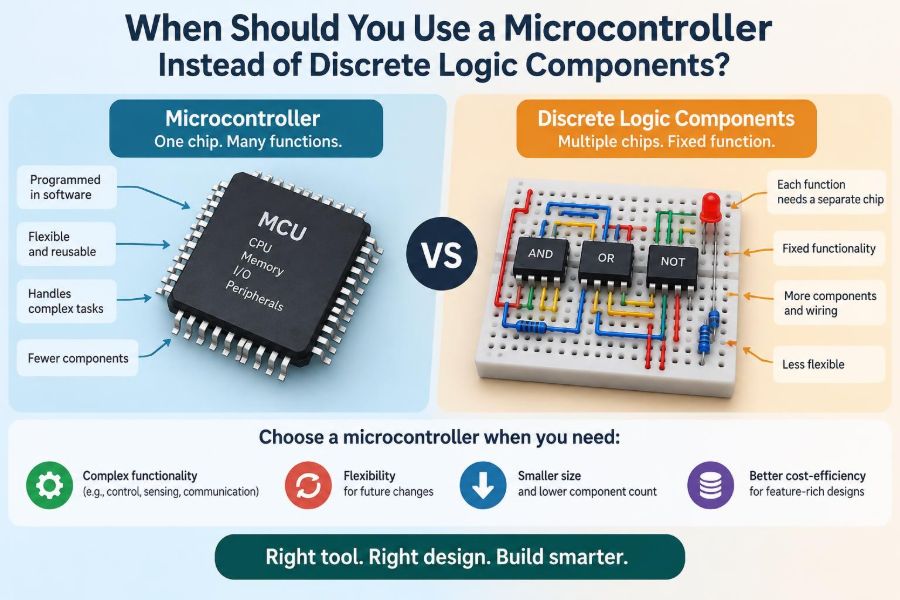

A door controller needs to read a keypad, time how long a lock stays open, flash a warning LED, and ignore repeated button presses. A designer can build those functions from logic gates, flip-flops, counters, timers, and comparators. Or they can use one small microcontroller and a program.
Both approaches can work. The more useful question is not which technology is newer, but which one produces the clearest, most reliable, and most maintainable design for the actual job.
Discrete logic still has strong advantages: immediate response, visible signal paths, and operation with no firmware to write. Microcontrollers bring different strengths: flexible behavior, compact implementation, communication interfaces, and the ability to change a product after the circuit board exists.
The best choice comes from understanding what the circuit must do now, what may change later, and what can go wrong in the real electrical environment.
🧩 Start With the Functional Problem
Before choosing components, describe the required behavior in plain language. Inputs may be switches, sensors, communication signals, or analog voltages. Outputs may drive LEDs, relays, motors, displays, or other electronic systems.
If the behavior is simply “turn output on when both inputs are high,” discrete logic is usually the natural answer. If it becomes “turn output on under several conditions, wait a selectable time, log a fault, and report status,” a microcontroller deserves serious consideration.
🔍 What Counts as Discrete Logic?
Discrete logic means implementing a function directly with hardware building blocks. These include logic gates, multiplexers, flip-flops, counters, shift registers, timers, comparators, and dedicated state-machine devices.
The term does not mean the components must be physically separate individual gates. A single logic IC may contain several gates. What matters is that the circuit’s behavior is determined primarily by fixed connections rather than executable software.
🧠 What a Microcontroller Adds
A microcontroller is a small computer on an integrated circuit. It typically contains a processor core, program memory, data memory, input/output pins, timers, and often analog-to-digital converters, serial interfaces, and pulse-width modulation peripherals.
Its pins still interact with the physical world, but firmware decides how those signals are interpreted. The same pin can be part of a keypad scan today and a diagnostic interface in a revised firmware version tomorrow, provided the electrical hardware supports it.
⚖️ The Fundamental Difference: Fixed Paths Versus Instructions
In a logic circuit, signals propagate through connected hardware paths. A gate responds when its input changes, subject to its propagation delay. In a microcontroller, the processor or a hardware peripheral samples, evaluates, and acts according to instructions.
This distinction affects timing, test methods, failure modes, and future changes. It also explains why neither option is automatically “better.” A fixed hardware path can be ideal for a simple safety interlock, while software is far better at managing many operating modes.
🚦 Choose Discrete Logic for Very Simple Boolean Functions
Use discrete logic when the job is fundamentally a small Boolean expression: AND, OR, NOT, XOR, or a straightforward combination of them. An enable signal that requires a closed guard switch, a healthy supply indication, and an operator command is a typical example.
A few gates may be easier to inspect than a programmed device. The schematic directly shows the condition that allows the output to change, with no code repository, compiler settings, or startup sequence involved.
⏱️ Choose a Microcontroller When Timing Rules Multiply
One fixed delay can be handled by a timer IC, a counter, or an RC network where precision requirements are modest. But timing requirements often grow: different delays in different modes, retry limits, timeout recovery, periodic sampling, and adjustable intervals.
When the design starts accumulating counters and timing chains, firmware often reduces the hardware substantially. A timer peripheral can measure intervals while the processor handles the surrounding decisions.
🔁 State Machines Are a Major Decision Point
A system with modes such as idle, armed, running, paused, faulted, and reset is a state machine. Small state machines can be built cleanly with flip-flops and combinational logic, especially when the transitions are few and fixed.
As states, exceptions, and transitions increase, discrete implementations become harder to read and modify. Firmware can express a state machine directly, often making unusual transitions—such as a fault overriding every normal mode—more explicit.
🎛️ Use Hardware for One Fast, Deterministic Response
Discrete logic is attractive when an output must respond with tightly bounded delay. Gates have specified propagation delays, and a dedicated hardware path does not wait for a processor to finish another task.
Microcontrollers can also respond quickly through interrupts, capture/compare units, and dedicated peripherals. However, software timing must account for clock configuration, interrupt latency, higher-priority activity, and any disabled-interrupt periods. For nanosecond-scale logic or extremely tight jitter limits, dedicated logic is often the safer fit.
📏 Understand Determinism and Jitter
Deterministic behavior means the timing is predictable within known bounds. Jitter is variation in when an event occurs. A gate chain has timing variation from voltage, temperature, and device tolerances, but its operation does not depend on a scheduler.
A polling firmware loop may introduce substantial jitter because the controller checks an input only when it reaches that line of code. Interrupt-driven designs reduce this, and hardware timer peripherals can reduce it further. The required timing tolerance should guide the architecture.
🔢 Count Complexity, Not Just Components
Component count is useful, but it is not the only measure of complexity. A circuit with four ICs may be easy to validate if every device has one obvious role. A single microcontroller can be deceptively complex if it requires a difficult firmware architecture.
Count the conditions, timing rules, modes, interfaces, and failure responses. When these relationships dominate the design effort, a programmable solution often scales better than adding more fixed-function logic.
🛠️ Consider How Requirements Will Change
Requirements change for ordinary reasons: a customer wants a different timeout, a technician needs a diagnostic mode, or a sensor behaves differently in a new installation. With discrete logic, even a small rule change can require a schematic revision and new board assembly.
With a microcontroller, many changes can be made in firmware. That flexibility is valuable only when the product has a safe and controlled way to update, identify, and test its firmware.
🧪 Prototyping Often Favors Programmability
During early development, a microcontroller lets a team test alternative thresholds, timing values, and sequences without repeatedly rewiring the prototype. Serial output can reveal internal variables that would otherwise require extra test points and instruments.
This does not mean a prototype should permanently remain software-based. Once behavior is stable, review whether a critical simple function should stay programmable or become a dedicated hardware path.
🏭 Production Volume Changes the Trade-Off
For a low-volume instrument or custom fixture, reducing design iterations and enabling field adjustments may matter more than minimizing the bill of materials. A microcontroller can be economical because it replaces several functions and supports reuse across variants.
At high volume, the calculation becomes more nuanced. A tiny logic solution may have lower unit cost, simpler assembly, lower test time, and no programming step. Exact cost depends on availability, packaging, required support parts, and manufacturing process—not merely the price of one IC.
🔌 Pin Count and Board Space Matter
A microcontroller does not automatically save space. It may need a programming connector or pads, decoupling capacitors, reset circuitry, clock components in some designs, and level-shifting or protection circuits.
Conversely, a growing discrete design can consume board area quickly through multiple packages and routing between them. Compare the complete implementation, including passives and connectors, rather than comparing package outlines alone.
🔋 Power Consumption Needs a Real Budget
Modern microcontrollers can operate at very low power and wake periodically from sleep. That makes them useful in battery-powered devices that need measurement, decision-making, and communication.
But a controller running continuously at a high clock rate can consume more than a small static logic circuit. CMOS logic families also differ widely in power use, especially when switching frequency, supply voltage, and input conditions are considered. Estimate active and standby states separately.
📈 Analog Inputs Often Tip the Balance Toward a Microcontroller
If a system must measure temperature, battery voltage, light level, or pressure, it needs analog processing. A microcontroller with an analog-to-digital converter can sample such signals and apply thresholds, filtering, calibration, or averaging in firmware.
Discrete alternatives include comparators, op-amps, resistor networks, and dedicated ADCs. They may be better for a fixed threshold or high-performance analog requirement, but multiple adjustable analog decisions can make the programmable route more practical.
📡 Communication Is Rarely Elegant With Gates Alone
UART, I²C, SPI, CAN, USB, wireless modules, and networked protocols require framing, timing, buffering, error handling, and often message interpretation. Some can be implemented with discrete devices, but the result is usually specialized and inflexible.
A microcontroller with the relevant peripheral can manage these tasks efficiently. Remember that the physical-layer hardware still matters: a controller’s UART pins do not replace a transceiver needed for standards such as RS-485 or CAN.
🧮 Data Storage and Calculations Need Software
When a design must remember settings, total operating hours, sensor history, calibration values, or fault records, a microcontroller is generally the direct option. It can also perform scaling, moving averages, lookup tables, checksums, and control calculations.
Discrete logic can count events and shift bits, but general arithmetic and configurable storage rapidly become cumbersome. This is one of the clearest boundaries between a fixed logic task and an embedded-system task.
🧱 Keep Safety-Critical Paths Simple
A microcontroller should not be assumed safe merely because its firmware contains a safety check. Software can hang, inputs can be misread, clocks can fail, and output pins can enter unexpected states during reset.
For hazards involving injury, fire, damaging motion, or excessive energy, use an appropriate safety architecture. That may include independent hardware interlocks, watchdog supervision, redundant monitoring, fail-safe output design, and compliance work suited to the application. A full safety assessment is beyond the scope of a component-choice shortcut.
🐕 Add a Watchdog, but Do Not Treat It as Magic
A watchdog timer resets a controller if firmware stops servicing it as expected. It is a useful recovery mechanism for many faults, including some software hangs and abnormal control flow.
It cannot prove that the program is making correct decisions. Poorly designed firmware can continue servicing a watchdog while stuck in the wrong state. Use watchdogs with input validation, sensible defaults, fault logging where appropriate, and independent output protections.
⚡ Plan for Startup, Reset, and Brownout Behavior
Discrete logic and microcontrollers both have startup behavior, but controllers deserve special attention. Before firmware initializes the pins, outputs may be inputs, weakly pulled in one direction, or briefly undefined depending on the device and circuit.
Define what external loads do during power-up, reset, programming, and low supply voltage. Pull resistors, output-enable circuitry, brownout detection, and safe driver design are often more important than the application code’s first normal instruction.
🌩️ Electrical Noise Can Defeat Either Approach
Long switch wires, relays, motors, and poor grounding can create transients or noise that look like valid input transitions. A microcontroller may react to a brief glitch; a logic gate may do the same.
Use appropriate electrical measures first: decoupling capacitors near IC power pins, defined input levels, filtering where justified, suppression for inductive loads, sound grounding, and protected interfaces. Firmware debounce and digital filtering can help, but they cannot repair a severely compromised signal path.
🧷 Debouncing Shows the Difference Clearly
A mechanical switch does not change state once cleanly. Its contacts may bounce for a short period, creating several transitions. Hardware debounce can use an RC network and Schmitt-trigger input, a flip-flop, or a dedicated debouncer.
Firmware debounce can sample the input after a settling interval or require stable readings over time. For a keypad with many buttons, software is usually compact. For one critical immediate input, a hardware conditioner may be clearer and more robust.
🧰 Debugging Is Different, Not Automatically Easier
Discrete circuits can be examined with a multimeter, logic probe, or oscilloscope. Signals are physically present at nodes, and a timing diagram can often reveal the faulty stage.
Microcontroller debugging adds serial logs, breakpoints, tracing, and internal register views. These tools are powerful, yet they can alter timing or hide intermittent failures. Good embedded designs provide test points, status indicators, and diagnostic access rather than relying entirely on source code.
📚 Firmware Creates a Lifecycle Responsibility
A programmable product needs version control, build records, programming procedures, regression testing, and a method to identify what firmware is installed. These practices are manageable and valuable, but they are real engineering work.
A fixed logic circuit avoids firmware maintenance, although it still needs documented revisions and production testing. Choose a microcontroller when its flexibility justifies the responsibility of maintaining software over the product’s life.
🔐 Connected Devices Need Security Considerations
If a microcontroller accepts updates, configuration commands, or network data, unauthorized access becomes an engineering concern. The design may need authenticated updates, protected debug access, careful command parsing, and a recovery strategy for interrupted updates.
A non-connected controller has fewer exposure paths, but physical access can still matter. Discrete logic avoids many software security issues simply because there is no code to alter, though it does not solve physical tampering or system-level security.
🧾 Compare the Options Systematically
| Design factor | Discrete logic is often stronger when… | A microcontroller is often stronger when… |
|---|---|---|
| Function | The rule is small, fixed, and direct. | Many rules, modes, or exceptions must interact. |
| Timing | Response must be immediate and tightly bounded. | Timers, scheduling, or adjustable intervals are needed. |
| Change | Requirements are stable for the product life. | Behavior may evolve after hardware is built. |
| Interfaces | Only a few digital signals are involved. | Analog measurement, displays, storage, or communications are needed. |
| Risk | An independent hardware path is required. | Diagnostics, supervision, and coordinated fault handling add value. |
This comparison is a design aid, not a rulebook. Many good products use both approaches together.
🤝 Hybrid Designs Are Often the Best Answer
A practical architecture may use a microcontroller for sequencing, user settings, displays, and communications, while dedicated hardware handles power switching, input conditioning, overcurrent shutdown, or an emergency inhibit path.
This division gives software flexibility without asking software to perform every electrical function. It also makes the boundaries explicit: the controller commands the system, while hardware prevents certain unacceptable conditions.
🚫 Avoid Replacing Every Gate With Code
It is tempting to route every signal to a controller because spare pins appear available. That can turn a simple combinational function into a polling, latency, reset-state, and firmware-verification problem.
If two signals only need a reliable AND function, a gate or appropriately designed hardware interlock may be the cleaner choice. Programmability should solve a real requirement, not merely demonstrate that software is possible.
🧱 Avoid Building a “Logic Museum”
The opposite mistake is retaining an expanding collection of gates, counters, timers, and glue logic after the behavior has clearly become programmable control. Such circuits can be difficult to alter because one timing change affects several interconnected devices.
When troubleshooting requires reconstructing a large state machine from wiring, it is worth considering whether explicit firmware, clear documentation, and a controller with adequate resources would reduce long-term risk.
✅ Use a Short Selection Checklist
- Can the function be described as a small, fixed logic expression?
- Does the design need configurable timing, multiple modes, calculations, or stored settings?
- What timing latency and jitter are actually acceptable?
- What must happen during reset, brownout, noise events, and firmware failure?
- Will communication, logging, diagnostics, or analog sensing be needed?
- How likely are requirement changes after prototypes are built?
- Can the team safely test, program, maintain, and support firmware?
- Which functions require independent hardware protection?
Answering these questions early prevents an architecture from being chosen solely because a familiar part happens to be in stock.
🎯 The Core Principle: Match the Implementation to the Behavior
Use discrete logic when the required behavior is small, stable, fast, and best expressed as direct electrical relationships. Use a microcontroller when the value lies in changing behavior, coordinating many conditions, handling data, timing complex sequences, or communicating with other systems.
The strongest designs do not treat the choice as a contest. They assign each function to the technology that makes its operation, limits, and failure response easiest to understand and verify.
Choose a microcontroller when programmable complexity creates real value, and choose discrete logic when fixed hardware makes the critical behavior simpler, faster, or safer. Good engineering is often the thoughtful combination of both. 🔌🧠🛠️