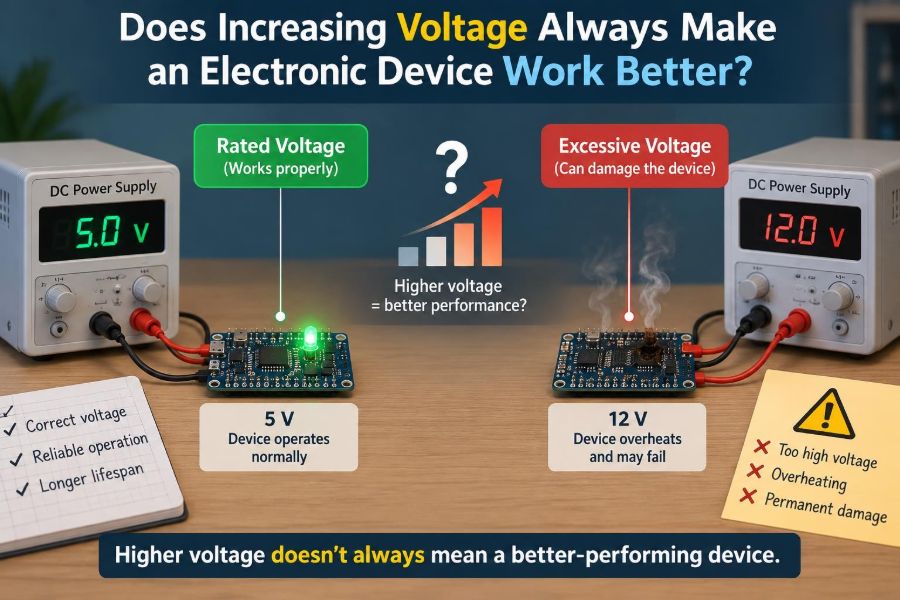

A phone charger that makes a cable warm, a motor that spins faster after a battery change, and an LED that suddenly burns out can all seem to tell the same story: more voltage means more performance.
That intuition is understandable. Voltage is often described as electrical “pressure,” and more pressure appears as though it should push a device to work harder. In some carefully designed systems, a higher voltage really does enable more speed, brightness, torque, or power transfer.
But an electronic device is not a simple pipe. It is a collection of parts with voltage limits, current limits, heat limits, timing requirements, and control circuits. Raising the supply voltage may improve one behavior while damaging another.
The useful engineering question is not “Is higher voltage better?” It is what voltage does this particular circuit require, tolerate, and use safely?
⚡ Voltage Is Electrical Potential Difference
Voltage is the difference in electric potential between two points. It provides the energy-per-unit-charge that can drive charge through a circuit. A 9 V battery establishes a larger potential difference than a 1.5 V cell.
Voltage alone does not tell us how much electricity will flow. Current depends on the connected load, the source capability, and the rest of the circuit. This distinction is the starting point for avoiding many practical mistakes.
🚰 The Water Analogy Helps—Up to a Point
Voltage is often compared with water pressure, current with water flow, and resistance with a pipe restriction. Higher pressure can produce more flow through the same restriction.
The analogy breaks down if it suggests every appliance wants more pressure. A garden hose, sprinkler, and faucet are built for particular pressures. Likewise, electronic components are designed around specified electrical conditions.
📐 Ohm’s Law Explains Why Current Changes
For a simple resistive load, Ohm’s law is expressed as I = V/R. If resistance remains constant and voltage rises, current rises in direct proportion.
For example, a hypothetical 100-ohm resistor draws 50 mA at 5 V and 100 mA at 10 V. Many real devices are not fixed resistors, but the relationship still explains why excessive supply voltage often creates excessive current somewhere in a circuit.
🔥 Power Often Rises Faster Than Expected
Electrical power is P = VI. For a fixed resistance, combining this with Ohm’s law gives P = V²/R. Doubling voltage across that resistor makes the power dissipation four times larger.
That squared relationship is why “only a little more voltage” can matter. Extra power becomes useful work in some cases, but it also commonly becomes heat.
🎯 Devices Are Designed Around Operating Ranges
A datasheet commonly distinguishes a recommended operating range from absolute maximum ratings. The recommended range is where the part is intended to perform as specified. Absolute maximum ratings are damage boundaries, not normal targets.
Running close to a maximum may reduce reliability even when failure is not immediate. Temperature, load transients, manufacturing variation, and supply noise can all push real operation beyond the value seen on a bench meter.
🏷️ Read the Label Before Connecting Power
A device label may state an input such as “5 V DC,” “9–12 V DC,” or “100–240 V AC.” Those markings are not interchangeable. They describe voltage type, range, polarity, and sometimes current or power requirements.
- DC versus AC: many low-voltage devices require DC and may be damaged by an AC output.
- Polarity: a barrel connector may physically fit while having the wrong center-pin polarity.
- Current rating: a supply should be capable of providing the required current; it does not normally force its full rated current into a compatible load.
🔋 A Higher-Rated Current Supply Is Different
Two adapter specifications are frequently confused. A 5 V, 3 A supply can often replace a 5 V, 1 A supply if the connector, polarity, regulation, and other requirements match. The device draws the current it needs.
A 12 V, 1 A supply is not an equivalent replacement for a 5 V, 1 A supply. The matching current number does not compensate for the wrong voltage.
💡 LEDs Need Current Control, Not Just Voltage
An LED has a forward voltage range, but it is not a voltage-regulating component. Once it begins conducting strongly, a small rise in applied voltage can cause a large rise in current.
That is why a basic LED circuit uses a series resistor, while higher-power lighting commonly uses a constant-current driver. Applying a larger voltage directly to an LED may briefly make it brighter, then overheat and destroy its junction.
🌈 Brightness Has Useful and Unsafe Limits
Increasing the controlled current through an LED can increase light output, within its ratings. However, heat rises, efficiency can change, color can shift, and lifetime can shorten at high junction temperature.
Well-designed LED drivers may use a higher supply voltage internally to power several LEDs in series. That does not mean the individual LEDs are receiving uncontrolled extra voltage; the driver is actively limiting current.
🧠 Integrated Circuits Have Narrower Margins
Many modern integrated circuits operate at low voltages such as 1.8 V, 3.3 V, or 5 V. Their tiny transistor structures can be damaged when voltage exceeds the specified limit, sometimes without obvious external heating.
Overvoltage can break down thin insulating layers, increase leakage, or trigger unwanted internal current paths. A chip may appear to work after an event but have reduced long-term reliability.
🛡️ Logic-Level Compatibility Is Not Optional
A signal wire carries voltage too. Connecting a 5 V output directly to a 3.3 V-only microcontroller input can exceed that input’s rating, even if both boards have a safe power supply.
Use level shifters, resistor networks where appropriate, or interfaces designed for mixed-voltage systems. Check input thresholds and absolute maximum ratings rather than assuming “high” and “low” have universal meanings.
🧲 Motors Behave Differently From Resistors
For a DC motor, increasing voltage generally increases no-load speed because the motor develops more back electromotive force as it spins. Under load, more voltage can also make more current available and increase torque.
Yet the benefit is conditional. Motor windings, brushes, bearings, gears, and the driven mechanism all have limits. A motor rated for one voltage may run too fast, overheat, wear rapidly, or damage its mechanical load at a higher voltage.
🌀 Starting Current Creates a Hidden Stress
A stopped motor has little or no back electromotive force. At startup or stall, current can be much higher than during normal rotation. Raising supply voltage increases this stressful current unless a controller limits it.
This matters for pumps, fans, robotics, and power tools. A supply may look adequate during steady operation but sag, trip, or overheat during startup.
🔊 Audio Amplifiers Need Headroom, Not Excess
An audio amplifier with a higher permissible supply voltage may be able to deliver a larger unclipped output swing into a suitable speaker load. This is one reason amplifier power stages specify supply rails and load impedance carefully.
But exceeding the amplifier’s rail rating can damage output transistors or capacitors. Even within limits, more available amplifier power can overheat or overdrive a speaker if the system is not matched.
📻 Analog Circuits Can Change Their Behavior
Some analog circuits need a particular supply range to provide adequate signal headroom. An operational amplifier, for instance, may handle larger input or output swings with suitable supply rails.
That does not mean every op-amp benefits from a higher rail voltage. Input common-mode range, output swing, dissipation, and maximum supply ratings still apply. Circuit performance must be evaluated as a whole.
💻 Digital Systems May Run Faster at Higher Voltage
In some digital technologies, a modest voltage increase can make transistor switching faster because transistors drive nodes more strongly. This principle has historically been used in performance tuning.
The trade-off is substantial: dynamic power is approximately related to capacitance, switching frequency, and the square of supply voltage. More voltage can therefore produce much more heat, while also increasing electrical stress and leakage.
❄️ Voltage, Temperature, and Reliability Interact
Heat is not merely uncomfortable for electronics. It accelerates several aging processes, alters component values, and reduces the safe operating margin of semiconductors. Higher voltage can increase heat directly or indirectly through increased current.
A circuit that works on an open workbench may fail inside a sealed enclosure on a warm day. Good design considers ambient temperature, airflow, heatsinking, and the temperature rise of each power-dissipating component.
🧱 Capacitors Have Voltage Ratings Too
Every capacitor has a voltage rating that must exceed the highest voltage it will actually see, including normal supply variation and transients. Exceeding that rating can cause leakage, dielectric breakdown, or failure.
Electrolytic capacitors deserve particular care because polarity also matters. A capacitor’s capacitance value does not tell you its safe voltage; “100 µF” without its voltage rating is incomplete information.
⚙️ Regulators Can Make Higher Input Voltage Usable
A voltage regulator converts an input supply into a controlled output, such as 12 V down to 5 V or 5 V down to 3.3 V. This can let a device operate from a higher-voltage source, but only if the regulator is designed for it.
A linear regulator dissipates approximately (Vin − Vout) × Iout as heat. Supplying 12 V instead of 7 V to make 5 V at significant current may turn the regulator into a heater.
🔄 Switching Regulators Improve Efficiency, Not Magic
Buck, boost, and buck-boost converters transfer energy by rapidly switching inductors or capacitors. They can efficiently step voltage down, up, or both, and are common in battery-powered equipment.
They still have input-voltage limits, output-current limits, ripple, electromagnetic interference concerns, and thermal limits. A converter allows controlled adaptation; it does not make an arbitrary supply safe.
📉 Battery Voltage Is Not a Constant Label
A battery’s nominal voltage is a useful shorthand, not a promise of one exact value at every moment. Voltage changes with state of charge, load current, temperature, chemistry, and age.
Designers account for the full expected range. A device intended for a battery pack may need to tolerate fresh-off-charge voltage, low-battery voltage, and brief dips when a motor or radio transmitter draws current.
🌩️ Transients Can Be More Dangerous Than the Average
A meter may show the correct average voltage while short spikes exceed what sensitive electronics can tolerate. Motors, relays, long wires, static discharge, and automotive electrical systems can create transient events.
Protection may include fuses, transient-voltage suppressors, reverse-polarity protection, flyback diodes, filtering capacitors, and properly chosen regulators. Which protection is appropriate depends on the source and failure mode.
🔌 Cable Resistance Can Cause the Opposite Problem
Sometimes a device receives too little voltage even though its adapter label looks correct. Long or thin cables have resistance, so voltage drops as current flows. Connectors can add resistance as they wear or corrode.
A higher source voltage is not automatically the right cure, because it can overvoltage the device when the load changes. Better approaches include a lower-resistance cable, a correctly designed remote-sense supply, or power conversion near the load.
🧪 Measure at the Device, Under Load
Measuring an adapter with nothing connected gives only part of the picture. Check the voltage at the device input while the device is operating, particularly during motor startup, radio transmission, or peak processing demand.
A multimeter is useful for steady values. An oscilloscope is often needed to reveal dips, ripple, and fast spikes. Use instruments correctly and observe safety rules when working around mains-powered equipment.
🧰 A Safe Method for Testing a New Supply
When documentation is unclear, do not begin by connecting the most powerful source available. Identify the device’s expected input, connector polarity, and plausible current requirement first.
- Find the manufacturer documentation, label, or schematic if available.
- Confirm AC or DC, nominal voltage, allowed range, and polarity.
- Inspect cables and connectors for physical compatibility without assuming electrical compatibility.
- Use a current-limited bench supply when practical, beginning at the specified voltage.
- Monitor current draw, temperature, and behavior under normal load.
🚫 Common “More Voltage” Mistakes
A frequent error is treating voltage as a performance knob on equipment that has no regulation or safety margin for adjustment. Another is trusting a connector because it fits physically.
- Replacing a low-voltage adapter with one of higher voltage because both use the same plug.
- Powering an LED strip or single LED without the driver intended for it.
- Assuming a higher-voltage battery pack is safe because its capacity is similar.
- Ignoring maximum input ratings on development boards and sensor modules.
- Trying to solve a voltage-drop problem by oversupplying an unregulated load.
✅ When Increasing Voltage Really Is the Right Choice
Higher voltage is useful when the entire system is designed for it. Power distribution often uses higher voltage to reduce current for a given power level, which reduces resistive cable loss because cable heating follows I²R.
It can also be appropriate when a rated motor controller supports a higher battery voltage, when a converter needs sufficient input headroom, or when a circuit’s datasheet specifies a valid higher operating range. The key is intentional design, not hopeful substitution.
📊 Questions to Ask Before Raising Voltage
| Question | Why it matters |
|---|---|
| What is the allowed input range? | It separates normal operation from damage territory. |
| Is the load regulated or direct? | Direct loads may see the increased voltage immediately. |
| What happens to current? | Current determines heating, wire stress, and source demand. |
| Can every component tolerate it? | ICs, capacitors, connectors, and protection parts may have different limits. |
| What occurs at startup and fault? | Peak current and transients may exceed steady-state measurements. |
🧭 The Core Principle: Match the Supply to the Design
Voltage is neither inherently good nor inherently harmful. It is a design parameter that sets electrical stress, influences current, and interacts with every part of a system.
A higher voltage can enable useful outcomes—greater power transfer, speed, or operating headroom—when components, controls, cooling, and insulation are chosen for it. Outside those conditions, it commonly creates overheating, malfunction, shortened life, or immediate damage.
The best supply is not the one with the largest number on its label. It is the one whose voltage, current capability, waveform, polarity, regulation, and protection match the device’s requirements.
Increasing voltage makes an electronic device work better only when the device and its entire power path are engineered to use that higher voltage safely. Check specifications, measure under load, and treat every power connection as an engineering decision. 🔌⚡🛠️