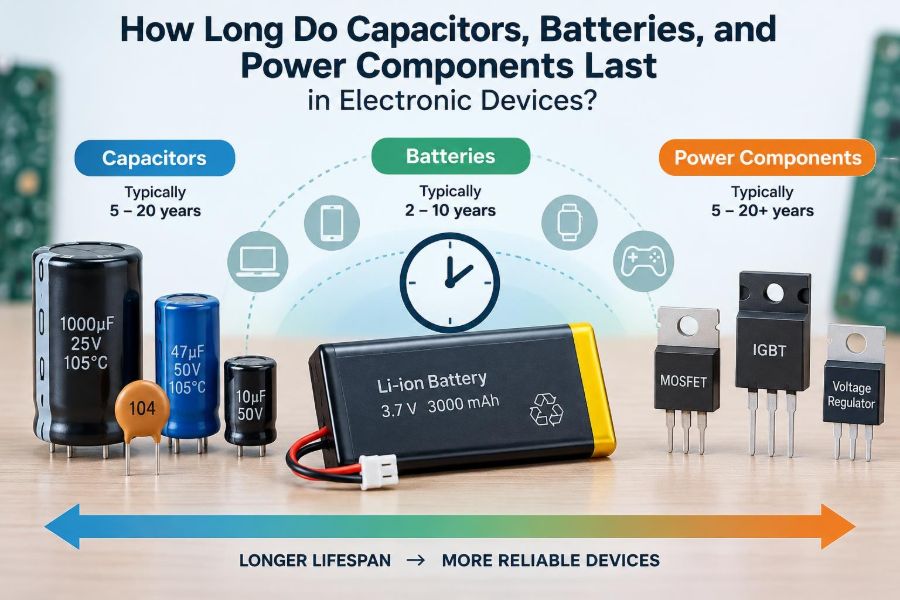

A phone that suddenly shuts down at 30 percent, a monitor that flickers after warming up, and a router that needs an occasional restart can all feel like unrelated faults. Often, though, the underlying issue is the same: a component in the power path has aged beyond the conditions it was designed to tolerate.
Electronic devices do not have a single expiration date. Their processors may still be perfectly functional while a battery has lost capacity, an electrolytic capacitor has dried out, or a relay has worn through its contact life. The part that ages first frequently determines whether the whole product still feels reliable.
For engineers, repair technicians, and curious users, component lifetime is more than a specification-sheet detail. It affects maintenance schedules, warranty decisions, product design, safety, repairability, and electronic waste.
Understanding lifetime also prevents a common mistake: assuming that a stated number of years, hours, or cycles applies in every application. Temperature, voltage, electrical stress, storage, and usage patterns can change the result dramatically.
🔍 What Component Lifetime Actually Means
Component lifetime is the period during which a part continues to meet its required electrical and mechanical performance. It does not necessarily mean the moment it stops working completely.
A capacitor can remain connected but develop excessive equivalent series resistance, or ESR, causing noise and voltage ripple. A battery can still power a device yet have too little usable capacity for practical use. In both cases, the device may seem unreliable long before the component is electrically open or shorted.
Manufacturers may specify operational life, cycle life, shelf life, or useful life under particular test conditions. These terms answer different questions and should not be treated as interchangeable.
🧩 Why One Device Contains Many Different Lifetimes
A typical electronic product contains semiconductors, capacitors, inductors, connectors, batteries, fuses, relays, solder joints, and printed circuit boards. Each has a different dominant aging mechanism.
Silicon integrated circuits can operate for many years when electrical and thermal limits are respected. Mechanical switches and relays are limited by movement and contact wear. Electrochemical parts, especially batteries and wet electrolytic capacitors, generally have more visible calendar aging.
This is why replacing a small group of capacitors can revive an otherwise capable power supply, while replacing the battery may be the most meaningful repair for an aging portable device.
🌡️ Heat Is Usually the Main Lifetime Multiplier
Heat accelerates many chemical reactions and material changes inside electronic components. It dries electrolyte, speeds battery side reactions, degrades insulating films, and repeatedly expands and contracts soldered assemblies.
A component rated for high temperature is not invulnerable; the rating establishes the conditions it can tolerate, not a promise of indefinite service. Continuous operation near a maximum rating generally leaves less margin for manufacturing variation, airflow changes, dust buildup, and nearby hot parts.
Good thermal design therefore improves more than comfort or efficiency. It can substantially improve long-term reliability.
⚡ Voltage, Current, and Electrical Derating
Derating means operating a part below its maximum rated voltage, current, power, or temperature. It gives the design room to handle transients, tolerances, and real operating conditions that are less tidy than a laboratory test.
For example, a capacitor exposed to recurring voltage spikes may experience more stress than its nominal DC voltage suggests. A resistor can meet its wattage rating on paper but still run excessively hot because it is packed near other heat sources.
Derating is not a universal fixed percentage. The appropriate margin depends on the component technology, failure consequences, transient environment, cooling, and manufacturer guidance.
📦 Calendar Aging Versus Use Aging
Some components age simply with time. A lithium-ion battery slowly loses capacity while stored, especially when it is warm or held at a high state of charge. Rubber seals, adhesives, and some polymer materials also change over years.
Other parts primarily age with use. A relay wears through switching operations; a connector wears through mating cycles; a flash-memory device is affected by program and erase cycles.
Most real products face both mechanisms. A laptop battery may lose capacity from calendar aging even if it rarely leaves a desk, while charge and discharge cycles add further wear.
🫙 Aluminum Electrolytic Capacitors: Useful but Consumable
Aluminum electrolytic capacitors store high capacitance in a compact, economical package. They are widely used for bulk energy storage and filtering in power supplies, audio equipment, motor drives, and many consumer products.
Many conventional types use a liquid or gel-like electrolyte. Over time, especially at elevated temperature, electrolyte can gradually evaporate or chemically change. Capacitance may decline and ESR may rise, reducing the capacitor’s ability to smooth ripple current.
A life rating expressed in hours is commonly tied to a specified temperature, rated voltage, and ripple-current condition. It is a design reference, not a direct prediction that every installed capacitor will fail at that hour count.
💨 How Electrolytic Capacitor Aging Shows Up
Aging capacitors may cause slow startup, audible hum in audio gear, unstable power rails, display flicker, resets under load, or excessive output ripple. Bulging vents or leaked material are clear warning signs, but many failed capacitors show no visible change.
Testing requires context. Measuring capacitance alone can miss an ESR problem. Conversely, an in-circuit measurement can be distorted by parallel components, so technicians must interpret meter readings carefully.
In switch-mode power supplies, capacitors near hot transformers, heat sinks, or rectifiers often deserve special attention because they experience both ambient heat and ripple-current heating.
🧱 Polymer and Film Capacitors Age Differently
Polymer electrolytic capacitors use a conductive polymer rather than a conventional liquid electrolyte. They often offer low ESR and good ripple handling, but they still have voltage, temperature, surge, and lifetime limits.
Film capacitors use thin plastic dielectric films and are common in timing, signal, AC suppression, and high-voltage applications. Their failure behavior depends strongly on film material, construction, moisture exposure, voltage stress, and repetitive pulse energy.
Neither technology is automatically the best replacement for every electrolytic capacitor. The circuit’s capacitance, ESR, frequency behavior, physical space, and voltage requirements all matter.
🧲 Ceramic Capacitors and the Small-Part Assumption
Multilayer ceramic capacitors are often exceptionally long-lived electrically, but their small size should not imply zero risk. Board flexing, poor handling, vibration, or thermal stress can create cracks in the ceramic body.
A crack may produce intermittent behavior or, in some cases, a short circuit. This matters especially when a ceramic capacitor is placed directly across a power rail with substantial available current.
Capacitance in certain high-permittivity ceramic formulations can also vary with DC bias, temperature, and age. Engineers choose dielectric class and package size according to the circuit’s required stability, not just the printed nominal value.
🔋 Lithium-Ion Batteries: Capacity Is Not the Whole Story
Lithium-ion batteries age through reactions at the electrodes and electrolyte interfaces. Over time, these reactions consume active lithium and increase internal resistance, reducing both stored energy and the ability to deliver peak current.
A battery can report a reasonable charge percentage yet cause shutdown under a demanding load because voltage sags more than it did when new. This is common in devices that combine an older battery with a sudden camera, radio, or processor load.
Age, charge history, depth of discharge, temperature, charging voltage, and high-current use all influence the outcome. There is no single cycle count that accurately describes every cell chemistry, pack design, or user pattern.
🔄 Understanding Battery Cycle Life
A battery cycle is best understood as use equivalent to its full rated capacity, not necessarily one physical charging session. Two discharges of roughly half the capacity can collectively represent about one full equivalent cycle.
Shallow cycling can be gentler than repeatedly draining a battery to a very low state of charge, although the best strategy depends on the device’s battery-management system and intended use. Avoiding unnecessary heat is usually more universally helpful than obsessing over a precise charge percentage.
Battery-management electronics track voltage, current, temperature, and sometimes estimated state of health. Their estimates are useful, but they are models rather than direct measurements of every internal chemical change.
🔥 Heat, High Charge, and Battery Storage
For lithium-ion batteries, warm storage at a high state of charge tends to accelerate capacity loss. This is relevant to spare batteries, seasonal equipment, and laptops kept continuously in hot environments.
Many devices include charge-limit or battery-preservation settings for users who keep them connected to power for long periods. Such features can reduce time spent at the highest charge voltage, though they do not eliminate calendar aging.
For equipment stored for months, follow the product manufacturer’s storage instructions. A battery should not be stored depleted for an extended period, and a damaged, swollen, leaking, or unusually hot battery should not be charged or reused.
🚨 Battery Safety Changes the Repair Decision
Battery replacement is not merely a capacity upgrade. Lithium-ion cells can be hazardous when punctured, crushed, overheated, incorrectly wired, or charged with unsuitable electronics.
Use the correct pack type and connector arrangement, including any temperature sensor or communication circuitry expected by the device. A physically similar pack is not necessarily electrically compatible.
- Stop using a battery that swells, leaks, smells unusual, or becomes abnormally hot.
- Do not bend or puncture pouch cells during disassembly.
- Recycle batteries through an appropriate collection route rather than placing them in household waste.
When the pack is bonded into a product or the enclosure is difficult to open safely, professional service can be the more sensible option.
🔌 Primary Batteries and Shelf Life
Primary batteries are designed for one-time discharge and have their own storage behavior. Alkaline cells can leak as they age, particularly after deep discharge or long storage. Lithium primary cells often offer long shelf life, but their current capability and safety requirements vary by chemistry and package.
A remote control with corroded contacts illustrates a broader point: the failure may be caused by leaked electrolyte and damaged metal, not simply an empty cell. Removing depleted batteries from rarely used devices reduces that risk.
Never recharge a battery unless it is explicitly designed and labeled for recharging with an appropriate charger.
⚙️ Power Semiconductors: Robust but Stress Sensitive
MOSFETs, diodes, regulators, and insulated-gate bipolar transistors can have long service lives, yet they are vulnerable to overvoltage, overcurrent, overheating, electrostatic discharge, and repetitive switching stress.
In a power converter, switching transitions create loss even when the device is efficient overall. If a cooling fan slows, a thermal pad dries or shifts, or a heat sink becomes dust-covered, junction temperature rises and semiconductor aging accelerates.
Failures may be immediate after a severe surge or gradual after years of thermal cycling. Protective circuits, snubbers, proper gate drive, surge suppression, and conservative thermal design all help manage these risks.
🌊 Ripple Current Quietly Ages Power Supplies
Ripple current is the alternating current flowing through a capacitor while it filters a power rail. Because a real capacitor has ESR, ripple current produces internal heating proportional to the current squared and the ESR.
This explains why a capacitor can be stressed even if its DC voltage is safely below the printed voltage rating. In compact switch-mode power supplies, high-frequency ripple and restricted airflow can make capacitor selection especially consequential.
Replacing a failed capacitor with one of the same capacitance and voltage but inadequate ripple-current capability can produce a short-lived repair.
🌀 Inductors, Transformers, and Magnetic Components
Inductors and transformers do not usually wear out through a simple cycle counter. Their insulation systems, winding temperature, core losses, mechanical mounting, and exposure to surges determine their reliability.
Excessive temperature can embrittle insulation and varnish. Vibration can fatigue leads or loosen windings. A transformer that hums more loudly than before may have a mechanical issue, though sound alone does not establish an electrical fault.
Magnetic components must also avoid saturation. When a core saturates, current can rise rapidly, stressing switches, windings, and surrounding components.
🧯 Fuses, Surge Protectors, and Sacrificial Parts
Some power components are intended to fail under abnormal conditions. A fuse opens to limit fault energy, while a metal-oxide varistor, or MOV, absorbs transient surge energy and can gradually degrade after repeated events.
A replaced fuse should never be treated as the repair itself. If it opened, the underlying overload, short circuit, inrush event, or component failure must be investigated. Installing a higher-rated fuse to stop it blowing can defeat the intended protection.
Surge protectors also need realistic expectations. They reduce certain transient risks but cannot guarantee protection against every wiring fault, lightning-related event, or prolonged overvoltage.
🧷 Connectors, Cables, and Contact Resistance
Power problems are often blamed on capacitors or batteries when the real fault is a connector. Corrosion, fretting from vibration, damaged cable strands, weak spring contacts, and contamination increase contact resistance.
Even a small resistance can become significant at high current because power loss rises with the square of current. The connector may heat, oxidize further, and create an escalating failure path.
Look for discoloration, softened plastic, loose fit, intermittent charging, or voltage drop under load. Cleaning may help some low-voltage contacts, but overheated or mechanically damaged connectors generally need replacement.
🔩 Solder Joints and Thermal Cycling
Printed circuit boards and their components expand at different rates as temperature changes. Repeated heating and cooling can fatigue solder joints, especially around heavy connectors, transformers, power transistors, and board-mounted relays.
A device that works after being tapped, warmed, or flexed may have an intermittent connection, but these informal observations are not proof. Improper probing can create shorts or expose the user to hazardous voltage.
Inspection under magnification and careful electrical diagnosis are more reliable than reheating every suspect joint. Unnecessary rework can lift pads, damage components, and introduce new faults.
💧 Humidity, Dust, and Corrosive Environments
Environmental conditions can shorten lifetime even when the circuit is not heavily loaded. Humidity encourages corrosion and leakage paths, dust blankets heat sinks, and industrial contaminants can attack metal contacts and coatings.
Outdoor, automotive, marine, and factory environments need component selection and enclosure design matched to their conditions. A consumer-grade power adapter may be entirely suitable indoors but unsuitable for a damp enclosure or a vibration-heavy vehicle installation.
Conformal coating, gaskets, filters, ventilation paths, and corrosion-resistant finishes are useful only when applied with attention to serviceability and heat removal.
📊 Reading Lifetime Ratings Without Overpromising
Datasheet lifetime figures are conditional engineering data. A capacitor endurance test may specify thousands of hours at maximum rated temperature with rated ripple current. A battery cycle-life figure may use a defined charge rate, discharge rate, cutoff voltage, and temperature.
Those conditions allow comparison, but they are not a universal calendar-life guarantee. Lower temperature and lower stress often help; unexpected heat, surges, or vibration often hurt.
| Specification | What it usually describes | What it does not guarantee |
|---|---|---|
| Endurance life | Performance after a controlled powered test | Exact installed calendar life |
| Cycle life | Battery performance after defined charge and discharge cycles | Capacity retained under every user pattern |
| Shelf life | Storage suitability under stated conditions | Full performance after poor storage |
| Maximum rating | Limit not intended for routine exceedance | Preferred continuous operating point |
🧪 Symptoms Are Clues, Not a Diagnosis
Random resets can come from a weak battery, a degraded power supply, firmware faults, a loose connector, overheating, or excessive load. A buzzing power supply can indicate transformer vibration, capacitor-related ripple, or a control-loop issue.
Good troubleshooting begins by defining the condition: Does it occur only under load? After warm-up? On battery but not mains power? With a particular cable? These details narrow the possible mechanisms.
Measure safely and compare results with the circuit’s expected behavior. Replacing parts based only on appearance or internet anecdotes can waste time and hide the original fault.
🛠️ Safe Measurements for Power Components
Before measuring a capacitor, remember that some equipment can retain dangerous charge after unplugging. High-voltage power supplies, mains-connected appliances, and large battery packs require procedures and tools appropriate to the hazard.
A multimeter can check voltage, continuity, resistance, and sometimes capacitance. An ESR meter, oscilloscope, electronic load, and thermal camera can provide more useful evidence in the right hands, but they do not remove the need for safe probing practices.
- Disconnect power and verify the relevant rail is discharged before handling circuitry.
- Use correctly rated probes and meters for the voltage category involved.
- Do not short a charged capacitor with a screwdriver.
- Seek qualified help for mains-powered equipment or unfamiliar battery packs.
🧰 Choosing Replacement Capacitors Correctly
A proper replacement must satisfy more than capacitance. Check capacitance tolerance, voltage rating, temperature rating, ESR or impedance, ripple-current rating, physical dimensions, lead spacing, polarity, and intended circuit role.
For an electrolytic capacitor in a switching supply, selecting a low-ESR type designed for that service may be essential. A replacement with a higher voltage rating can be acceptable if its dimensions and electrical behavior suit the circuit, but it is not automatically superior.
Observe polarity meticulously. Reversing a polarized electrolytic capacitor can cause rapid failure and, in severe cases, venting.
🔧 Replacing Batteries Without Creating New Problems
Use a replacement from a reputable source that matches the original electrical specifications and pack architecture. For devices with removable cells, use the specified chemistry and avoid mixing old and new cells or different brands in the same series string.
For built-in packs, adhesive removal, flex cables, and delicate displays can make the mechanical work riskier than the electrical connection. After installation, check that the pack is not pinched, bent, or pressed against sharp edges.
If a device has a calibration or health-reporting procedure, follow the manufacturer’s instructions. Deliberately deep-cycling a lithium-ion battery as a routine practice is not generally a maintenance requirement.
🏗️ Design Choices That Extend Service Life
Designers can improve lifetime by moving heat-sensitive capacitors away from heat sources, providing airflow, selecting components with suitable endurance ratings, and limiting thermal cycling where feasible.
Serviceability matters too. A battery that can be replaced without damaging the enclosure and capacitors that are accessible on a board can keep a product useful longer. Replaceability must be balanced against size, sealing, cost, and safety requirements.
Monitoring can be valuable in critical equipment. Temperature sensors, fan-fault detection, voltage supervision, and event logs help reveal degrading conditions before a failure becomes disruptive.
🧼 Practical Habits for Device Owners
Users cannot stop chemical aging, but they can avoid conditions that accelerate it. Keep vents clear, remove dust carefully, use correctly rated chargers and adapters, and avoid leaving electronics in very hot vehicles or enclosed sunny spaces.
For battery-powered equipment, avoid physical damage and investigate sudden loss of runtime rather than compensating with increasingly frequent charging. For mains-powered equipment, unplugging during long periods of nonuse can reduce exposure to some surges, although it is not a substitute for correct electrical protection.
A quality power source and a cool, clean operating environment often do more for longevity than any single maintenance ritual.
🚫 Common Lifetime Myths to Avoid
One myth is that every bulging capacitor is the only defective part. It may be the visible victim of heat, excessive ripple, or a failing control circuit. Another is that every aged battery should be frozen, deeply discharged, or rapidly charged to restore it; these actions can be ineffective or unsafe.
It is also misleading to say all solid-state electronics last forever because they have no moving parts. Semiconductors, solder joints, passives, connectors, and packaging all experience stress and aging.
Finally, maximum ratings are not recommended targets. A well-designed product operates with margin for normal variation and abnormal but foreseeable events.
🗓️ Planning Maintenance by Consequence
Not every device needs preventive part replacement. A low-cost household gadget may be best repaired only after symptoms appear, while a backup power system, medical-support environment, industrial controller, or communications installation may justify scheduled inspection and battery replacement.
The right plan depends on the consequence of downtime, access difficulty, known operating temperature, spare-part availability, and the ability to test condition. Preventive replacement without a clear plan can introduce assembly errors, so it should be targeted rather than automatic.
Documenting installation dates, temperatures, alarms, and measured battery health makes maintenance decisions less dependent on guesswork.
♻️ Repair, Reuse, and Responsible End of Life
Replacing a degraded battery or a small set of correctly identified power components can prevent an otherwise useful device from becoming waste. That benefit is strongest when the repair is safe, technically justified, and supported by available parts.
Some products are not economical or safe to repair, particularly after liquid damage, severe overheating, or failure in a mains isolation barrier. In those cases, responsible recycling recovers materials and keeps batteries and electronic waste out of inappropriate disposal streams.
Repairability is not about repairing everything forever. It is about making informed choices rather than treating every power-related fault as disposable.
✅ The Core Principle: Manage Stress, Not Just Age
Capacitors, batteries, and power components last longest when heat, voltage, current, mechanical strain, and environmental exposure are kept within sensible limits. Their age matters, but their operating history often explains more than the date printed on a label.
For diagnosis, begin with symptoms and measurements rather than assumptions. For design, choose suitable technologies, provide margin, control temperature, and consider how a future technician will inspect or replace the parts most likely to age.
The practical lesson is simple: reliability comes from matching each component to its real environment, then recognizing that even well-chosen parts eventually need inspection, replacement, or retirement.
Electronic devices last longer when their power components are treated as stress-sensitive systems, not as permanent parts with a fixed expiry date. A cooler, cleaner, correctly loaded device is easier to trust, maintain, and repair. 🔋🔧⚡