
Your phone reaches the end of a long day with a few percent charge left. You plug it in, and within minutes it begins recovering energy that will later run its screen, processor, radio, and camera. The small battery behind that routine is performing a carefully controlled chemical process.
The same basic idea powers laptops, cordless tools, electric vehicles, home storage systems, and many portable medical devices. The scale changes dramatically, but the central mechanism does not: lithium ions move between two materials while electrons travel through an external circuit.
Lithium-ion batteries feel familiar because they are everywhere, yet their behavior can be confusing. Why does cold weather reduce range? Why does fast charging create heat? Why can a battery show a high percentage and still deliver less runtime than it once did?
Answering those questions starts with separating two related flows: the movement of charged atoms inside the cell and the movement of electrical charge through the device it powers.
🔋 A Battery Is an Energy Converter
A battery does not store electricity in the same direct sense as a tank stores water. It stores chemical potential energy: energy associated with the tendency of materials to react and reach a lower-energy state.
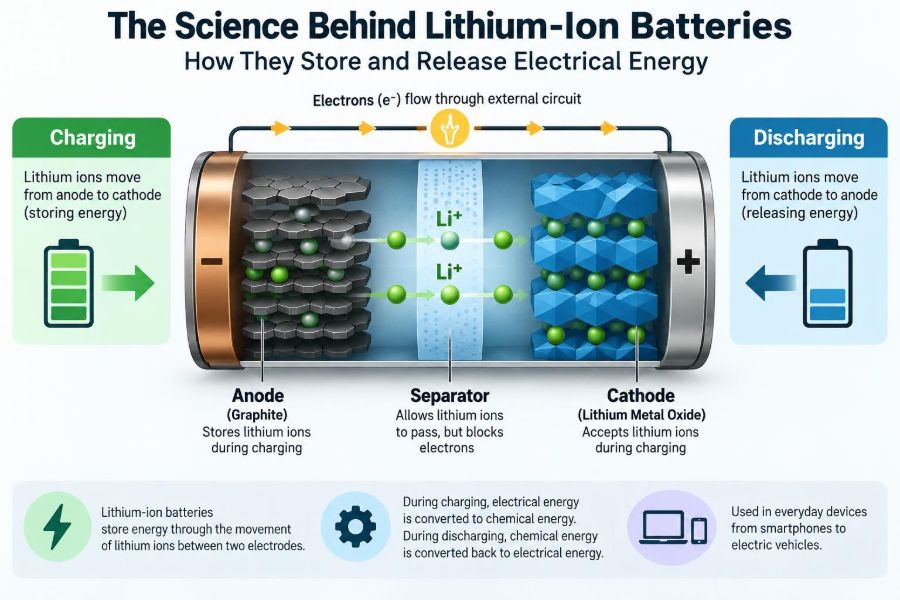
During discharge, a spontaneous electrochemical reaction converts part of that chemical energy into electrical energy. During charging, an external power source drives the reaction in the reverse direction and restores a higher-energy chemical arrangement.
⚛️ The Meaning of “Lithium-Ion”
Lithium is a light element that readily gives up one electron, becoming a positively charged ion written as Li+. In a lithium-ion cell, lithium is usually not deposited as pure metal during normal operation. Instead, lithium ions are reversibly hosted inside solid electrode materials.
This reversible insertion is often called intercalation. A useful analogy is guests moving into and out of available spaces in a layered or porous building without demolishing its overall structure.
🧩 The Four Essential Cell Parts
A conventional lithium-ion cell contains four functional elements: a negative electrode, a positive electrode, an electrolyte, and a separator. A metal current collector supports each electrode and carries electrons to external terminals.
- Negative electrode: commonly graphite, which hosts lithium during charging.
- Positive electrode: a lithium-containing metal oxide or phosphate that releases and accepts lithium.
- Electrolyte: an ion-conducting liquid or gel.
- Separator: a porous insulating film that keeps electrodes apart.
➖ Why “Anode” and “Cathode” Can Confuse People
In electrochemistry, anode and cathode are defined by the reaction, not by a permanent plus or minus label. Oxidation occurs at the anode, and reduction occurs at the cathode.
When a rechargeable lithium-ion battery is discharging, the negative electrode is the anode and the positive electrode is the cathode. During charging, reaction directions reverse. Engineers often avoid ambiguity by simply saying “negative electrode” and “positive electrode.”
🔄 What Happens During Discharge
When a device is switched on, lithium leaves the negative electrode as Li+ ions. The associated electrons cannot cross the electrolyte, so they travel through the external circuit, powering the load along the way.
The ions cross the electrolyte and separator toward the positive electrode. There, ions and electrons are both incorporated into the positive electrode material. The cell continues delivering current until usable lithium movement, voltage, temperature, or protection limits are reached.
⚡ Why Electrons Take the Long Route
The electrolyte is designed to conduct ions while blocking electrons. This separation is crucial: if electrons crossed internally in large numbers, energy would be released inside the cell instead of through the useful circuit.
The external route through wires, switches, and electronics is what makes the battery a power source. Electron flow in the circuit and ion flow inside the cell are coupled; one cannot continue for long without the other.
🔌 What Happens During Charging
A charger applies a voltage higher than the battery’s present voltage. This forces electrons back toward the negative electrode through the external circuit.
At the same time, lithium ions leave the positive electrode, travel through the electrolyte, and enter spaces in the negative electrode. Charging therefore restores a lithium-rich negative electrode, although no real cell returns to a perfectly unchanged condition after repeated use.
🧪 The Electrolyte’s Quiet Role
Most commercial lithium-ion cells use an organic liquid electrolyte containing a lithium salt. It must allow ion motion over a practical temperature range while remaining stable enough against both electrode materials.
That is a demanding compromise. The electrolyte must not conduct electrons appreciably, must wet tiny pores in the electrodes, and must operate within a limited voltage and temperature window. Its chemistry strongly affects power capability, safety behavior, and aging.
🧻 The Separator Prevents a Direct Short
The separator is a thin, porous polymer film placed between electrodes. Its pores let lithium ions pass, but its electrically insulating structure prevents the electrodes from touching.
Damage, contamination, metal particles, manufacturing defects, or severe mechanical abuse can compromise that barrier. A local internal short can produce intense heating, which is why cell manufacturing and pack protection require careful quality control.
🏗️ Inside an Electrode: More Than Active Material
An electrode coating is usually a composite. It contains active material particles that store lithium, a conductive additive that helps electrons reach those particles, and a binder that holds the coating together on its current collector.
The coating also has pores filled with electrolyte. Good performance depends on balanced pathways: electrons need access through the solid network, and ions need access through electrolyte-filled pores. A thicker coating can raise energy per area, but may make transport more difficult at high current.
📈 Where Cell Voltage Comes From
Voltage arises from a difference in chemical potential between the two electrode materials. Put simply, the materials have different tendencies to hold lithium and electrons in their current states.
Cell voltage changes with state of charge, temperature, current, and electrode chemistry. A measured voltage during use is not only an indicator of stored energy; it also includes temporary voltage losses caused by current flowing through resistive and electrochemical processes.
🔢 Voltage, Capacity, Energy, and Power
These terms describe different aspects of a battery and should not be used interchangeably.
| Quantity | Meaning | Common unit |
|---|---|---|
| Voltage | Electrical potential difference | V |
| Capacity | Charge a cell can deliver under stated conditions | Ah or mAh |
| Energy | Total useful electrical work available | Wh |
| Power | Rate at which energy is delivered or accepted | W |
Energy is approximately voltage multiplied by capacity, but the practical result depends on operating conditions. A cell may have substantial capacity yet be unsuitable for a high-power tool if its internal resistance is too high.
🚗 Energy Density Versus Power Density
Energy density describes how much energy fits into a mass or volume. Power density describes how quickly that energy can be delivered or accepted.
Long-range electric vehicles benefit from high energy density, while power tools and hybrid systems may prioritize strong power output. Design choices that improve one target can complicate another: thicker electrodes may help energy density but can limit rapid charge and discharge performance.
⏱️ Understanding C-Rate
C-rate expresses current relative to a cell’s rated capacity. A 1C discharge rate would, in an idealized case, discharge a cell in roughly one hour; 0.5C corresponds to roughly two hours, while 2C corresponds to roughly half an hour.
Real-world runtime differs because usable capacity varies with temperature, cutoff voltage, cell age, and current. C-rate remains useful because it compares stress levels across cells of different sizes.
🌡️ Why Temperature Changes Battery Behavior
Cold conditions slow ion transport and interfacial reactions. Internal resistance effectively rises, so voltage sags more under load and less energy may be accessible before the device reaches its cutoff voltage.
Heat can improve short-term kinetics, but prolonged high temperature accelerates unwanted chemical reactions and material degradation. A battery thermal system therefore aims for a moderate, reasonably uniform temperature rather than simply making cells as cool as possible.
🔥 Where Heat Comes From
Some heat is generated by ordinary electrical resistance, often approximated by the familiar I²R relationship: higher current produces disproportionately more resistive heating. Additional heat can arise from electrochemical polarization and side reactions.
Fast charging and hard acceleration are demanding because they involve high current. Pack designers manage this through cell selection, electrical connections, cooling plates or airflow, sensors, and software limits.
🪨 Why Graphite Is Widely Used
Graphite can reversibly host lithium at a low potential relative to lithium metal, helping create a useful cell voltage. Its layered carbon structure, established manufacturing methods, and reasonable cycle behavior have made it a common negative-electrode material.
It is not perfect. Lithium movement and surface reactions at graphite become more challenging at low temperature or aggressive charging conditions. Some modern electrodes blend graphite with silicon-containing materials to raise capacity.
🧱 Positive Electrode Chemistries Shape the Trade-Offs
The positive electrode strongly influences voltage, energy density, cost, power capability, and thermal behavior. Common families include layered nickel-containing oxides, lithium iron phosphate, and manganese-containing oxides.
No chemistry is universally best. Lithium iron phosphate is often selected where long life and thermal robustness are valued, while some nickel-rich layered oxides can offer higher energy density but require careful engineering and management. Actual pack performance depends on the entire design, not the chemistry label alone.
🧱 Silicon’s Promise and Its Engineering Challenge
Silicon can host much more lithium per mass than graphite, making it attractive for higher-capacity negative electrodes. The difficulty is that silicon expands and contracts substantially as it cycles.
That mechanical motion can crack particles, disrupt electrical contact, and repeatedly expose fresh surface to the electrolyte. Practical designs often use modest silicon additions, engineered particle structures, and specialized binders rather than replacing graphite completely.
🛡️ The Protective Interphase Is Necessary but Imperfect
Early in a cell’s life, electrolyte reactions at the negative electrode form a thin film called the solid electrolyte interphase, or SEI. This film allows lithium ions to pass while reducing continued electrolyte decomposition.
A stable SEI is beneficial. However, it consumes some lithium during formation and can grow or crack over time, especially under heat, high voltage, or mechanical stress. That gradual loss of cyclable lithium contributes to capacity fade.
📉 What Battery Aging Really Means
Aging is not one failure mechanism. It can include SEI growth, loss of active material, particle cracking, electrode delamination, electrolyte degradation, rising resistance, and loss of lithium inventory.
Calendar aging occurs while a battery sits, particularly in unfavorable temperature and state-of-charge conditions. Cycle aging results from repeated charge and discharge. A battery can therefore age noticeably even when it is used lightly.
📊 State of Charge Is an Estimate
State of charge, shown as a percentage, estimates how much usable charge remains. Battery-management systems combine current measurement, voltage behavior, temperature, and learned cell characteristics to make that estimate.
It is not a direct fuel gauge. Voltage alone is often unreliable during load or immediately after charging because it shifts with current and then relaxes. Estimation becomes harder as cells age and their available capacity changes.
🧠 The Battery Management System Protects the Pack
A multi-cell pack needs a battery management system, or BMS, to monitor cell voltages, current, and temperatures. It can disconnect the pack or limit operation when conditions approach unsafe or damaging boundaries.
In series-connected packs, cells do not remain identical forever. The BMS may use cell balancing to reduce differences in state of charge, preventing one weaker cell from being overcharged or overdischarged before the rest of the pack.
⚡ Why Charging Has Distinct Stages
Many lithium-ion chargers use a constant-current phase followed by a constant-voltage phase. First, the charger supplies a controlled current until the cell reaches its specified upper voltage limit.
It then holds that voltage while the current tapers down. This second stage matters because forcing high current into a nearly full cell can promote damaging reactions. Exact limits depend on the specific cell chemistry and manufacturer guidance.
🚧 Fast Charging Has Physical Limits
Fast charging is not merely a matter of providing a larger charger. Lithium ions must travel through electrolyte and electrode pores, cross interfaces, and enter host structures without creating excessive concentration gradients or heat.
Under unsuitable conditions, particularly cold temperatures or very high charge rates, lithium can deposit on the negative electrode as metallic lithium rather than inserting properly. This phenomenon, called lithium plating, can reduce capacity and create safety concerns. Charging controls must account for temperature, current, and cell state.
🧯 Thermal Runaway: A Serious but Managed Risk
Thermal runaway is a self-heating failure sequence in which heat-generating reactions accelerate as temperature rises. It can follow severe overheating, internal short circuits, physical damage, misuse, or faults that defeat protection systems.
Modern products reduce risk through cell design, separators, vents, fuses, protective electronics, robust enclosures, and thermal management. These measures reduce probability and consequences; they do not make damaged or improperly handled cells harmless.
🔧 Practical Habits That Support Battery Life
For consumer devices, use the manufacturer-supplied or approved charging equipment and keep charging ports, cables, and battery compartments in good condition. Avoid leaving batteries in very hot enclosed spaces, such as a vehicle under strong sun.
- Avoid charging a visibly swollen, leaking, crushed, or unusually hot battery.
- Allow a heavily used device to cool when practical before demanding rapid charging.
- For long storage, follow the manufacturer’s recommended state of charge and storage temperature.
- Do not bypass pack electronics or mix unmatched cells in a battery pack.
Features that limit charging near full capacity can reduce time spent at high voltage in some applications, but the best setting depends on the product and the owner’s need for daily runtime.
♻️ End-of-Life Requires Careful Handling
Lithium-ion batteries should not be placed in ordinary household waste streams. A discarded cell can be crushed or shorted, creating a fire hazard in collection vehicles and processing equipment.
Dedicated battery collection and recycling pathways can recover valuable materials and manage hazardous components more safely. For a damaged battery, local waste or emergency guidance is more appropriate than attempting disassembly at home.
🔮 Solid-State and Other Future Directions
Solid-state batteries replace the flammable liquid electrolyte with a solid ion-conducting material. They may offer useful safety or energy-density opportunities, but creating durable, low-resistance interfaces at manufacturing scale remains difficult.
Other directions include improved silicon composites, sodium-ion batteries for some cost-sensitive uses, better recycling processes, and electrode manufacturing methods that reduce material and energy demands. Progress is usually incremental because every improvement must work reliably across thousands of cycles and real operating conditions.
🧭 The Core Principle to Remember
A lithium-ion battery works because its two electrodes provide different chemical homes for lithium. During discharge, lithium ions move internally toward the positive electrode while electrons move externally through the load; charging reverses those movements using supplied electrical energy.
Everything else—voltage limits, charging profiles, cooling systems, state-of-charge estimation, and safety circuits—exists to keep that reversible movement efficient, balanced, and within the materials’ operating limits.
Lithium-ion batteries are best understood not as boxes of stored electricity, but as engineered systems that repeatedly convert chemical energy and electrical energy through controlled ion and electron transport. That perspective makes their performance, limitations, and care requirements much easier to understand. 🔋⚡🧠