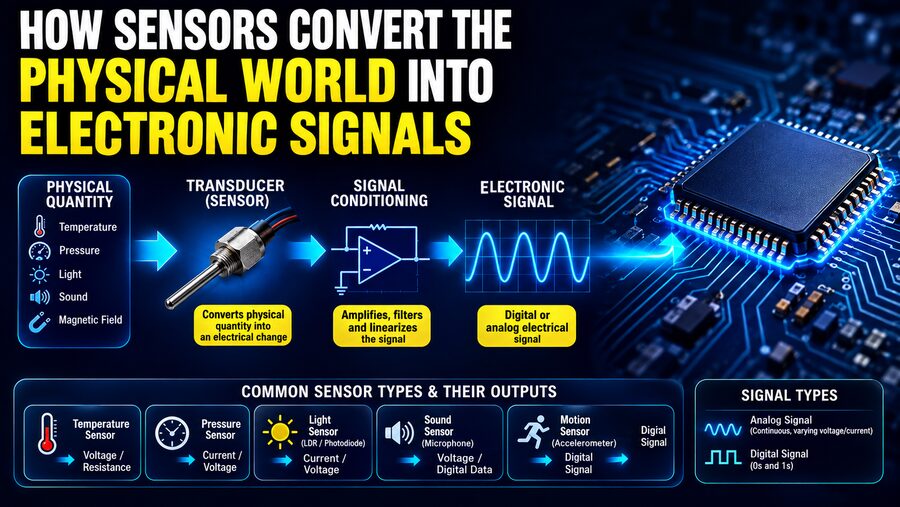

Modern technology constantly measures the world around us. Smartphones detect motion and orientation, cars monitor tire pressure and engine temperature, factories measure flow and vibration, medical devices track heartbeats and blood oxygen, and weather stations record temperature, humidity, and atmospheric pressure. 🌡️🚗📱
All of this is possible because of sensors.
A sensor is a device that detects some physical property and converts it into a form that an electronic system can process. In many cases, that means transforming something from the physical world—such as heat, light, pressure, motion, sound, or chemical concentration—into an electrical voltage, current, resistance, capacitance, frequency, or digital signal. ⚡
This conversion process is one of the most important foundations of electronics, automation, robotics, medicine, aerospace, and modern computing.
🔍 What Is a Sensor?
A sensor is essentially an interface between the physical world and the electronic world.
The physical quantity being measured is often called the measurand.
Examples include:
- Temperature 🌡️
- Pressure
- Light intensity 💡
- Sound
- Acceleration
- Magnetic field 🧲
- Humidity
- Chemical concentration
- Force
- Distance
- Rotation
- Flow rate
The sensor responds to changes in the measurand and produces an electrical output that represents those changes.
For example, a temperature sensor might produce a voltage that increases as temperature rises.
A pressure sensor might change its electrical resistance when pressure deforms a tiny structure.
A light sensor might generate electrical current when photons strike a semiconductor.
The key idea is simple:
Physical quantity → sensor response → electrical signal
⚙️ Transduction: The Core Principle Behind Sensors
The process of converting one form of energy or information into another is called transduction.
A sensor is therefore often described as a transducer.
Different sensors use different physical principles for transduction.
Some convert heat into voltage.
Others convert mechanical deformation into resistance changes.
Some use light to generate electrical charge.
Others detect magnetic fields by measuring changes in voltage or current.
The specific method depends on what engineers need to measure and how accurately, quickly, and reliably they need to measure it.
🌡️ How Temperature Sensors Work
Temperature is one of the most commonly measured physical quantities.
Several technologies can convert temperature into an electrical signal.
🔥 Thermocouples
A thermocouple uses two different metals joined together.
When the junction is at a different temperature from the reference ends of the wires, a small voltage is produced.
This phenomenon is known as the Seebeck effect.
The voltage is usually very small—often measured in microvolts or millivolts—but electronics can amplify and interpret it.
Thermocouples are widely used because they can operate over very large temperature ranges.
You might find them in:
- Industrial furnaces
- Engines
- Power plants
- Manufacturing equipment
- Scientific instruments
🌡️ Thermistors
A thermistor changes its electrical resistance as its temperature changes.
One common type is the NTC thermistor, where resistance decreases as temperature increases.
By measuring that resistance, a circuit can estimate the temperature.
Thermistors are often used in:
- Battery packs 🔋
- Air conditioners
- Consumer electronics
- Automotive systems
- Medical devices
⚙️ Resistance Temperature Detectors
An RTD also uses the relationship between temperature and electrical resistance.
Platinum is commonly used because its resistance changes in a predictable way with temperature.
RTDs are often selected when high accuracy and stability are important.
💡 How Light Sensors Convert Photons Into Electricity
Light consists of photons carrying electromagnetic energy.
Semiconductor materials can interact with these photons.
A photodiode, for example, can generate or change electrical current when light strikes its active region.
More light generally produces a stronger electrical response.
This allows electronics to measure light intensity.
Photodiodes are used in:
- Automatic screen brightness controls 📱
- Optical communication
- Barcode scanners
- Medical instruments
- Cameras
- Smoke detectors
- Remote-control receivers
Digital cameras use millions of tiny light-sensitive elements.
Each pixel in an image sensor detects incoming light and converts it into electrical charge.
That charge is later converted into digital numbers representing brightness and color. 📸
So every digital photograph begins as countless microscopic conversions from photons into electrical signals.
🎙️ How Microphones Convert Sound Into Electrical Signals
Sound is a pattern of pressure changes traveling through air.
A microphone converts these pressure variations into an electrical signal.
Different microphone technologies use different methods.
🎤 Dynamic Microphones
A dynamic microphone contains a diaphragm attached to a small coil of wire.
Sound waves cause the diaphragm and coil to move near a magnet.
According to electromagnetic induction, this motion generates an electrical voltage.
The resulting voltage follows the shape of the sound wave.
⚡ Condenser Microphones
A condenser microphone uses two electrically conductive surfaces forming a capacitor.
One surface acts as a flexible diaphragm.
When sound moves the diaphragm, the distance between the surfaces changes.
That changes the capacitance, producing an electrical signal related to the incoming sound.
Modern smartphones often use tiny MEMS microphones, which perform similar sensing functions using microscopic structures fabricated on semiconductor chips.
🚗 How Pressure Sensors Work
Pressure sensors are used almost everywhere, from aircraft to smartphones.
Many modern pressure sensors rely on a tiny flexible membrane called a diaphragm.
When pressure changes, the diaphragm bends slightly.
Engineers then measure that bending electrically.
One method uses piezoresistive elements.
When the material is mechanically strained, its electrical resistance changes.
A circuit measures that resistance change and converts it into a pressure reading.
Pressure sensors are used for:
- Tire-pressure monitoring 🚘
- Engine control
- Industrial pipelines
- Weather measurement
- Medical ventilators
- Altimeters
- Hydraulic systems
Even the barometer inside some smartphones works using a tiny pressure-sensitive structure.
⚖️ How Force and Weight Sensors Work
Digital scales often use devices called load cells.
A load cell may contain strain gauges attached to a metal structure.
When weight is applied, the structure bends slightly.
The deformation may be extremely small, but the strain gauges detect it because their electrical resistance changes.
Several strain gauges are often connected in a circuit known as a Wheatstone bridge.
This circuit makes tiny resistance changes easier to measure accurately.
The result is an electrical voltage proportional to the applied force.
So when you stand on a digital scale, your weight slightly deforms a metal structure, which changes electrical resistance, which becomes a voltage, which is then converted into the number shown on the display. ⚖️
🏃 How Motion Sensors Detect Acceleration
Smartphones can tell when you rotate them, shake them, or move them.
This is largely possible because of tiny devices called accelerometers.
Many modern accelerometers are built using MEMS, or Micro-Electro-Mechanical Systems.
Inside a MEMS accelerometer is an extremely small movable mass suspended by microscopic structures.
When the device accelerates, inertia causes the tiny mass to shift.
That movement changes an electrical property, often capacitance.
The electronics measure the change and calculate acceleration.
Accelerometers are used in:
- Smartphones 📱
- Drones
- Cars
- Game controllers 🎮
- Fitness trackers
- Aircraft
- Industrial monitoring
🌀 How Gyroscopes Detect Rotation
A gyroscope measures rotational motion.
Modern electronic gyroscopes often also use MEMS technology.
Instead of using a large spinning wheel, a MEMS gyroscope may contain tiny vibrating structures.
When the device rotates, the vibration pattern shifts due to the Coriolis effect.
Sensors detect that movement and convert it into electrical information representing angular velocity.
Smartphones commonly combine accelerometers and gyroscopes to understand device orientation and movement.
This is how your phone knows when you rotate the screen from portrait to landscape. 🔄
🧲 How Magnetic Sensors Work
Magnetic sensors detect magnetic fields.
One common example is the Hall effect sensor.
When electric current flows through a conductor or semiconductor placed in a magnetic field, a voltage can appear across the material.
This voltage is called the Hall voltage.
By measuring it, electronics can determine the strength or presence of a magnetic field.
Hall sensors are used for:
- Wheel-speed detection
- Motor control
- Position sensing
- Laptop lid detection
- Automotive systems
- Industrial machinery
Your smartphone’s digital compass also uses magnetic sensing technology to determine its orientation relative to Earth’s magnetic field. 🧭
📏 How Distance Sensors Measure Objects Without Touching Them
Many systems need to measure distance without physical contact.
Several sensing technologies can do this.
🔊 Ultrasonic Sensors
Ultrasonic sensors emit sound waves above the normal range of human hearing.
The sound travels toward an object, reflects, and returns.
The sensor measures the travel time.
Because the speed of sound is known, distance can be estimated using:
Distance = Speed × Time / 2
The division by two is required because the sound travels to the object and back.
Ultrasonic sensors are common in parking-assistance systems and robots.
💡 Optical and Laser Sensors
Optical sensors can measure distance using reflected light.
Some systems use time of flight, measuring how long a pulse of light takes to return.
Others use triangulation or phase measurements.
LiDAR systems use laser light to generate detailed maps of surrounding environments. 🚗🌐
🧪 How Chemical Sensors Work
Sensors can also detect chemicals.
For example, a gas sensor may contain a material whose electrical resistance changes when exposed to certain gases.
Other chemical sensors produce voltage through electrochemical reactions.
These sensors can detect substances such as:
- Oxygen
- Carbon monoxide
- Hydrogen
- Methane
- Alcohol
- Various industrial gases
Chemical sensors are important in factories, homes, laboratories, medical equipment, and environmental monitoring. ☁️
❤️ How Medical Sensors Measure the Human Body
Medical technology depends heavily on sensors.
A pulse oximeter, for example, estimates blood oxygen saturation using light.
It shines different wavelengths of light through tissue and measures how much light is absorbed.
Oxygenated and deoxygenated hemoglobin absorb light differently.
By comparing the measurements, electronics estimate oxygen saturation. ❤️
Other medical sensors include:
- ECG electrodes for heart activity
- Blood-pressure sensors
- Glucose sensors
- Temperature probes
- Ultrasound transducers
- Respiration sensors
These devices transform biological processes into electrical signals that computers can analyze.
⚡ Analog Signals: Electrical Representations of Reality
Many sensors initially produce an analog signal.
An analog signal changes continuously.
For example, a temperature sensor may produce:
0.5 V at one temperature
1.0 V at a higher temperature
1.5 V at an even higher temperature
The voltage continuously tracks the physical measurement.
But digital computers process numbers rather than continuous voltages.
So the analog signal often needs another conversion step.
🔢 Analog-to-Digital Conversion
An Analog-to-Digital Converter, or ADC, converts a sensor’s analog voltage into a digital number.
The process generally involves two key ideas:
Sampling and quantization.
Sampling means measuring the analog signal at specific moments in time.
Quantization means assigning each measurement to one of a finite number of digital levels.
For example, a 12-bit ADC can represent:
2¹² = 4,096 levels
A 16-bit ADC can represent:
65,536 levels
Higher resolution allows smaller voltage differences to be distinguished.
Once digitized, the measurement can be processed by a:
- Microcontroller
- CPU
- Smartphone
- Industrial controller
- Embedded computer
This creates the chain:
Physical world → sensor → analog voltage → ADC → digital data → software
📈 Why Sensor Signals Often Need Amplification
Many sensors generate extremely small signals.
A thermocouple, for example, may produce only a few millivolts.
A strain gauge may produce an even smaller change.
Such signals can be difficult for electronics to measure directly.
Engineers use amplifiers to increase their strength.
An instrumentation amplifier may take a tiny sensor voltage and magnify it while attempting to reject unwanted interference.
For example:
2 millivolts → amplifier → 2 volts
The physical information remains the same, but the signal becomes easier to measure accurately. 🔍
🧹 Filtering Out Noise
Real electronic signals contain unwanted disturbances called noise.
Noise can come from:
- Motors
- Power lines
- Radio transmitters
- Switching electronics
- Thermal effects
- Nearby circuits
Sensors often require filters to remove unwanted frequency components.
For instance, a temperature sensor usually measures something that changes relatively slowly.
Rapid electrical fluctuations are probably noise rather than real temperature changes.
A low-pass filter can reduce those unwanted high-frequency variations.
Signal filtering can be performed using analog circuits, digital algorithms, or both. 📉
🎯 Calibration: Connecting the Signal to a Real Measurement
A sensor producing 1.82 volts is not useful unless the system knows what 1.82 volts means.
Calibration establishes the relationship between sensor output and the actual physical quantity.
For example:
0.5 V = 0°C
2.5 V = 50°C
4.5 V = 100°C
Software can use this relationship to convert voltage into temperature.
Calibration may also compensate for manufacturing differences, nonlinear behavior, aging, or environmental effects.
High-precision sensors may need regular recalibration to remain accurate. 🎯
📏 Accuracy, Precision, and Resolution Are Different
Sensor performance is described using several important terms.
Accuracy tells us how close a measurement is to the true value.
Precision describes how consistently repeated measurements agree with each other.
Resolution describes the smallest change a measurement system can distinguish.
A sensor could produce very repeatable measurements while still being inaccurate if it is poorly calibrated.
For example, a thermometer that always reads 2°C too high may be precise but not accurate.
Understanding these differences is essential when selecting sensors for engineering applications.
⏱️ Sensors Also Need to Respond Quickly Enough
Some measurements change very slowly.
Room temperature, for example, may change over minutes.
Other measurements can change thousands or millions of times per second.
A microphone must respond rapidly enough to capture audio frequencies.
A crash sensor in a vehicle must detect sudden acceleration within milliseconds. 🚘
Engineers therefore consider response time and bandwidth.
A sensor that is accurate but too slow may still be useless for a fast-changing system.
🌡️ Environmental Conditions Affect Sensors
Sensors rarely operate under perfect laboratory conditions.
They may experience:
- Extreme heat
- Cold
- Humidity
- Dust
- Mechanical vibration
- Radiation
- Corrosive chemicals
- Electromagnetic interference
Engineers must select sensors that can survive their environment.
For example, a sensor used inside a jet engine requires very different materials and construction from one inside a household thermostat. ✈️
🤖 Sensors Are the “Senses” of Robots
A robot without sensors would have very little understanding of its surroundings.
Sensors give robots information about:
- Position
- Orientation
- Distance
- Force
- Temperature
- Sound
- Images
- Motion
A self-driving vehicle, for example, may combine data from:
- Cameras 📸
- Radar
- LiDAR
- Ultrasonic sensors
- GPS
- Accelerometers
- Gyroscopes
Software then combines these inputs to build a model of the environment.
This process is known as sensor fusion.
By combining multiple imperfect measurements, systems can often estimate reality more reliably than with one sensor alone.
🏭 Sensors Make Automation Possible
Modern factories depend on thousands of sensors.
A chemical plant might monitor:
- Tank levels
- Pressure
- Temperature
- Flow rates
- Gas concentration
- Vibration
A manufacturing robot might detect position and force.
A production line might use cameras to inspect products.
Without sensors, automated systems would have no reliable way to know what was happening inside their processes.
Sensors therefore form the feedback side of control systems. 🏭
A controller receives measurements, compares them with desired values, and adjusts equipment accordingly.
For example:
Temperature too low → sensor detects it → controller activates heater
This cycle may repeat continuously.
🌐 The Internet of Things Depends on Sensors
The Internet of Things, or IoT, connects physical devices to digital networks.
Sensors are often the first link in that chain.
A smart agriculture system might measure:
- Soil moisture 🌱
- Temperature
- Humidity
- Light
- Rainfall
A microcontroller converts these readings into digital data and sends them to a server.
Software can then analyze the information and automatically control irrigation.
Similar systems are used in buildings, cities, healthcare, transportation, and industry.
🧠 From Reality to Numbers
The entire process of electronic sensing can be summarized as:
Physical phenomenon → transducer → electrical signal → signal conditioning → ADC → digital number → software interpretation
For example, in a digital thermometer:
Temperature → resistance change → voltage → ADC reading → temperature calculation → display
In a microphone:
Sound pressure → diaphragm motion → electrical signal → amplification → ADC → digital audio
In a camera:
Light → charge in pixels → electrical measurements → ADC → digital image
Once physical reality has been converted into numbers, computers can store, analyze, transmit, and respond to it. 💻
🌟 Final Thoughts
Sensors are among the most important technologies connecting electronics to the real world.
Computers themselves operate on electrical and digital information. They cannot directly experience temperature, pressure, sound, light, movement, or chemical concentration.
Sensors provide that missing link. 📡
They use physical phenomena such as electromagnetism, resistance changes, capacitance, mechanical deformation, chemical reactions, and semiconductor effects to transform real-world conditions into measurable electrical signals.
Signal-conditioning circuits then amplify and filter those signals, while analog-to-digital converters transform them into numbers that computers can understand.
This is how a smartphone detects rotation. 📱
It is how a car knows its tires are losing pressure. 🚗
It is how a medical monitor detects a heartbeat. ❤️
It is how a robot sees and navigates its environment. 🤖
And it is how enormous industrial plants automatically monitor thousands of physical conditions every second. 🏭
In a sense, sensors give machines their eyes, ears, touch, balance, and awareness of the environment.
Without them, computers could calculate—but they would have almost no idea what was happening in the physical world around them.