
Most computers run programs on fixed processors. A CPU is manufactured with a predetermined internal architecture, and software tells that processor which instructions to execute. Even highly specialized GPUs follow hardware structures that were defined before the chip left the factory.
Field-Programmable Gate Arrays, or FPGAs, work differently. 🧠🔧
An FPGA is an integrated circuit whose internal digital logic can be reconfigured after manufacturing. Instead of merely writing software that runs on existing hardware, engineers can use an FPGA to create entirely new digital circuits inside the chip.
That means an FPGA can behave like a custom communication controller today, a video-processing engine tomorrow, and a machine-learning accelerator later—provided the design fits within its available resources.
This unusual combination gives FPGAs a powerful advantage: the performance and parallelism of custom hardware with some of the reprogrammability normally associated with software.
They are widely used in telecommunications, aerospace, industrial automation, networking, medical devices, automotive systems, scientific instruments, artificial intelligence, and prototype chip development.
🧩 What Is an FPGA?
An FPGA is a semiconductor device containing a large collection of configurable digital building blocks.
These typically include:
- 🔲 Programmable logic elements
- 🔗 Configurable interconnections
- 💾 Embedded memory
- ➕ Arithmetic units
- ⏱️ Clock-management circuitry
- 🔌 Input/output interfaces
Engineers configure these resources to form a digital circuit.
Unlike a conventional CPU program, an FPGA design does not simply execute one software instruction after another.
Instead, the configuration determines how electrical signals physically flow through the chip.
In other words, engineers are not merely telling a processor what calculations to perform.
They are describing what digital hardware should exist. ⚙️
🧱 Configurable Logic Blocks
At the heart of an FPGA are many small programmable elements often called configurable logic blocks, or similar names depending on the manufacturer.
These blocks can implement basic Boolean logic functions such as:
AND
OR
XOR
NOT
They can also build more complicated structures including:
🔢 Counters
📦 Registers
🔄 State machines
➕ Adders
🔍 Comparators
🎛️ Control logic
One common internal component is a lookup table, often abbreviated LUT.
A LUT can be programmed to produce a desired output for different combinations of input bits.
By connecting many LUTs and registers together, engineers can construct very sophisticated digital systems.
🔗 Programmable Interconnects
Logic blocks alone would not be very useful if they could not communicate.
FPGAs therefore contain a large network of programmable routing resources.
These interconnections act like configurable wiring.
During FPGA configuration, engineers determine which logic blocks should connect to which others.
For example, one group of logic elements might perform multiplication.
Another might accumulate results.
Another could process incoming network packets.
Programmable routing connects all of these components into a functioning hardware architecture.
This is one of the reasons FPGA design is sometimes compared to building an electronic circuit using software tools. 🖥️🔌
💻 Hardware Description Languages
FPGA engineers commonly describe their digital circuits using hardware description languages, or HDLs.
Popular examples include:
VHDL
Verilog
SystemVerilog
These languages can look similar to programming languages, but their purpose is fundamentally different.
A traditional software statement might mean:
Execute this operation after the previous instruction.
An HDL statement may instead describe:
Create hardware that continuously performs this operation whenever the relevant signals change.
This difference is extremely important.
HDLs describe hardware structure and behavior, not simply a sequence of CPU instructions.
🔄 Software-Like Flexibility
Why are FPGAs often described as flexible like software?
Because their hardware configuration can be changed.
Suppose an engineer designs an FPGA-based image processor.
If a new filtering algorithm is required, the engineer can modify the digital design, generate a new configuration file, and reprogram the FPGA.
The physical chip remains the same.
Its internal function changes. 🔧➡️⚡
A custom ASIC, by contrast, is manufactured with permanent circuitry.
If the design contains a major error or needs an entirely new architecture, a new chip may have to be designed and manufactured.
FPGAs therefore offer tremendous value when requirements may evolve.
🏭 FPGA vs. ASIC
An ASIC, or Application-Specific Integrated Circuit, is a chip built for a particular purpose.
ASICs can provide excellent:
⚡ Performance
🔋 Energy efficiency
📦 Density
💰 Unit cost at very high production volumes
But developing an ASIC can be extremely expensive and time-consuming.
Creating a new ASIC may involve:
🧠 Circuit design
🔍 Verification
🏭 Semiconductor fabrication
🧪 Testing
📦 Packaging
Once manufactured, the logic generally cannot be changed.
An FPGA avoids the fabrication step for each new design.
Engineers can modify the configuration electronically.
This makes FPGAs particularly attractive for:
🧪 Prototyping
📉 Lower production volumes
🔄 Frequently changing standards
🚀 Rapid development
🎯 Specialized acceleration
⚡ FPGA vs. CPU
A CPU is extremely flexible because it can run many different programs.
However, most CPU workloads are ultimately executed through a limited number of processor cores.
Even modern CPUs with multiple cores generally execute instructions according to a predefined architecture.
An FPGA can create many independent hardware operations that occur at the same time.
For example, imagine processing 100 independent data streams.
A CPU may handle them using threads, vector instructions, or repeated loops.
An FPGA could potentially create many dedicated processing pipelines operating simultaneously.
This massive hardware parallelism can provide major performance advantages for certain workloads. 🚀
🎮 FPGA vs. GPU
GPUs are also highly parallel.
They contain thousands of processing units optimized for workloads that can be divided into many similar mathematical operations.
This makes GPUs excellent for:
🎮 Graphics
🤖 Machine learning
🔬 Scientific computing
📊 Data processing
However, the internal GPU architecture is still fixed.
An FPGA can be configured to create a custom data path optimized specifically for one algorithm.
For example, if an application needs unusual bit widths or specialized mathematical logic, the FPGA does not necessarily have to use general-purpose 32-bit or 64-bit arithmetic.
Engineers might create a 13-bit data path if that is sufficient.
This can save hardware resources and potentially improve efficiency.
🚄 Hardware Parallelism
One of the most important advantages of FPGAs is true parallel execution.
Imagine a system that must:
- Receive sensor data.
- Filter the data.
- Detect patterns.
- Calculate measurements.
- Send results over a network.
A software program might execute these operations through instructions scheduled on a processor.
An FPGA can create separate hardware circuits for each stage.
All stages can operate simultaneously as data flows through them.
This architecture is called a pipeline.
Once the pipeline is full, the system may produce a new result every clock cycle. ⏱️
🏗️ What Is Pipelining?
Pipelining divides a complex computation into multiple hardware stages.
Consider multiplying numbers and then adding the results.
Instead of performing every operation in one long hardware path, engineers can divide the calculation into stages with registers between them.
For example:
Input → Multiply → Register → Add → Register → Output
While one dataset is being added, the next dataset can already be multiplied.
This resembles an assembly line. 🏭
Each stage performs different work at the same time.
Pipelining can dramatically increase throughput, even if each individual piece of data still takes several stages to reach the output.
⏱️ Deterministic Timing
Another important advantage of FPGAs is predictable timing.
General-purpose operating systems may interrupt software tasks because of:
🧠 Process scheduling
💾 Memory activity
🌐 Network events
⚙️ Background services
For some applications, unpredictable delays are unacceptable.
An FPGA circuit can often respond to signals within a precisely designed number of clock cycles.
This deterministic behavior is valuable in:
✈️ Aerospace control
🏭 Industrial automation
📡 Telecommunications
🔬 Scientific instrumentation
🚗 Automotive systems
When timing must be extremely consistent, FPGA hardware can outperform general-purpose software solutions.
📡 Telecommunications
FPGAs are widely used in communications equipment because network and wireless standards often require enormous amounts of high-speed signal processing.
An FPGA might perform:
📶 Modulation
🔍 Error detection
🧮 Digital filtering
🔄 Protocol conversion
📦 Packet processing
🔐 Encryption
Telecommunications standards also evolve over time.
Because FPGAs can be reconfigured, manufacturers can update hardware behavior without necessarily replacing the entire device.
This is especially useful in rapidly changing communications infrastructure.
🌐 Networking and Data Centers
Modern networks transmit enormous quantities of information.
High-speed networking hardware may need to examine and modify packets at rates too demanding for conventional software alone.
FPGAs can be used for:
📦 Packet filtering
🛡️ Firewall acceleration
🔐 Encryption
🔀 Traffic routing
📊 Network monitoring
🗜️ Data compression
Because the data path can be customized, an FPGA can begin processing incoming packets immediately as they arrive.
This reduces the need to move every piece of data through a CPU-based software stack.
🤖 FPGA Acceleration for Artificial Intelligence
Machine-learning applications often involve repeated mathematical operations such as matrix multiplication.
GPUs dominate many AI workloads, but FPGAs can also be useful accelerators.
An FPGA-based AI engine can be optimized for a specific neural-network architecture.
Engineers may create custom units for:
➕ Accumulation
✖️ Multiplication
🔢 Low-precision arithmetic
📦 Data movement
🧠 Activation functions
One advantage is the ability to use specialized numeric formats.
If a model operates adequately with 8-bit or even lower-precision numbers, the FPGA can dedicate hardware specifically to those representations.
This can increase parallelism and reduce energy consumption for certain workloads.
🎥 Video and Image Processing
Digital video is another excellent FPGA application.
Imagine a camera capturing millions of pixels every second.
Each pixel may need to undergo:
🎨 Color conversion
🔍 Noise reduction
📏 Scaling
✨ Image enhancement
🎯 Object detection preparation
An FPGA can construct a streaming pipeline in which pixels flow through multiple processing stages continuously.
There may be no need to store an entire image before processing begins.
This can reduce latency significantly.
FPGAs are therefore common in professional video equipment, industrial cameras, broadcasting systems, and machine-vision devices.
🚗 Automotive Applications
Modern vehicles contain increasing amounts of high-speed electronics.
FPGAs can help process information from:
📷 Cameras
📡 Radar
🧭 Navigation systems
🛞 Sensors
🔌 Vehicle networks
They may also provide interfaces between different communication standards.
Because automotive systems often require predictable behavior and low latency, programmable hardware can be attractive for certain functions.
However, automotive FPGAs must meet demanding reliability, temperature, and safety requirements.
✈️ Aerospace and Defense
FPGAs are especially valuable in aerospace and defense systems because these applications frequently combine specialized processing with long product lifetimes.
They may be used for:
📡 Radar processing
🛰️ Satellite communication
🧭 Navigation
🔐 Secure communications
🎛️ Control systems
🔬 Sensor processing
Some aerospace FPGAs are specifically designed to withstand radiation and extreme environmental conditions.
Reprogrammability can also provide advantages for long-lived spacecraft.
A satellite may remain in orbit for many years.
The ability to modify processing hardware after launch can be extremely valuable. 🛰️
🔬 Scientific Instruments
Scientific instruments often produce high-speed streams of data.
Examples include:
🔭 Telescopes
🧬 DNA analysis equipment
⚛️ Particle detectors
📡 Radio astronomy systems
🧪 Laboratory measurement devices
An FPGA can perform initial processing directly next to the data source.
For instance, it might filter irrelevant events and send only useful information to a CPU.
This reduces the amount of data that higher-level software needs to process.
🔌 Input/Output Flexibility
FPGAs can also support a wide range of communication interfaces.
Depending on the device, engineers can implement or connect to protocols such as:
🔗 Ethernet
⚡ PCI Express
📦 USB
🎛️ SPI
🧠 I²C
📡 High-speed serial links
This makes FPGAs useful as bridge devices.
Suppose a legacy industrial machine uses an older communication protocol while a modern computer system uses a newer interface.
An FPGA can potentially translate between them in hardware.
💾 Embedded Memory
Most modern FPGAs contain internal memory blocks.
These may be used for:
📦 Buffers
🗃️ Lookup tables
🔢 Temporary calculation storage
🎥 Video line storage
📡 Packet queues
Accessing internal FPGA memory can be extremely fast because it exists physically close to the processing logic.
Some advanced FPGAs also include interfaces to external high-speed memories.
Data movement is often one of the biggest performance considerations in FPGA system design.
➕ Dedicated Arithmetic Blocks
Many FPGAs contain specialized arithmetic resources, often called DSP blocks.
These hardware units are optimized for operations such as multiplication and accumulation.
They are useful for:
📡 Digital signal processing
🎵 Audio filtering
📷 Image processing
🤖 Neural networks
🔬 Scientific calculations
Instead of constructing every multiplier from ordinary FPGA logic, engineers can use these dedicated hardware blocks more efficiently.
🧠 FPGAs With Built-In CPUs
Some FPGA devices combine programmable logic with conventional processor cores on the same chip.
These are often called SoC FPGAs.
A system might contain:
💻 ARM processor cores
⚡ FPGA programmable logic
💾 Memory controllers
🔌 Peripheral interfaces
The CPU can run an operating system such as Linux.
Meanwhile, the FPGA fabric handles timing-critical or highly parallel tasks.
For example:
CPU: user interface and networking software
FPGA: real-time signal processing
This combination provides both software programmability and custom hardware acceleration.
🧪 FPGA Prototyping for Future Chips
One important use of FPGAs is prototyping ASIC designs.
Suppose a company is designing a new processor.
Fabricating the final silicon chip may cost a huge amount of money.
Before committing to manufacturing, engineers can implement much of the proposed architecture on FPGAs.
They can then test:
🧮 Logic behavior
💻 Software compatibility
🔄 Communication protocols
🐞 Hardware bugs
⚡ Performance concepts
Finding problems before chip fabrication can save enormous cost.
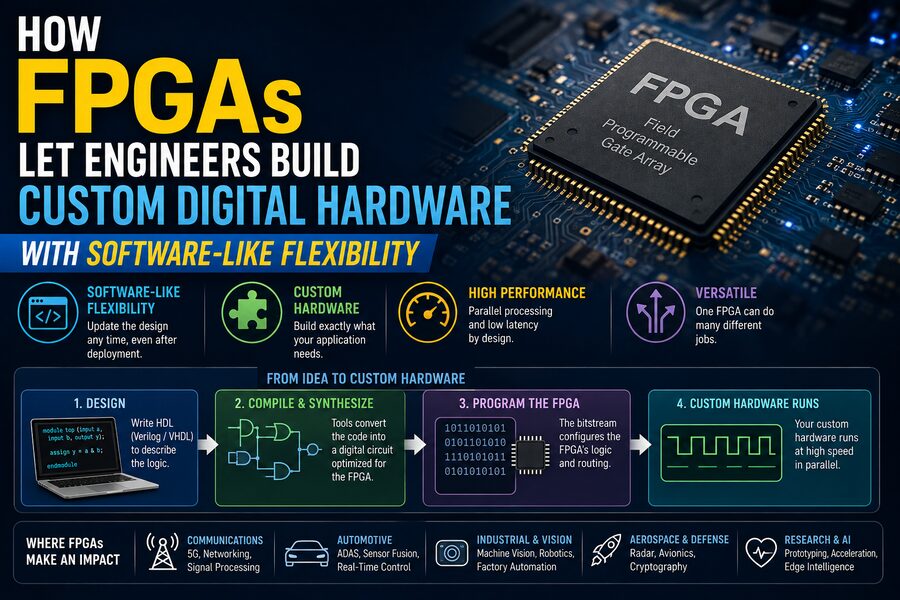
🛠️ The FPGA Development Process
Building FPGA hardware typically involves several stages.
1️⃣ Design Entry
Engineers create hardware descriptions using HDL, schematic tools, or higher-level design frameworks.
2️⃣ Simulation
Before programming the physical chip, the design can be simulated.
Simulation helps identify logical errors.
3️⃣ Synthesis
A software tool converts the hardware description into lower-level logic structures.
This process is called synthesis.
4️⃣ Place and Route
The development tools decide where each logical function should physically exist inside the FPGA and how the programmable connections should link everything together.
5️⃣ Timing Analysis
Tools verify that electrical signals can travel through the design quickly enough to meet the desired clock speed.
6️⃣ Bitstream Generation
The final configuration is packaged into a file often called a bitstream.
7️⃣ FPGA Programming
The bitstream is loaded into the FPGA, configuring its internal hardware.
⚙️ The device now behaves according to the engineer’s design.
📦 What Is an FPGA Bitstream?
A bitstream contains configuration information defining the FPGA’s internal state.
It may determine:
🔲 LUT contents
🔗 Routing connections
💾 Memory initialization
🔌 I/O behavior
⏱️ Clock configuration
Loading a different bitstream can substantially change what the device does.
This is what gives FPGAs their programmable nature.
Some systems load their configuration automatically during startup from external flash memory.
🔄 Partial Reconfiguration
Certain FPGAs support an even more advanced capability called partial reconfiguration.
This allows part of the FPGA to be changed while another part continues operating.
Imagine an FPGA divided into several functional regions.
One region handles networking.
Another performs signal processing.
With partial reconfiguration, engineers might replace the signal-processing circuit while leaving the networking logic active.
This can enable extremely flexible systems. 🔄⚡
Possible applications include:
📡 Adaptive communications
🛰️ Space systems
🤖 Reconfigurable accelerators
🔐 Changing encryption engines
🧑💻 High-Level Synthesis
Traditional FPGA design requires detailed knowledge of hardware description languages.
However, newer development approaches attempt to make programmable hardware more accessible.
High-Level Synthesis, or HLS, tools can translate certain algorithms written in higher-level languages such as C or C++ into FPGA hardware.
The engineer can describe a computation more like software.
The tool attempts to create:
⚙️ Logic
📦 Pipelines
🔗 Data paths
💾 Memory structures
However, good FPGA performance still generally requires an understanding of hardware principles.
Simply converting ordinary software code does not automatically produce an efficient circuit.
🧠 Thinking in Hardware Instead of Software
FPGA programming requires a different mindset from conventional software development.
Consider this code concept:
A = B + C
D = E + F
A CPU may execute these operations sequentially depending on its architecture and scheduling.
An FPGA designer can create two separate adders.
Both calculations can happen at the same time.
This is one reason FPGA designs can achieve impressive throughput.
However, it also means engineers must think carefully about:
⚙️ Parallelism
⏱️ Timing
📦 Data movement
💾 Memory architecture
🔗 Signal routing
FPGA development sits somewhere between software engineering and digital electronics.
⏱️ Clock Frequency Is Not Everything
Modern CPUs may operate at several gigahertz.
Many FPGA designs run at substantially lower clock frequencies.
Yet an FPGA can still outperform a CPU for certain applications because it performs much more useful work during each clock cycle.
For example, an FPGA might contain dozens or hundreds of arithmetic units operating simultaneously.
Performance therefore depends not only on:
Clock speed
but also on:
Parallelism × Work completed per cycle
This distinction is fundamental to understanding hardware acceleration.
🔋 Energy Efficiency
Custom data paths can also make FPGAs energy-efficient for some workloads.
A CPU contains complex circuitry supporting many possible instructions.
If an application uses only a small subset of those capabilities, much of the processor’s architecture may not contribute directly to the task.
An FPGA can implement only the hardware required for a particular algorithm.
This specialization can reduce unnecessary operations.
However, FPGAs are generally less energy-efficient than well-designed ASICs performing the same fixed task.
They trade some hardware efficiency for reconfigurability.
⚠️ Challenges of Using FPGAs
FPGAs offer impressive flexibility, but they are not ideal for every application.
Their disadvantages can include:
💰 Higher cost than simple microcontrollers
🧩 More difficult development
⏱️ Long synthesis and routing times
🔍 Complex debugging
⚡ Lower maximum clock speeds than some processors
🔋 Higher power consumption than specialized ASICs
FPGA tools can also be complicated.
A design that works logically may fail to meet timing requirements.
Engineers therefore need knowledge of both digital logic and software development tools.
🐞 FPGA Debugging
Debugging FPGA hardware can be challenging because internal signals are not as easy to inspect as software variables.
Developers may use:
🔬 Logic analyzers
📡 Internal signal capture tools
🧪 Simulation
📊 Timing reports
💻 Hardware debuggers
Many FPGA platforms provide internal logic-analyzer features that capture selected signals while the circuit is running.
These tools allow engineers to inspect what happened inside the FPGA after a trigger event.
Debugging hardware still requires careful planning because observing too many signals can consume significant FPGA resources.
🔐 FPGA Security
Because FPGA behavior is defined by configuration data, protecting the configuration can be important.
An attacker who obtains a proprietary FPGA design might learn valuable intellectual property.
Modern FPGA platforms may provide features such as:
🔐 Encrypted bitstreams
🔑 Secure boot
✅ Authentication
🛡️ Tamper protection
Security becomes particularly important when FPGAs control critical infrastructure, communications, or defense systems.
🆚 FPGA vs. Microcontroller
A microcontroller is a small processor designed to run software for embedded systems.
It is typically excellent for:
🌡️ Sensor monitoring
🔘 Button control
🖥️ Simple displays
⚙️ Motors
📡 Basic communication
An FPGA becomes attractive when the system requires:
⚡ Very high parallelism
⏱️ Precise timing
📡 High-speed interfaces
🧮 Specialized computation
🔄 Custom digital protocols
A microcontroller executes programmed instructions.
An FPGA creates custom hardware.
Many systems use both.
🚀 Why FPGAs Are Important for Innovation
FPGAs occupy a valuable position between software and permanent silicon.
They let engineers experiment with new hardware architectures without manufacturing a completely new chip.
A team developing an experimental networking protocol can build specialized packet hardware.
A researcher can create a custom scientific accelerator.
An automotive engineer can prototype a real-time sensor-processing pipeline.
A telecommunications company can update processing logic as standards evolve.
All of this can happen using hardware whose internal structure can be redesigned after deployment. 🔄
🌟 Conclusion
FPGAs allow engineers to build custom digital hardware with software-like flexibility because their internal logic and connections are programmable after manufacturing.
Instead of merely running instructions on a fixed processor, FPGA developers configure the chip to become the digital circuit their application needs.
Programmable logic blocks perform calculations.
Routing resources connect them.
Embedded memories store data.
DSP blocks accelerate arithmetic.
High-speed interfaces move information into and out of the device.
Together, these components allow engineers to construct custom pipelines capable of processing many operations simultaneously. ⚡🧠
This gives FPGAs several important strengths:
🚀 Massive parallelism
⏱️ Predictable low-latency operation
🔄 Reconfigurability
🎯 Application-specific hardware acceleration
🧪 Fast prototyping before ASIC production
They are not as easy to program as conventional CPUs, nor are they as efficient as fully custom ASICs for massive production volumes. Their power comes from occupying the space between those extremes.
A CPU asks:
“Which software instruction should I execute next?”
An FPGA asks a more fundamental question:
“What hardware should I become?” ⚙️✨
That ability to reshape digital hardware after manufacturing is why FPGAs remain one of the most versatile technologies in modern electronics.