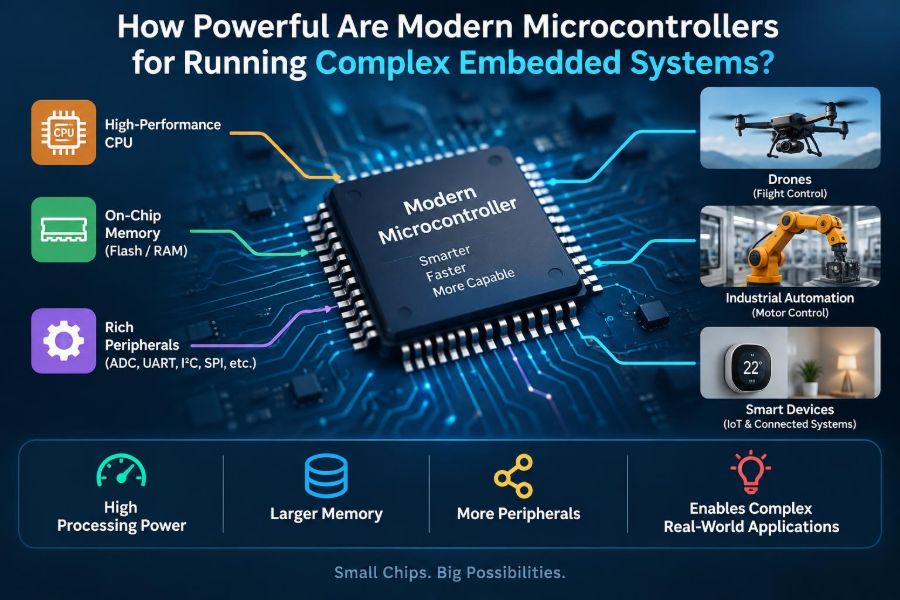

A smart thermostat learns a household schedule, a drone stabilizes itself in gusty air, and a battery-powered sensor sends encrypted data through a wireless network. None of these products necessarily needs a full computer inside. Many are built around a microcontroller.
That can seem surprising if your mental picture of a microcontroller is a tiny chip blinking an LED or reading a pushbutton. Modern devices can run multiple software tasks, process sensor data, drive displays, communicate over several protocols, and enforce meaningful security boundaries—all while using very little power.
But “powerful” is a conditional word. A microcontroller can be an excellent fit for a complicated embedded product and still be the wrong choice for a camera-heavy interface, a large application framework, or a workload needing gigabytes of memory.
The useful question is not whether microcontrollers have caught up with computers. It is whether their mix of processing, memory, real-time behavior, peripherals, and energy use matches the system in front of you.
🧩 What a Microcontroller Actually Integrates
A microcontroller unit, or MCU, places a processor core, memory, and hardware interfaces on one chip. Those interfaces commonly include timers, analog-to-digital converters, serial ports, GPIO pins, watchdogs, and communication controllers.
This integration is its defining advantage. Instead of assembling a processor, external memory, timing hardware, and basic I/O around a board, designers can often build a reliable control system with one MCU and a small number of support components.
💻 Microcontroller Versus Microprocessor
A microprocessor is usually intended to work with external RAM, storage, and a richer operating environment. It is a natural home for systems that need large memories, high-resolution graphics, desktop-like interfaces, or complex application stacks.
An MCU is optimized for direct interaction with the physical world. It starts quickly, responds predictably to inputs, and can remain in very low-power states between events. The categories overlap at the high end, but the design priorities remain different.
| Need | Microcontroller strength | When a microprocessor may fit better |
|---|---|---|
| Motor and sensor control | Deterministic timers and direct I/O | Usually unnecessary |
| Battery operation | Deep sleep and fast wake-up | Only if heavier computing is essential |
| Rich graphical interface | Possible on capable MCUs | Better for large, animated interfaces |
| Large local data sets | Limited by on-chip and external memory | Better when abundant RAM and storage are required |
⚙️ Processing Power Has Moved Well Beyond 8-Bit Control
Simple 8-bit MCUs still make sense for inexpensive, narrow jobs. Yet many current embedded designs use 32-bit cores with clock rates and instruction sets suitable for filtering, communications, control algorithms, and modest user interfaces.
Some chips include multiple cores or specialized accelerators. The practical result is not that every embedded task has become easy; it is that tasks once reserved for a larger processor can now be practical within a compact, efficient control platform.
🧠 Architecture Matters More Than Clock Speed
Clock frequency is easy to compare, but it is not a complete performance measure. Two MCUs at the same frequency can differ substantially because of core architecture, memory access speed, cache behavior, instruction execution, and the presence of a floating-point unit.
A useful analogy is two workshops with motors turning at the same speed. The workshop with better tool placement and a dedicated cutting machine may complete more work. Likewise, an MCU with efficient memory paths and hardware support can outperform a superficially similar part.
📦 Memory Is Often the First Real Constraint
Firmware must fit in nonvolatile memory, commonly flash, while variables, stacks, communication buffers, and temporary calculations occupy RAM. Complex software usually runs out of RAM before it runs out of processor cycles.
A display buffer, encrypted network packets, logging queues, and several task stacks can consume memory quickly. External RAM can expand capacity on some platforms, but it introduces board complexity, cost, power use, and less predictable access timing.
🗂️ Flash, RAM, and Nonvolatile Data Have Different Jobs
Flash stores program code and configuration that must survive power loss. RAM holds changing data while the system is running. Separate nonvolatile areas may store settings, calibration values, or event records.
Treating these resources as interchangeable causes trouble. Frequent writes can wear some nonvolatile memory technologies, while keeping large constant lookup tables in RAM wastes scarce working space. A memory map is a design tool, not paperwork to postpone.
⏱️ Real-Time Behavior Is a Major Advantage
Embedded systems often care not merely about finishing work, but about finishing it before a deadline. A motor controller may need to update its output at a precise interval; a protection circuit may need to react before a fault damages hardware.
This is called real-time behavior. A fast processor that occasionally responds late can be unsuitable, while a modest MCU that consistently meets its timing deadline can be exactly right.
🚨 Interrupts Let the Chip Respond to Events
An interrupt briefly pauses ordinary code so the MCU can handle an urgent event, such as a timer expiry, received byte, encoder transition, or fault signal. It avoids wasting processor time constantly asking every device whether anything happened.
Interrupt routines should remain short. Recording data, acknowledging hardware, or releasing a task is usually safer than performing lengthy calculations inside the interrupt, because long routines delay other time-sensitive events.
🕰️ Timers and DMA Remove Repetitive Work
Timers generate accurate periodic events, measure pulse widths, create PWM waveforms, and capture input timing without software constantly counting instructions. They are central to applications from LED dimming to power conversion.
Direct memory access, or DMA, transfers data between a peripheral and memory with little CPU involvement. For example, a DMA controller can collect a stream of ADC samples while the CPU analyzes the previous block. This division of labor is one reason modern MCUs handle surprisingly busy systems.
📡 Peripheral Hardware Does More Than Connect Pins
UART, I²C, SPI, CAN, USB, Ethernet, and radio interfaces are often described as communications ports. In practice, their hardware features can determine whether a design is robust under load.
Buffers, error detection, automatic frame handling, and DMA support reduce the number of deadlines firmware must meet manually. Choosing an MCU means checking the exact peripheral implementation, not just counting how many protocol names appear in a datasheet.
📏 Analog Capability Connects Code to Physical Signals
Many embedded products begin with voltage, current, temperature, pressure, sound, or light rather than digital data. An ADC turns an analog voltage into a number; a DAC or PWM output can produce a controllable analog-like signal.
Resolution alone does not guarantee a useful measurement. Reference stability, sensor conditioning, sampling rate, layout noise, and calibration may matter more than the number printed beside the ADC in a product summary.
🔁 Control Loops Are a Demanding Everyday Workload
A feedback control loop measures a system, compares the measurement with a target, and adjusts an output. A fan controller, robotic joint, heater, and power supply all use variations of this idea.
The workload is typically small but relentless. If a loop must run every fixed interval, random delays from slow communication code, memory allocation, or poorly managed interrupts can create oscillation, sluggish response, or instability.
🧮 Digital Signal Processing Is Now Commonplace
Digital signal processing, or DSP, includes filtering noise, transforming sampled signals, estimating frequency, and extracting useful features from data. Audio products, vibration monitors, and energy meters frequently use these techniques.
MCUs with DSP-oriented instructions or floating-point hardware can perform these calculations more efficiently. Still, algorithm choice matters: a carefully designed fixed-point filter may be more appropriate than a computationally expensive floating-point approach on a constrained device.
🤖 Edge AI Is Useful, but Narrower Than the Hype
Some MCUs can run small machine-learning inference models locally. A model might classify a short sound, recognize a simple motion pattern, or detect an anomaly in sensor readings without sending raw data to a server.
This is valuable when latency, privacy, connectivity, or power makes cloud processing unattractive. Training large models on an MCU is generally not the goal, and high-resolution vision or broad language tasks usually exceed its memory and compute budget.
🧵 Multitasking Does Not Require a Large Operating System
A bare-metal program can use a superloop: it repeatedly checks tasks and performs work. This approach is compact and can be very dependable when the system is simple and all tasks complete quickly.
As responsibilities grow, a real-time operating system, or RTOS, can schedule separate tasks for communications, sensing, storage, and control. The RTOS brings structure, but it also adds stacks, synchronization problems, and scheduling decisions that developers must understand.
🔒 Concurrency Bugs Can Defeat a Powerful MCU
When tasks and interrupts share data, timing-dependent failures become possible. A variable can change halfway through an update, one task can wait forever for a resource, or a low-priority task can block a critical one.
Useful protections include short critical sections, queues, event flags, timeouts, and disciplined ownership of each hardware resource. More processor speed can conceal these bugs during testing, but it does not correct the underlying design.
🌐 Wireless Stacks Consume More Than CPU Time
Bluetooth, Wi-Fi, cellular, and mesh networking add protocol state, security operations, buffers, retransmissions, and power-management requirements. A board that sends one sensor value occasionally is very different from one maintaining several encrypted connections.
Integrated wireless MCUs simplify RF design, but developers should reserve memory early and test difficult conditions: weak signal, reconnection, simultaneous traffic, and interrupted firmware updates. Happy-path tests rarely reveal the full resource requirement.
🛡️ Security Is Part of System Capability
A connected controller needs a way to establish trust, protect secrets, and accept only authorized firmware. Secure boot verifies software before executing it, while hardware-backed key storage can make private credentials harder to extract.
Cryptographic accelerators can reduce the time and energy needed for common operations. They do not make a product secure by themselves; secure update design, sensible debug access, key provisioning, and vulnerability maintenance remain essential.
🔋 Power Budget Shapes the Entire Architecture
For a battery device, peak performance matters less than energy spent per useful task. An MCU may wake, sample a sensor, transmit a short packet, and return to deep sleep in a fraction of the time a general-purpose platform needs to become ready.
Peripheral choices matter here. Leaving a sensor powered, polling a radio, or refreshing a display can dominate the budget even if the MCU sleeps efficiently. Measure current in realistic operating states rather than trusting a single headline number.
🌡️ Thermal and Environmental Limits Still Apply
Industrial equipment, vehicles, outdoor enclosures, and medical-adjacent instruments may face temperature extremes, electrical noise, vibration, moisture, or power transients. The MCU selection must include its rated conditions and the surrounding protection circuit.
A capable chip cannot compensate for an inadequate power supply, poor grounding, or unprotected external connector. Reliability is a board-level and system-level property.
🏭 A Motor Drive Shows What “Complex” Can Mean
Consider a hypothetical compact motor controller. One MCU may read current and position feedback, run a control algorithm at fixed intervals, generate complementary PWM outputs, watch fault inputs, communicate with a supervisory unit, and log diagnostic information.
This is complex because the activities have different urgency. Hardware timers and analog comparators can react rapidly to faults, DMA can gather measurements, and scheduled firmware can handle lower-priority communications. The MCU succeeds by assigning each job to the right resource.
🏠 A Smart Appliance Has a Different Complexity Profile
A connected appliance may combine touch input, a display, temperature sensing, safety interlocks, local controls, cloud communication, and over-the-air updates. Its challenge is less about a single ultra-fast control loop and more about safely coordinating many features.
A midrange MCU can often manage it well if the user interface is modest and the software architecture is disciplined. A rich graphical display, video, or browser-like experience may shift the design toward a microprocessor or a companion processor.
🚁 Robotics Often Needs a Partitioned Design
A robot may have hard real-time actuator control, sensor fusion, path planning, vision, and a network interface. Trying to force all of these workloads into one chip is not automatically elegant; it can produce competing deadlines and difficult validation.
A common architecture places time-critical motor control on an MCU and assigns heavy perception or planning to a more powerful processor. Clear interfaces between the two make failures easier to contain and timing easier to reason about.
🖥️ Graphics Are Possible Within Clear Limits
Many MCUs drive small color displays, render menus, show charts, and support touch interfaces. Efficient graphics libraries, external display controllers, partial screen updates, and careful asset compression can deliver a polished result.
Frame buffers are expensive in RAM, especially at higher resolution and color depth. Before promising visual effects, calculate the memory needed for pixels, fonts, images, and working buffers—not just the application code.
🧪 Benchmarking Must Resemble the Real Product
A synthetic benchmark may compare arithmetic speed, but it says little about interrupt delays, radio traffic, flash access, or memory pressure. Prototype the most demanding combined scenario, not only each feature in isolation.
- Run sensors, communications, and display updates at the same time.
- Test low battery voltage, noisy inputs, and slow network recovery.
- Track stack use, heap use, missed deadlines, and watchdog resets.
- Measure power during wake-up, transmission, processing, and sleep.
Instrumentation turns assumptions into engineering evidence.
📊 Selecting an MCU Starts With Requirements, Not a Part Number
Start by listing deadlines, input and output types, communication links, estimated memory use, power states, security needs, environmental conditions, and product lifetime expectations. Then identify which requirements are hard constraints.
For example, an ADC channel count may be negotiable through an external multiplexer, while a safety response time may not be. This distinction prevents a familiar development board from becoming the accidental architecture decision.
🧰 Development Tools Affect Schedule and Quality
Compilers, debuggers, trace tools, vendor libraries, board-support packages, and community knowledge influence how quickly a team can create and maintain a product. A technically ideal chip with immature tools can be a costly choice.
Debug access also matters after the first prototype. Trace capability, crash logging, test fixtures, and production programming methods should be considered while the hardware is still easy to change.
⚠️ Common Ways Teams Overestimate Capability
One mistake is adding features until RAM disappears, then treating memory optimization as a late cleanup task. Another is assuming that an RTOS automatically makes software scalable, even when task priorities and shared resources are poorly designed.
Teams also underestimate integration load. A processor that handles a control algorithm comfortably may struggle once encryption, diagnostics, display updates, logging, and worst-case communication all arrive together.
🧱 When an MCU Is Not the Right Tool
Choose a larger processing platform when the product genuinely needs large dynamic memory, high-end graphics, extensive local storage, sophisticated operating-system services, or computational workloads that cannot meet their deadlines after careful optimization.
This is not a failure of the MCU. Good engineering means selecting the simplest platform that meets present requirements with credible margin for future changes, rather than defending a preferred technology.
🔗 Hybrid Architectures Offer a Practical Middle Ground
A system can pair an MCU with a Linux-capable processor, wireless module, FPGA, dedicated motor driver, or AI accelerator. The MCU handles predictable control and power sequencing while the companion handles the workload it is better suited to perform.
Partitioning adds interfaces and integration work, so it is not free. But it can improve responsiveness, reduce safety risk, and prevent a single software stack from becoming too large to test confidently.
✅ The Core Principle: Match Determinism to the Job
Modern microcontrollers are powerful enough for many systems that would once have required much larger electronics. Their strength comes from more than CPU speed: tightly integrated peripherals, fast event response, low-power operation, and direct control of real-world signals work together.
The best question is therefore not “Can this MCU run my code?” Ask whether it can run the complete workload, under worst-case conditions, with enough memory, timing margin, energy budget, security support, and diagnostic visibility to make the product dependable.
A modern microcontroller is most powerful when its hardware features and software architecture are deliberately matched to the system’s real deadlines and constraints. That is how a small chip becomes the reliable control center of a complex embedded product. 🔌⚙️🧠