
Nearly every modern electronic system depends on a reliable source of repeating electrical signals. Computers need clock signals to coordinate billions of operations per second. Radios need stable carrier frequencies for transmitting and receiving information. Watches require accurate timing references. Communication systems, test equipment, smartphones, navigation devices, and industrial controllers all rely on carefully controlled oscillations. ⏱️📻💻
The circuits responsible for producing these repeating signals are called oscillators.
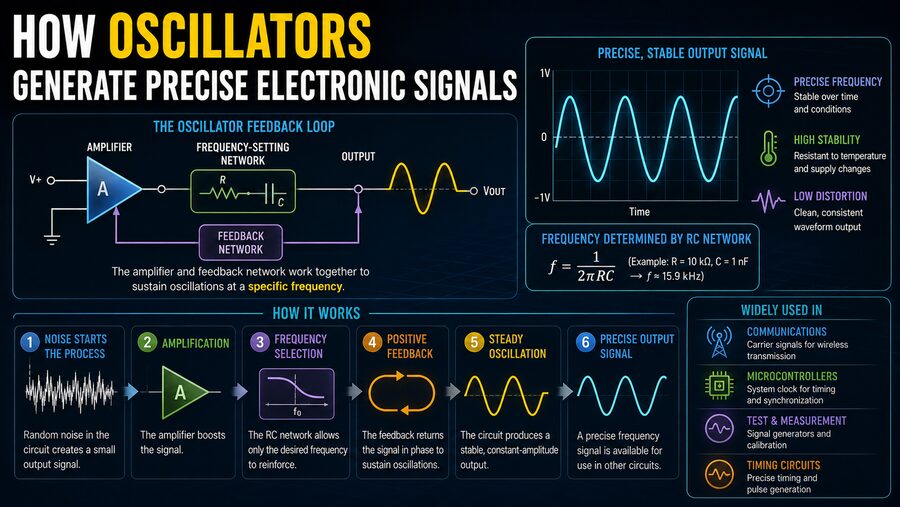
An electronic oscillator converts electrical energy from a power supply into a continuously repeating waveform without requiring a repeating external input signal. Depending on its design, an oscillator can generate sine waves, square waves, triangular waves, pulses, or other periodic signals.
The basic idea can be summarized as:
DC electrical power ➡️ oscillator circuit ➡️ repeating AC signal
But generating a signal is only part of the challenge. Many electronic systems require the oscillation to have an extremely precise and stable frequency. Achieving that precision involves feedback, resonant components, timing networks, amplifiers, and sometimes carefully manufactured quartz crystals. ⚙️🔬
🔄 What Is an Electronic Oscillation?
An oscillation is a repeating variation around some reference level.
A swinging pendulum is a mechanical example. It moves from one side to the other, repeatedly passing through its center position.
In electronics, voltage or current can behave in a similar repeating way.
For example, a sine-wave oscillator may produce a voltage that continuously changes like this:
Positive ➡️ zero ➡️ negative ➡️ zero ➡️ positive
The pattern then repeats.
The number of complete cycles that occur every second is called the frequency.
Frequency is measured in hertz (Hz).
For example:
- 1 Hz = 1 cycle per second
- 1 kHz = 1,000 cycles per second
- 1 MHz = 1,000,000 cycles per second
- 1 GHz = 1,000,000,000 cycles per second
A 10 MHz oscillator therefore produces ten million cycles every second. ⚡
⏱️ Why Frequency Matters
Frequency determines how quickly an electronic waveform repeats.
Different applications require very different frequencies.
A digital clock might use an accurately divided timing signal to measure seconds.
A microprocessor may operate with a clock frequency of several gigahertz.
A radio transmitter may require a carrier frequency in the megahertz or gigahertz range.
Audio test equipment may generate signals ranging from tens of hertz to tens of kilohertz.
Because many systems depend on precise timing, even a small frequency error can sometimes cause noticeable problems.
A poor timing reference could lead to:
- Incorrect digital communication
- Clock drift
- Radio tuning errors
- Unstable data conversion
- Timing mismatches
- Frequency inaccuracies
That is why oscillator design places strong emphasis on frequency stability. 🎯
⚙️ The Basic Components of an Oscillator
Although oscillator designs vary widely, many contain several common elements:
An amplifier
Provides gain to compensate for energy losses.
A frequency-selective network
Determines which frequency is favored.
Positive feedback
Returns part of the output signal to the input in a way that reinforces oscillation.
A power supply
Provides the energy needed to sustain the signal.
The oscillator continuously recycles part of its own output.
Conceptually:
Amplifier output ➡️ feedback network ➡️ amplifier input ➡️ output again
If the conditions are correct, the signal reinforces itself and continues oscillating. 🔁
🔁 Positive Feedback Creates Sustained Oscillation
Feedback is one of the most important ideas in oscillator operation.
In many electronic systems, negative feedback is used to reduce distortion or stabilize gain.
Oscillators, however, commonly rely on positive feedback.
With positive feedback, part of the output signal returns to the input in a phase relationship that strengthens the existing signal.
Imagine pushing someone on a swing. 🎠
If you push at exactly the right time, each push adds energy to the swinging motion.
If you push at the wrong time, you may slow the swing instead.
An oscillator works similarly. Feedback must return to the amplifier with the correct phase and sufficient amplitude to reinforce the desired frequency.
📐 The Barkhausen Criterion
A commonly taught condition for sustained oscillation is called the Barkhausen criterion.
In simplified form, sustained oscillation requires:
Loop gain ≈ 1
and
Total phase shift around the feedback loop = 0° or an integer multiple of 360°
This means that after the signal travels through the amplifier and feedback network, it returns in phase with itself.
If the returned signal reinforces the original waveform, oscillations can be maintained.
If the loop gain is too small, oscillations die away.
If it is excessively large without amplitude control, the signal may grow until the amplifier saturates and causes distortion.
Practical oscillators therefore require careful control of gain and feedback. 🧠
✨ How Oscillation Starts Without an Input Signal
An oscillator does not usually need someone to inject the first repeating waveform.
So where does the first signal come from?
The answer is often electrical noise.
All real electronic circuits contain tiny random voltage and current fluctuations caused by thermal effects, semiconductor behavior, power-up transients, and other physical processes.
When an oscillator is switched on, these tiny signals contain many frequencies.
The frequency-selective feedback network favors one particular frequency.
That frequency is amplified more strongly than the others.
It travels around the feedback loop repeatedly:
Noise ➡️ amplification ➡️ feedback ➡️ more amplification
Very quickly, one periodic signal grows until the oscillator reaches its normal operating amplitude.
The apparently spontaneous waveform therefore begins from microscopic electrical disturbances already present in the circuit. ⚡
🎵 LC Oscillators and Electrical Resonance
One common oscillator design uses an inductor (L) and a capacitor (C).
Together they form an LC resonant circuit, sometimes called a tank circuit.
The capacitor stores energy in an electric field.
The inductor stores energy in a magnetic field.
Energy can move back and forth between them:
Capacitor electric field ➡️ inductor magnetic field ➡️ capacitor electric field
This continuous exchange naturally occurs at a particular resonant frequency.
The approximate resonant frequency is:
f = 1 / (2π√LC)
where:
- f = frequency
- L = inductance
- C = capacitance
By choosing suitable values of L and C, engineers can design oscillators for particular frequencies.
LC oscillators are especially useful at radio frequencies. 📻
📻 Common Types of LC Oscillators
Several classic oscillator circuits use LC resonance.
Hartley Oscillator
A Hartley oscillator typically uses two inductive sections and one capacitor.
The inductive components establish the feedback ratio and resonant frequency.
Colpitts Oscillator
A Colpitts oscillator usually uses one inductor with two capacitors.
The capacitive divider provides feedback.
Clapp Oscillator
The Clapp oscillator is related to the Colpitts design but includes an additional capacitor that can improve frequency stability in certain applications.
These oscillator families have been widely used in radio transmitters, receivers, signal generators, and communication circuits. 📡
🔋 RC Oscillators Use Resistors and Capacitors
Not every oscillator needs an inductor.
At lower frequencies, circuits based on resistors (R) and capacitors (C) can be convenient.
An RC network introduces delays and phase shifts that can be used to establish oscillation.
One example is the RC phase-shift oscillator.
Several resistor-capacitor sections are arranged so that they introduce a total phase shift. Combined with the phase shift of an amplifier, the signal returns with the correct phase for positive feedback.
RC oscillators are commonly used for audio-frequency and lower-frequency signal generation.
🎼 The Wien Bridge Oscillator
The Wien bridge oscillator is a well-known RC oscillator capable of producing low-distortion sine waves.
It uses a frequency-selective resistor-capacitor feedback network.
At one particular frequency, the feedback network produces the correct phase and attenuation needed for oscillation.
A major design challenge is keeping the amplitude stable.
If gain is too low, oscillations fade.
If gain is too high, the amplifier clips the sine wave.
Practical Wien bridge designs use automatic gain-control techniques to maintain a clean output waveform.
Historically, such oscillators have been widely used in audio test equipment and laboratory signal generators. 🎵🔬
🔷 Crystal Oscillators Provide Much Greater Precision
For applications requiring highly stable frequency, quartz crystal oscillators are extremely important.
Quartz has a physical property called the piezoelectric effect.
When voltage is applied to a quartz crystal, the crystal can deform slightly.
Conversely, when the crystal is mechanically stressed, it can produce an electrical voltage.
Because of this relationship between electrical and mechanical behavior, a carefully cut quartz crystal can act as an extremely selective mechanical resonator.
At its natural resonant frequency, the crystal vibrates very efficiently.
This resonance can be incorporated into an electronic feedback circuit to produce a highly stable oscillator. 💎⚡
💎 Why Quartz Is So Accurate
A quartz crystal behaves somewhat like an extremely precise tuning fork.
Its dimensions, shape, cut angle, and material properties determine its resonant frequency.
Compared with ordinary resistor-capacitor networks, quartz crystals have a very high quality factor, commonly called Q.
A high-Q resonator responds very strongly near its intended frequency and much less strongly at nearby frequencies.
This sharp selectivity helps keep the oscillator frequency stable.
Quartz crystal oscillators are used in:
- Computers 💻
- Microcontrollers
- Digital watches ⌚
- Radios 📻
- Communication equipment
- Measurement instruments
- Networking hardware
- Automotive electronics 🚗
A small quartz component may therefore serve as the timing heartbeat of an entire electronic system.
⌚ Why Watches Often Use 32,768 Hz
Many digital watches use quartz crystals operating at 32,768 Hz.
This number may look unusual, but it has an elegant digital advantage.
32,768 equals:
2¹⁵
That means digital divider circuits can repeatedly divide the oscillator frequency by two:
32,768
➡️ 16,384
➡️ 8,192
➡️ …
➡️ 2
➡️ 1 Hz
After 15 divide-by-two stages, the circuit obtains a signal of exactly one cycle per second—assuming the original oscillator is accurate.
This makes 32,768 Hz especially convenient for timekeeping applications. ⏰
💻 Oscillators as Computer Clock Sources
Digital processors depend on synchronized timing.
A computer’s processor contains enormous numbers of transistors that must perform operations in a carefully coordinated sequence.
A clock oscillator provides timing pulses that help organize these operations.
The system may use a crystal oscillator as the initial reference and then multiply or divide that frequency using additional electronic circuits.
For example:
Reference oscillator ➡️ frequency synthesis ➡️ processor clock
Modern chips often use phase-locked loops (PLLs) to produce much higher internal frequencies from a stable lower-frequency reference.
A 25 MHz or 100 MHz reference oscillator may therefore help generate clock frequencies of several gigahertz inside a processor or communication chip. 💻⚡
🔒 What Is a Phase-Locked Loop?
A Phase-Locked Loop, or PLL, is an electronic control system that synchronizes an oscillator with a reference signal.
A typical PLL contains:
- A reference oscillator
- Phase detector
- Loop filter
- Voltage-controlled or digitally controlled oscillator
- Frequency divider
The system compares the oscillator’s phase with the reference.
If the generated signal is too fast or too slow, the control loop adjusts it.
Once synchronized, the oscillator is said to be locked.
PLLs are essential in:
📡 Radio communication
💻 Computer clocks
📱 Smartphones
🌐 Networking
🎥 Video systems
📶 Wireless communication
They allow one precise reference oscillator to generate many other controlled frequencies.
🎛️ Voltage-Controlled Oscillators
A Voltage-Controlled Oscillator (VCO) produces a frequency that changes in response to an input control voltage.
For example:
Higher control voltage ➡️ higher output frequency
or, depending on design:
Higher voltage ➡️ lower frequency
VCOs are important in frequency synthesizers and PLLs.
In radio systems, they can help tune transmitters and receivers electronically.
Modern integrated circuits may use related structures such as digitally controlled oscillators, where frequency is adjusted by digital commands rather than a purely analog voltage.
🔲 Oscillators Can Generate Square Waves Too
Not all oscillators produce smooth sine waves.
Digital electronics often require square waves.
A square wave rapidly switches between two voltage levels.
For example:
LOW ➡️ HIGH ➡️ LOW ➡️ HIGH
Square waves are useful because digital circuits interpret voltage levels as logical states such as 0 and 1.
One simple square-wave oscillator is the astable multivibrator.
It continuously switches between two states without requiring an external trigger.
Timer integrated circuits, transistor pairs, logic gates, and microcontroller peripherals can all be used to generate periodic square waves.
⏲️ The 555 Timer as an Oscillator
The famous 555 timer integrated circuit can operate in an astable mode to generate repeating pulses.
External resistors and a capacitor determine how quickly the capacitor charges and discharges.
As the capacitor voltage crosses internal threshold levels, the circuit switches its output state.
The cycle repeats:
Capacitor charges ➡️ threshold reached ➡️ output changes ➡️ capacitor discharges ➡️ threshold reached ➡️ output changes again
This creates a continuous rectangular waveform.
555 timer oscillators are popular in educational circuits, blinking lights, tone generators, simple timing systems, and pulse generators. 💡
🌊 Relaxation Oscillators
Oscillators based on repeated charging and discharging are often called relaxation oscillators.
A capacitor slowly accumulates electrical charge until its voltage reaches a threshold.
Then the circuit rapidly changes state and the capacitor begins discharging or charging in another direction.
Once another threshold is reached, the process reverses.
This repeating cycle can produce:
- Square waves
- Sawtooth waves
- Triangle-like waveforms
Relaxation oscillators are simpler than high-precision crystal oscillators but are useful where extreme frequency accuracy is unnecessary.
🎯 What Makes an Oscillator Precise?
A precise oscillator must resist changes caused by the environment and circuit conditions.
Important sources of frequency variation include:
- Temperature 🌡️
- Power-supply changes
- Component aging
- Mechanical vibration
- Manufacturing tolerances
- Electrical loading
- Humidity
- Noise
If a resistor changes slightly with temperature, an RC oscillator’s frequency may shift.
If the dimensions of a quartz crystal change microscopically with temperature, its resonant frequency may also shift.
Engineers therefore use special designs to improve stability.
🌡️ Temperature-Compensated Crystal Oscillators
A Temperature-Compensated Crystal Oscillator (TCXO) includes circuitry that compensates for predictable changes in crystal frequency as temperature varies.
The circuit measures or estimates temperature and applies corrections to keep the output frequency close to the intended value.
TCXOs are used in applications that require better stability than an ordinary crystal oscillator but do not justify more complex temperature-controlled systems.
Examples include communication equipment, navigation electronics, and precision embedded systems. 📡
🔥 Oven-Controlled Crystal Oscillators
For even greater frequency stability, engineers may use an Oven-Controlled Crystal Oscillator (OCXO).
Despite the name, the “oven” is a miniature temperature-controlled enclosure.
The crystal is maintained at a carefully regulated temperature so that external temperature changes have much less effect.
Keeping the crystal thermally stable significantly improves frequency accuracy.
OCXOs are used in:
- Laboratory instruments 🔬
- Communication infrastructure
- Frequency standards
- High-performance radio systems
- Precision timing equipment
They consume more power than ordinary crystal oscillators but can provide much better stability.
⚛️ Atomic Frequency Standards
When quartz is not precise enough, electronic systems can use atomic frequency standards.
Atomic clocks derive their timing reference from extremely stable energy transitions within atoms.
Cesium and rubidium are commonly associated with atomic timing technologies.
An electronic oscillator is adjusted so that its frequency remains locked to an atomic transition.
Atomic standards can achieve extraordinary stability and are used in:
- Satellite navigation 🛰️
- Scientific laboratories
- Telecommunications
- National time standards
- Precision measurement
- Synchronization networks
Even these sophisticated systems still contain electronic oscillator circuits—the atomic process simply provides an extraordinarily accurate reference.
📉 Phase Noise and Signal Purity
Frequency accuracy is not the only measure of oscillator quality.
Real oscillators contain tiny short-term variations in phase and timing.
These variations are often described as phase noise.
An ideal oscillator would concentrate all its energy at one perfectly defined frequency.
A real oscillator spreads a small amount of energy around that frequency.
Low phase noise is especially important in radio systems because excessive oscillator noise can reduce receiver sensitivity, interfere with neighboring channels, and degrade communication quality. 📡
Designing low-noise oscillators requires careful attention to resonator quality, amplifier noise, power supplies, circuit layout, and component selection.
⏳ Jitter in Digital Systems
In digital electronics, timing variations are commonly described using the term jitter.
Imagine ideal clock pulses arriving at exactly regular intervals:
|—-|—-|—-|—-|
With jitter, the edges occur slightly earlier or later:
|—|—–|—|—–|
Tiny variations may be measured in picoseconds or nanoseconds.
Too much jitter can create problems in high-speed communication links, data converters, processors, and memory interfaces.
Accurate oscillators and PLLs are therefore critical to maintaining reliable digital timing. ⏱️
📡 Oscillators in Radio Communication
Radio systems depend heavily on oscillators.
A transmitter may use an oscillator to generate a carrier frequency.
Information such as voice, music, or digital data is then used to modulate that carrier.
A receiver uses local oscillators to select, convert, and process desired radio frequencies.
For example:
Stable oscillator ➡️ carrier signal ➡️ modulation ➡️ radio transmission
If the oscillator frequency drifts too far, the transmitter may move away from its assigned channel or the receiver may struggle to tune the signal correctly.
Modern radio systems therefore use highly stable crystal references and frequency synthesizers.
🎚️ Oscillators in Signal Generators
Laboratories use instruments called signal generators to produce controlled electrical waveforms.
These devices may generate:
- Sine waves
- Square waves
- Triangle waves
- Pulses
- Radio-frequency carriers
- Modulated signals
Engineers use these signals to test amplifiers, filters, radios, sensors, communication equipment, and countless other circuits.
The quality of the internal oscillator directly affects the accuracy of the generated test signal. 🔬⚡
🚗 Oscillators Are Everywhere
Oscillators are hidden inside an enormous variety of everyday systems.
You can find them in:
📱 Smartphones
💻 Computers
⌚ Watches
🚗 Vehicles
📺 Televisions
🎮 Game consoles
📡 Wi-Fi routers
🛰️ GPS receivers
🏥 Medical equipment
🏭 Industrial controllers
🎵 Audio equipment
📷 Cameras
Whenever electronics need to measure time, generate a carrier frequency, synchronize digital operations, scan a display, process data, or coordinate communication, an oscillator is likely involved.
🧠 The Fundamental Idea
Despite the many different oscillator designs, the central principle remains surprisingly simple.
An oscillator takes electrical energy from a power source and organizes part of that energy into a repeating waveform.
Feedback keeps the oscillation going.
A resonant or timing network determines how quickly it repeats.
The amplifier replaces energy lost in the circuit.
Additional control systems stabilize the frequency and amplitude.
So a simplified oscillator can be viewed as:
Power + amplification + frequency selection + feedback = sustained electronic oscillation
Precision is then improved through components such as quartz crystals, temperature compensation, phase-locked loops, or atomic references.
🏁 Conclusion
Electronic oscillators are the timing and frequency engines of modern technology. 📡⚡
They generate repeating electrical signals by combining amplification, feedback, and a frequency-selective element. When the returned signal has the correct phase and sufficient gain, the circuit continuously reinforces a particular waveform.
Different oscillator types serve different purposes.
RC oscillators are useful for relatively simple and lower-frequency timing applications.
LC oscillators use electrical resonance and are widely suited to radio-frequency circuits.
Crystal oscillators use the mechanical resonance of quartz to achieve much greater frequency stability.
Voltage-controlled oscillators and PLLs allow frequencies to be adjusted and synchronized electronically.
For the most demanding applications, quartz oscillators can be temperature compensated, oven controlled, or ultimately referenced to atomic standards.
From the clock signal coordinating a microprocessor to the carrier frequency transmitted by a radio tower, oscillators provide the repetitive timing that keeps electronic systems organized.
Every time a processor executes instructions, a wireless device tunes a channel, a digital watch counts a second, or a network sends synchronized data, a precisely controlled electronic rhythm is working in the background. 💻📶⏱️
In that sense, the oscillator is one of electronics’ most important invisible components: a circuit whose job is simply to repeat a signal—but to repeat it with extraordinary consistency. 🔁🎯