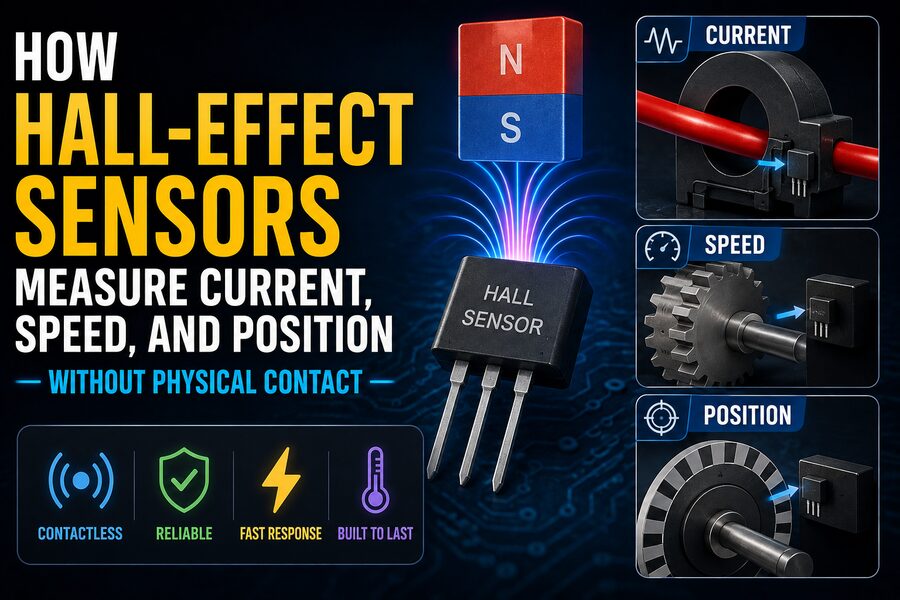

Modern machines constantly need to know what is happening around them. A motor controller may need to determine rotor position, a vehicle may need to measure wheel speed, and a power system may need to know how much electrical current is flowing through a conductor.
One technology can perform all of these jobs without requiring direct mechanical contact: the Hall-effect sensor. 🧲⚡
Hall-effect sensors detect magnetic fields and convert them into electrical signals. Because magnetic fields can pass through air, plastic housings, and many nonmagnetic materials, the sensor can often measure movement, position, or current without physically touching the object being monitored.
This contactless operation makes Hall-effect sensors extremely useful in automobiles, industrial machines, robotics, power electronics, household appliances, computers, electric vehicles, and countless embedded systems.
Their versatility comes from a simple physical phenomenon discovered more than a century ago: the Hall effect.
🧪 1. What Is the Hall Effect?
The Hall effect was discovered by American physicist Edwin Hall in 1879.
Imagine a thin piece of conductive or semiconductive material carrying an electric current.
Under normal conditions, charge carriers move through the material in a generally predictable direction.
Now place that material inside a magnetic field that is perpendicular to the current flow.
The moving charge carriers experience a force that pushes them sideways.
As charges accumulate on one side of the material, an electrical potential difference develops across it.
This voltage is called the Hall voltage.
In simplified form, the stronger the magnetic field, the larger the Hall voltage becomes.
That means a tiny electronic device can use Hall voltage to determine the presence and strength of a nearby magnetic field. 📡
⚡ 2. Why Semiconductors Are Ideal for Hall Sensors
Although the Hall effect can occur in conductors, semiconductor materials are especially useful because they can produce a relatively measurable Hall voltage.
Modern Hall sensors often use semiconductor structures integrated directly into silicon chips.
The sensing element may therefore be combined with:
- Amplifiers
- Voltage regulators
- Temperature compensation
- Signal filters
- Comparators
- Analog-to-digital converters
- Digital interfaces
This turns a small Hall element into a complete sensing system.
Instead of requiring engineers to interpret an extremely tiny raw voltage, modern sensors can provide a clean analog output or even a digital signal ready for a microcontroller. 💻
🧲 3. Hall Sensors Measure Magnetic Fields First
A Hall-effect sensor does not directly “see” current, speed, or mechanical position.
What it actually measures is magnetic field strength.
Engineers then arrange magnets, conductors, or magnetic targets so that the magnetic field changes in a predictable way with the quantity being measured.
For example:
Current creates a magnetic field around a wire.
Rotation can move magnets past the sensor.
Linear motion can change the distance between a magnet and the sensor.
Therefore, the same fundamental Hall-effect principle can be adapted to several completely different measurement tasks.
That is what makes the technology so versatile. 🔄
⚡ How Hall-Effect Sensors Measure Electrical Current
🔌 4. Every Current-Carrying Wire Produces a Magnetic Field
Whenever electrical current flows through a conductor, it creates a magnetic field around that conductor.
The strength of this magnetic field depends on the amount of current.
More current generally means a stronger magnetic field.
A Hall-effect current sensor places its sensing element where it can detect this magnetic field.
The sensor then converts magnetic field strength into an electrical output proportional to current.
This allows current to be measured without inserting a conventional resistive measurement element directly into the main current path.
That can be extremely valuable in high-current systems. ⚡
🌀 5. Using a Magnetic Core to Concentrate the Field
In many Hall current sensors, the conductor passes through or near a magnetic core.
The core concentrates the magnetic field generated by the current.
A small air gap is created in the core, and the Hall sensor is placed inside that gap.
When current increases:
- The conductor’s magnetic field becomes stronger.
- Magnetic flux through the core increases.
- The field inside the gap becomes stronger.
- The Hall voltage changes.
- Electronics convert that change into a current measurement.
Because the sensor is magnetically coupled rather than directly electrically connected to the high-current conductor, the measurement circuit can be electrically isolated.
This is known as galvanic isolation. 🛡️
🔋 6. Why Galvanic Isolation Matters
Isolation is important in systems containing dangerous or very different voltage levels.
For example, an electric vehicle battery may operate at hundreds of volts while the monitoring electronics operate at only a few volts.
A Hall-effect current sensor can measure battery current while maintaining electrical separation between the high-voltage power circuit and the low-voltage control electronics.
This improves safety and simplifies system design.
Hall current sensing is therefore commonly used in:
- Electric vehicles 🚙
- Solar inverters ☀️
- Motor drives
- Battery-management systems
- Industrial power supplies
- Charging equipment
- Uninterruptible power supplies
- Renewable-energy systems
📊 7. Open-Loop vs. Closed-Loop Hall Current Sensors
Hall current sensors can use different architectures.
🔹 Open-Loop Sensors
An open-loop sensor directly measures the magnetic field produced by the current.
The design is relatively simple and economical.
These sensors are widely used where extremely high precision is not required.
🔁 Closed-Loop Sensors
Closed-loop Hall current sensors use feedback.
The Hall element detects magnetic flux, and electronics generate an opposing magnetic field through a compensation coil.
The system attempts to cancel the original magnetic field.
The current required to create this cancellation can then be used to determine the original current.
Closed-loop designs can offer better accuracy, linearity, bandwidth, and temperature stability.
However, they are generally more complex and consume more power.
🏎️ How Hall-Effect Sensors Measure Speed
🔄 8. Turning Rotation Into Magnetic Pulses
To measure rotational speed, engineers arrange for a changing magnetic field to pass the Hall sensor repeatedly.
Consider a rotating wheel fitted with several magnets.
Every time a magnet passes the Hall sensor, the detected field changes.
The sensor generates a pulse.
If four magnets are attached to the wheel, one complete revolution may produce four pulses.
By counting how many pulses occur during a known period of time, the electronics can calculate rotational speed.
For example, if the sensor detects 400 pulses per minute and the wheel produces four pulses per revolution:
400 ÷ 4 = 100 revolutions per minute
So the wheel is turning at 100 RPM. 📈
🚗 9. Automotive Speed Measurement
Hall-effect sensors are widely used in vehicles.
They can help measure:
- Wheel speed
- Transmission shaft speed
- Engine crankshaft speed
- Camshaft speed
- Electric motor speed
- Fan speed
A toothed metal wheel or magnetic encoder may rotate near the sensor.
As each tooth, pole, or magnetic target passes, the magnetic field changes.
The sensor converts those changes into electrical pulses.
Electronic control units then calculate speed from pulse frequency.
Because there is no mechanical contact, there is very little physical wear at the sensing point. 🚘
⚙️ 10. Gear-Tooth Detection
Some speed sensors operate near a ferromagnetic gear.
A permanent magnet may be incorporated into the sensor.
As metal teeth pass the sensing face, they alter the magnetic field.
When a tooth approaches, magnetic flux changes.
When the gap between teeth passes, the flux changes again.
The Hall circuitry detects these alternating conditions and produces a digital pulse train.
This method is commonly used for rotating machinery because the gear itself can become the measurement target.
No separate mechanical switch is required.
📍 How Hall-Effect Sensors Measure Position
📏 11. Measuring Linear Position
Position sensing works by designing a system in which magnetic field strength varies with location.
Imagine a magnet attached to a moving lever.
A Hall sensor remains fixed nearby.
As the lever moves, the magnet moves closer to or farther from the sensor.
The detected field changes accordingly.
If the relationship between field strength and mechanical position is calibrated, the electronics can estimate the lever’s position.
This approach can be used for:
- Throttle position
- Pedal position
- Valve position
- Joystick position
- Door position
- Industrial actuator position
- Robotic joint position 🤖
Because the magnet and sensor do not need to touch each other, the mechanism can operate with minimal friction.
🎚️ 12. Analog Hall Sensors Provide Continuous Position Information
An analog Hall sensor produces an output voltage related to magnetic field strength.
For example, the sensor may output approximately half of its supply voltage when no magnetic field is present.
A magnetic field in one direction may increase the voltage.
A field in the opposite direction may reduce it.
This allows the system to determine both magnitude and, in some sensor designs, magnetic polarity.
Analog sensors are useful when an application needs a continuously varying measurement rather than a simple on/off indication.
A throttle sensor, for example, may need to distinguish between 10%, 40%, and 90% opening.
An analog Hall sensor can provide this type of proportional information.
🔘 13. Digital Hall Sensors Work Like Contactless Switches
Digital Hall sensors operate differently.
Instead of providing a continuously changing voltage, they switch between logical states.
For example:
Magnet detected → ON
Magnet absent → OFF
These devices can replace mechanical switches in many applications.
They are used in:
- Laptop lid detection 💻
- Door sensors
- Appliance controls
- Brushless motors
- Security systems
- Industrial limit sensing
Because there are no electrical contacts to physically open and close, Hall switches can survive millions of operating cycles.
↔️ 14. Latching Hall Sensors Remember Magnetic Polarity
Some Hall sensors are latching devices.
One magnetic polarity turns them on, while the opposite polarity turns them off.
The sensor remains in its current state even after the activating magnet moves away, until the opposite magnetic field appears.
This behavior is especially useful in brushless DC motors, where alternating magnetic poles pass the sensors as the rotor rotates.
The sensor output helps the motor controller determine when to energize different windings.
🌀 Hall Sensors Inside Brushless Motors
⚙️ 15. Determining Rotor Position
Brushless DC motors do not use mechanical brushes to switch current between windings.
Instead, electronic controllers perform the switching.
To know which winding should be energized, the controller needs information about rotor position.
Hall sensors placed inside the motor can detect the magnetic poles on the rotor.
As the rotor turns, the sensors generate a sequence of digital states.
The controller interprets these states and determines the rotor’s approximate angular position.
It then energizes the correct motor phases.
This process is called electronic commutation. ⚡🌀
Hall sensors therefore help electric motors start smoothly, rotate efficiently, and maintain correct direction.
They are widely found in:
- Electric bicycles
- Cooling fans
- Robotics
- Drones
- Industrial motors
- Automotive pumps
- Electric power steering systems
🎯 16. Hall Sensors Can Measure Angle Too
More advanced Hall sensor ICs can measure not just field strength but also the direction of the magnetic field.
A small magnet may be mounted on the end of a rotating shaft.
As the shaft turns, the magnetic field direction changes.
A multi-axis Hall sensor can measure different magnetic field components and calculate shaft angle.
This allows contactless angular measurements over a full rotation.
Applications include:
- Steering angle sensors
- Motor encoders
- Rotary knobs
- Robotic joints
- Industrial control valves
- Electronic pedals
Unlike mechanical potentiometers, these sensors do not rely on a sliding electrical contact.
That greatly reduces wear. 🔄
🧭 17. Multi-Axis Hall Sensors
Traditional Hall devices may measure magnetic flux along only one direction.
Modern integrated sensors can measure two or three axes:
- X-axis magnetic field
- Y-axis magnetic field
- Z-axis magnetic field
By combining these measurements, the sensor can determine complex magnet positions.
A 3D Hall sensor may be able to estimate:
- Distance
- Direction
- Rotation angle
- Lateral displacement
This can allow a single chip to replace several mechanical sensing components.
Such sensors are increasingly important in compact automotive, industrial, and consumer-electronics designs. 📐
🛡️ 18. Why Contactless Measurement Is Valuable
Mechanical sensors often depend on physical contact.
A traditional potentiometer, for example, uses a moving wiper sliding across a resistive surface.
Over time, friction can cause:
- Wear
- Electrical noise
- Dead spots
- Corrosion
- Mechanical failure
Hall sensors avoid many of these problems because the sensor and target can remain physically separated.
There is generally no friction between the sensing element and moving component.
This can increase reliability and lifetime, particularly in systems operating continuously.
💧 19. Sensors Can Be Sealed From Harsh Environments
Another advantage is that magnetic fields can pass through many nonmagnetic enclosures.
A Hall sensor can therefore be sealed behind plastic or another protective barrier while the magnet remains outside.
This makes it easier to protect electronics from:
- Dust
- Water
- Oil
- Chemicals
- Dirt
- Vibration
Industrial and automotive equipment often benefits from this physical isolation.
A mechanical switch might require an opening through an enclosure, while a Hall sensor can sometimes operate completely behind a sealed wall. 🛡️💧
🌡️ 20. Temperature Can Affect Accuracy
Hall sensors are highly useful, but they are not perfect.
Semiconductor characteristics change with temperature.
Permanent magnets can also produce slightly different magnetic field strengths as temperature changes.
Without compensation, these effects could introduce measurement errors.
Modern Hall sensor ICs often contain temperature-compensation circuitry.
Manufacturers calibrate the sensors so their output remains reasonably stable across a specified operating temperature range.
Automotive-grade sensors may be designed to tolerate extremely cold winter conditions as well as high temperatures found near engines or power electronics. 🌡️
⚠️ 21. External Magnetic Fields Can Cause Interference
Because Hall sensors detect magnetic fields, unwanted magnetic sources can influence measurements.
Possible interference may come from:
- Electric motors
- Large current-carrying cables
- Transformers
- Loudspeakers
- Nearby permanent magnets
Engineers reduce these effects through careful mechanical placement, magnetic shielding, calibration, differential sensing, and signal processing.
In current measurement, for example, some sensor designs measure magnetic fields at multiple locations and subtract common external interference.
Good system design is essential when precision is important.
🔌 22. Hall Sensors Can Measure Both AC and DC Current
One major advantage of Hall-effect current sensing is the ability to measure direct current as well as alternating current.
Some current transformers are excellent for AC measurement but cannot measure steady DC because they rely on changing magnetic fields.
Hall sensors can detect static magnetic fields.
Therefore, they can measure a constant battery current.
They can also follow a changing magnetic field and measure AC current.
This makes them especially useful in power electronics where both types of current may occur.
Electric vehicles are an excellent example because their batteries provide DC while motor inverters generate rapidly changing currents. 🚙⚡
📈 23. Accuracy Depends on the Entire Sensor System
A Hall sensor’s performance is influenced by much more than the Hall element itself.
Important factors include:
- Magnetic field strength
- Magnet geometry
- Distance between sensor and magnet
- Temperature
- Sensor offset
- Electronic noise
- Supply voltage
- Mechanical tolerances
- External magnetic interference
- Calibration
For precise position sensing, even a small change in the magnet-to-sensor air gap can affect the reading.
Designers therefore analyze both the electronics and the mechanical arrangement.
The sensor is only one part of the measurement system.
🚘 24. Hall Sensors Are Everywhere in Modern Vehicles
A modern automobile may contain many Hall-effect sensors.
Possible applications include:
- Crankshaft position
- Camshaft position
- Wheel speed
- Accelerator pedal position
- Steering position
- Transmission position
- Motor rotor position
- Battery current
- Seat position
- Door and latch detection
Electric and hybrid vehicles have increased the importance of magnetic sensing even further because they rely heavily on electric motors, high-current battery systems, and electronic control.
A driver may interact with dozens of Hall-based measurements without ever realizing it. 🚗🧲
🤖 25. Robotics and Automation Depend on Contactless Feedback
Robots need continuous information about motion and position.
A robotic arm may need to know the angle of every joint.
A mobile robot may need to measure wheel speed.
A gripper may need to determine whether its fingers are open or closed.
Hall sensors can provide this feedback without fragile mechanical contacts.
In factories, similar sensors can monitor:
- Conveyor speed
- Cylinder position
- Motor rotation
- Valve state
- Machine guards
- Automated actuators
Contactless sensing is especially valuable in equipment expected to operate millions of cycles with minimal maintenance. 🤖🏭
📱 26. Hall Sensors in Everyday Electronics
Hall-effect sensing is not limited to industrial equipment.
Many consumer devices use it as well.
A laptop, for example, may contain a small magnet in its screen.
When the lid closes, the magnet approaches a Hall sensor inside the body.
The sensor detects the magnetic field and tells the computer to turn off the display or enter sleep mode.
Similar designs can appear in:
- Smartphones
- Tablets
- Smart covers
- Game controllers
- Electric toothbrushes
- Kitchen appliances
- Smart-home equipment
A microscopic semiconductor sensor can effectively replace a physical switch.
✅ 27. Major Advantages of Hall-Effect Sensors
Hall sensors are widely used because they combine several valuable characteristics.
They provide contactless operation, reducing mechanical wear.
They can detect static as well as changing magnetic fields.
They can measure current without directly contacting high-voltage circuits.
They can detect speed at high rotational rates.
They can measure linear and rotational position.
They can operate through sealed nonmagnetic housings.
They can be extremely small and inexpensive.
Modern integrated versions also contain extensive signal-processing electronics.
Together, these characteristics make Hall sensing one of the most flexible technologies available to electronic designers. 🧲✨
⚖️ 28. Limitations and Engineering Tradeoffs
Hall sensors are not always the ideal choice.
Their limitations can include:
- Sensitivity to unwanted magnetic fields
- Temperature-related drift
- Magnet aging or variation
- Limited measurement distance
- Accuracy affected by mechanical alignment
- Lower precision than some specialized sensing technologies
Other measurement methods such as optical encoders, inductive sensors, current shunts, resolvers, or magnetoresistive sensors may be better for certain applications.
Engineers select the technology based on cost, accuracy, speed, environmental conditions, electrical isolation, and reliability requirements.
🧠 29. One Physical Effect, Many Measurements
The most interesting feature of the Hall effect is how one basic phenomenon can perform many jobs.
To measure current, the sensor detects the magnetic field around a conductor.
To measure speed, it counts repeating magnetic changes created by a rotating target.
To measure position, it measures how a magnetic field changes as a magnet moves.
To measure angle, advanced sensors analyze magnetic field direction.
The Hall sensor itself is always doing essentially the same thing: measuring magnetism.
Engineering converts that magnetic measurement into useful information about the physical world. 🔬➡️📊
🏁 Conclusion
Hall-effect sensors are a powerful example of how physics can eliminate the need for mechanical contact.
When current flows through a conductor, it produces a magnetic field. When a magnet rotates or moves, its magnetic field changes at the sensor. A Hall element detects those changes by producing a voltage related to the magnetic field passing through it.
Electronics then transform that tiny electrical signal into practical information.
For current sensing, Hall technology can measure electrical flow while maintaining galvanic isolation. ⚡
For speed sensing, repeated magnetic pulses reveal how quickly a wheel, shaft, or motor is rotating. 🏎️
For position sensing, changes in magnetic strength or direction reveal where a mechanical component is located. 📍
Because none of these measurements necessarily requires physical contact between the sensor and the moving or energized object, Hall sensors can operate with extremely little wear.
That makes them ideal for modern vehicles, electric motors, industrial machines, robots, power electronics, and everyday consumer devices.
From monitoring hundreds of amperes in an electric vehicle battery to detecting the closing of a laptop lid, the same fundamental principle is at work: use an invisible magnetic field as the bridge between the physical world and electronic information. 🧲💻⚡