
A wireless sensor works perfectly on the bench, then runs flat after a few weeks in the field. A handheld device feels responsive but becomes warm in a pocket. A product that was expected to last a year on one battery needs replacement far sooner.
These are not merely battery problems. They are usually system-design problems: a regulator drawing too much quiescent current, a radio staying awake, a peripheral left powered, or a battery being asked to deliver current it cannot efficiently supply.
Battery life matters because it shapes maintenance cost, reliability, user experience, enclosure size, and even safety. For an embedded device placed on a ceiling, inside a machine, or in a remote location, replacing a cell may cost far more than the cell itself.
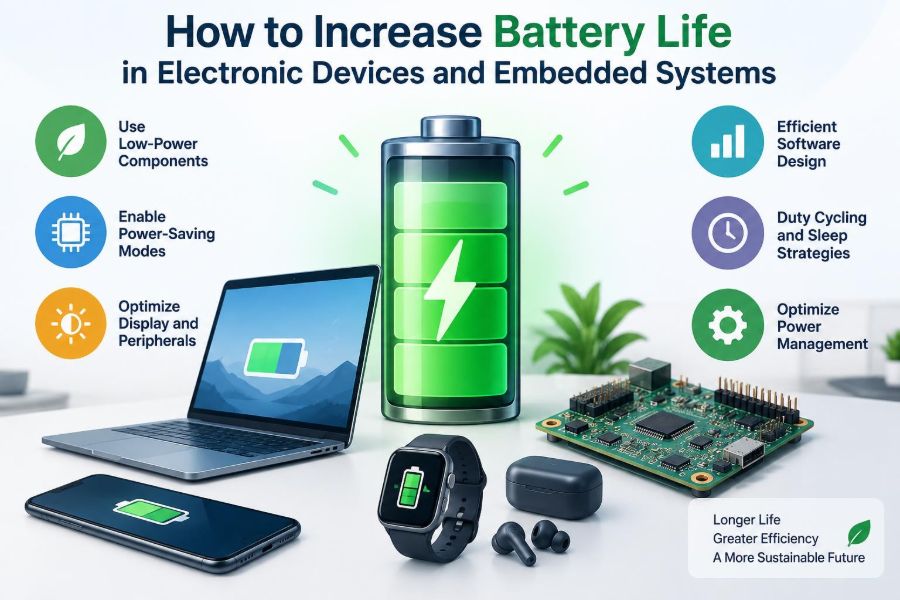
The most effective approach is not a single “low-power mode.” It is a disciplined process of understanding where energy goes, measuring real behavior, and designing hardware and firmware so that the device spends most of its life doing almost nothing.
🔋 Start With an Energy Budget
Battery capacity is commonly specified in milliampere-hours (mAh), but capacity alone does not predict operating time. A useful first estimate is battery capacity divided by average current. A 2,000 mAh battery supplying an average of 2 mA might ideally run for roughly 1,000 hours, before real-world losses are considered.
Build an energy budget early. List each operating state, its current, and how long it occurs. Include sleep, sensing, processing, transmitting, receiving, LEDs, display updates, and startup events. The average is determined by both current magnitude and time spent in each state.
📐 Understand Current, Power, and Energy
Current is the flow of charge; power is the rate at which energy is used. Electrical power is approximately P = V × I. Energy is power accumulated over time.
This distinction matters when voltages change. A regulator can make output current look modest while drawing a different current from the battery. For systems with multiple voltage rails, compare energy or battery-side current rather than evaluating each load only by its local current.
⏱️ Reduce Duty Cycle Before Optimizing Peak Current
Duty cycle is the fraction of time a function is active. A sensor consuming 5 mA for 10 ms once per second has a very different energy cost from one consuming 5 mA continuously.
Suppose a radio draws 30 mA during a 20 ms transmission every minute. Its transmission average is about 10 µA, excluding startup and receive time. Extending that active period, even with the same transmit power, can matter more than a small reduction in the 30 mA peak.
Ask a simple product question: does this task truly need to happen this often? Sampling, advertising, reporting, screen refreshes, and cloud synchronization are frequent opportunities to lower duty cycle.
😴 Make Sleep the Default State
For many battery-powered embedded products, sleep current dominates lifetime because the device spends nearly all of its time asleep. A design that wakes briefly every few minutes may accumulate far more sleep energy than active energy over months.
Use the deepest sleep mode that still preserves required wake sources, retained memory, and timing. Verify the microcontroller actually enters that mode; a debugger connection, an enabled peripheral clock, or a pending interrupt can keep a device in a shallower state than intended.
⏰ Choose Wake Sources Carefully
Every wake source has a cost. A periodic timer is predictable, but waking too frequently wastes energy. GPIO interrupts can be efficient for buttons, motion sensors, and threshold signals, provided noisy inputs do not create false wakes.
Where available, use autonomous peripheral features: a low-power timer, comparator, real-time clock, or sensor interrupt can watch for an event while the main CPU sleeps. Let hardware detect “something changed” instead of repeatedly waking software to ask.
🧠 Finish Work Quickly, Then Sleep Again
Lower clock frequency does not automatically save energy. If reduced speed makes a task take proportionally longer, total energy may remain similar or even increase because supporting circuits stay on longer.
A practical strategy is often race to sleep: run a short computation efficiently, complete it, and return to low-power sleep. This is not universal; dynamic voltage scaling can help where supply voltage and clock speed can be reduced together. Measure both approaches on the actual hardware.
📡 Treat Wireless Communication as an Energy Event
Radios are often the largest intermittent load. Transmission is costly, but receiving and listening can also consume substantial energy. A device that waits continuously for a packet may have poor battery life even if it transmits rarely.
Design the communication schedule before selecting a battery. Consider payload size, connection interval, acknowledgement policy, advertising interval, retransmissions, network availability, and the time needed to acquire or rejoin a network. Protocol configuration is part of power design, not merely connectivity setup.
📦 Send Less Data
Every byte is not equally expensive across every protocol, but reducing unnecessary traffic usually helps. Combine several readings into one report when latency permits, send only changed values, and avoid status messages that convey no new information.
Local processing can be worthwhile if it prevents expensive radio activity. For example, a vibration node may calculate a simple local feature and report an exception rather than streaming raw samples. The trade-off is that computation, memory, and validation requirements may increase.
📶 Select Transmit Power for the Real Link
Maximum radio output power is not always needed. If devices are close together with a reliable link margin, lower transmit power can reduce the energy of each message and limit interference.
However, reducing power too aggressively may increase packet loss and retries, which can consume more energy overall. Test at realistic distances, orientations, battery voltages, and obstructions. A lab link across an open desk is not equivalent to a deployed link through walls or machinery.
🎛️ Power-Gate Idle Peripherals
Sensors, amplifiers, memory chips, displays, and external modules can draw current even when the processor is asleep. If a component is needed only occasionally, use its shutdown pin or a load switch to remove power between measurements.
Power gating introduces responsibilities: allow startup time, ensure signal pins do not back-power the unpowered device, and restore configuration after wake-up. A peripheral may have a low-power mode that is simpler and safer than fully removing its supply.
🔍 Check the Entire Sensor Chain
It is easy to optimize the microcontroller while overlooking the analog front end. A precision reference, operational amplifier, voltage divider, bridge sensor, or pull-up resistor can quietly set the sleep-current floor.
For example, a permanently connected resistive divider used to monitor battery voltage consumes current continuously. Switching the divider on only while measuring, or using a much higher resistance where input leakage and ADC settling allow it, can reduce that loss.
🖥️ Manage Displays and User Feedback
Bright displays and indicator LEDs are visible energy users. Backlights, OLED panels, and repeated screen redraws can dominate portable device consumption during interaction.
Use timeouts, adaptive brightness, partial updates where supported, and event-driven display changes. An indicator LED should communicate something useful; a continuously lit “power on” LED is often an expensive status message. Keep usability in view—an unreadable dim display is not a successful optimization.
⚙️ Pick Regulators for the Actual Load Profile
Linear regulators are simple and can be excellent for small voltage drops and modest currents, but the voltage difference is dissipated as heat. Switching converters can improve conversion efficiency over suitable operating ranges, especially when input and output voltages differ substantially.
Do not choose solely by peak efficiency in a datasheet graph. Examine light-load behavior, quiescent current, dropout voltage, startup characteristics, ripple, and shutdown current. A converter that performs well at hundreds of milliamps may be a poor choice for a system sleeping at a few microamps.
🧪 Account for Quiescent Current
Quiescent current is current consumed by a regulator, supervisor, charger, or other circuit while it is operating but lightly loaded. In a low-duty-cycle design, this background current can exceed the microcontroller’s sleep current.
Read datasheets at the expected battery voltage and load. Also distinguish “enabled with no load” from true shutdown. Some devices retain internal circuits in shutdown or permit reverse current paths that defeat expectations.
🔌 Avoid Leakage and Back-Powering Paths
A supposedly off subsystem can receive power through a data pin, protection diode, pull-up, or interface cable. This is called back-powering, and it can cause mysterious current drain or unreliable startup.
Review every signal crossing a power domain. Use series resistors, isolation, correctly referenced pull-ups, or level translators when appropriate. Inputs connected to floating external circuits can also increase current or create random interrupts, so give unused pins deliberate states.
🧷 Use Pull Resistors Deliberately
A pull-up or pull-down resistor establishes a defined logic level, but it can consume static current whenever another device drives the opposite state. Internal pulls are convenient, though their resistance range may be too broad for precision current planning.
Choose the largest resistance that still meets noise immunity, rise time, leakage, and interface requirements. For slow human inputs, a high-value pull may be suitable. For a fast bus with significant capacitance, it may not be.
🌡️ Respect Temperature Effects
Battery voltage, available capacity, internal resistance, and chemical behavior all vary with temperature. Cold conditions commonly reduce the battery’s ability to deliver current, while prolonged heat can accelerate aging.
Design margins must reflect the intended environment. A device that works at room temperature can brown out during a cold radio burst because battery voltage temporarily sags under load. Test both cold starts and repeated high-current events rather than only steady operation.
🪫 Match Battery Chemistry to the Application
Different battery chemistries have different strengths. Rechargeable lithium-ion cells offer high energy density but require appropriate charging and protection. Primary lithium cells can suit long-lived low-drain devices. Alkaline cells are widely available but their voltage and useful capacity depend strongly on load and conditions.
Selection depends on more than nominal voltage. Consider pulse-current capability, self-discharge, temperature range, safety requirements, physical size, transport constraints, recharge cycles, and end-of-life behavior. Follow the battery manufacturer’s charging, discharge, and protection guidance.
📉 Design for Voltage Sag and End of Discharge
A battery is not an ideal voltage source. Its internal resistance causes voltage drop when current rises. A brief radio burst or motor startup can pull the supply below a microcontroller’s operating limit even when the battery appears acceptable at rest.
Use adequate local decoupling capacitors, but do not treat capacitors as a substitute for a capable source. Verify regulator headroom, wiring resistance, capacitor effective value, and brownout settings. Define what the device should do when energy is insufficient: save state, reduce features, report low battery, or shut down cleanly.
🧮 Measure Average Current Correctly
A handheld multimeter is valuable, but it may miss short bursts or average them inaccurately. Battery-powered systems often need a current profiler, source-measure unit, oscilloscope with a suitable current-sense method, or dedicated power analyzer.
Measure over a complete realistic cycle. Capture sleep current, wake-up, sensor stabilization, computation, radio exchange, and return to sleep. Record conditions such as supply voltage, firmware version, temperature, and network state so that comparisons remain meaningful.
📊 Separate Typical Behavior From Worst Case
Typical current helps estimate everyday life, while worst-case current determines whether the supply survives peaks. Both are necessary. A product may have excellent average consumption yet reset when a radio transmission coincides with a display update and a low battery.
| Question | Why it matters |
|---|---|
| What is the long-term average current? | Estimates operating life and maintenance interval. |
| What is the highest short-duration current? | Sizes the battery, regulator, traces, and capacitors. |
| What is the sleep current at end-of-life voltage? | Reveals background losses under difficult conditions. |
| How often do retries or faults occur? | Shows whether field behavior differs from the ideal cycle. |
🧩 Profile Firmware, Not Just Hardware
Firmware determines how long peripherals remain enabled and how often work repeats. Trace events around wake-up, sensor reads, packet handling, and sleep entry. A missed sleep call, busy-wait loop, verbose debug output, or repeated failed connection attempt can produce a major drain.
Replace polling with interrupts where practical. Avoid waiting in a tight loop for a conversion that could complete asynchronously. When polling is necessary, include a timeout and a low-power wait mechanism.
🛠️ Use Peripheral Hardware Efficiently
DMA, timers, ADC sequencers, serial controllers, and sensor FIFO buffers can move or collect data while the CPU sleeps. These features are not always free—the peripheral itself has a current cost—but they can reduce wake time and software overhead.
For example, a sensor FIFO may collect several samples before waking the host once. That can save CPU wakeups, though it also adds latency and may require enough memory to handle a batch.
🧭 Optimize Sampling for the Physical Signal
Sampling faster than the signal changes wastes energy and data. A room-temperature sensor rarely needs millisecond updates, while vibration analysis may require much faster sampling. The correct rate comes from the physical phenomenon and the decision being made.
Use thresholds, hysteresis, and adaptive schedules. A hypothetical environmental monitor might sample slowly under stable conditions, then sample more often after detecting a rapid change. Such policies should be validated so that important events are not missed.
🧱 Design the PCB for Low-Power Reliability
PCB choices affect battery life indirectly and directly. Long high-current paths create voltage drop, weak grounding can disturb analog measurements, and contamination or moisture can create leakage across high-impedance nodes.
Place decoupling capacitors close to load pins, keep pulse-current loops short, and use a solid return path. For very low-current designs, consider board cleanliness, guard techniques around sensitive nodes, and leakage through connectors or flux residue.
🔧 Control Development Features in Production
Debug interfaces, serial logging, test points, programming circuitry, and development LEDs are useful during engineering. In production, they may consume power or leave pins in unsuitable states.
Create a production power checklist. Disable unnecessary logging, remove or gate indicator LEDs, verify debugger-detached current, and test the exact firmware configuration that will ship. “Low power” measured only with a development board attached is not a final result.
⚠️ Avoid Common Battery-Life Shortcuts
Several tempting fixes fail because they target symptoms rather than energy flow.
- Increasing battery size without finding the drain can only postpone the problem.
- Choosing a “low-power” microcontroller does not help if sensors and regulators dominate current.
- Assuming datasheet sleep current applies to the complete board ignores external circuitry.
- Reducing radio power without checking retries can worsen total energy use.
- Using nominal battery capacity as a promise ignores load, temperature, aging, and cutoff voltage.
Good optimization is evidence-driven: measure, form a hypothesis, make one change, and measure again.
🧾 Build a Repeatable Power Test Plan
Power performance should be a requirement that can be tested, not a late-stage hope. Define representative use cases such as normal reporting, heavy interaction, poor network conditions, cold startup, low battery, and firmware recovery after a fault.
For each case, specify what to capture: average current over a cycle, peak current, time spent awake, successful task completion, and behavior at voltage limits. Repeating the same test after firmware or hardware changes prevents quiet regressions.
🔄 Consider Lifetime, Not Only One Charge Cycle
Long-term battery life also includes self-discharge, calendar aging, charging behavior, and the energy consumed while a device waits in storage. A product designed for years of shelf life needs exceptionally low off-state current and a battery chemistry suited to that period.
Rechargeable products need sensible charge limits, temperature handling, and user expectations around charging frequency. These choices involve safety and lifecycle trade-offs; use qualified charging circuits and follow component documentation rather than improvising battery management.
🧠 Apply a System-Level Optimization Order
A practical order prevents effort from being spent on tiny savings while a major load remains unchecked:
- Measure the complete device in real operating states.
- Eliminate unintended always-on loads and leakage paths.
- Reduce wake frequency and active duration.
- Optimize communication policy and payloads.
- Select efficient power architecture for the measured load profile.
- Validate battery behavior across voltage, temperature, and peak load.
This sequence works because architecture and duty cycle usually outweigh instruction-level micro-optimizations.
✅ The Core Principle: Minimize Useful Energy, Then Eliminate Waste
Long battery life comes from matching system activity to real needs. Measure only when a measurement can change a decision, compute only what must be computed, communicate only useful information, and keep every other circuit asleep or off.
Hardware, firmware, battery chemistry, and operating environment cannot be optimized independently. A low-power product emerges when their interactions are measured and treated as one system rather than a collection of parts.
The best battery-life improvement is usually the one that prevents energy from being needed in the first place, then verifies the result with real measurements. With a clear budget and disciplined testing, small design choices can add up to a device that lasts predictably in the field. 🔋📡⚙️