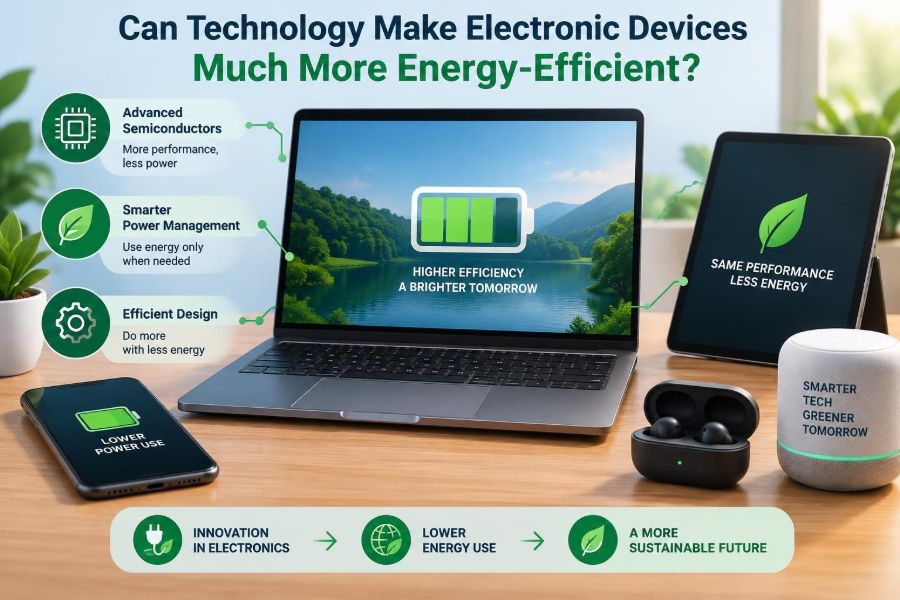

A phone left charging beside the bed, a laptop warming up during a video call, a television waiting for a remote-control signal: these ordinary moments all involve energy use that is easy to overlook. One device may seem insignificant. A home, office, factory, or data centre filled with devices is another matter.
For users, efficiency can mean longer battery life, less heat, quieter equipment, and lower electricity use. For engineers, it is also a design constraint that reaches from transistor physics to software scheduling, enclosure design, and the choice of power adapter.
Technology can make electronic devices far more energy-efficient, but it does not do so through one miracle component. Progress comes from reducing losses at every stage: converting power, processing information, moving data, lighting displays, and managing idle time.
The useful question is therefore not simply whether a product consumes less power. It is whether it delivers the required job with less energy, without creating unacceptable compromises in cost, reliability, repairability, security, or performance.
⚡ Energy Efficiency Is About Useful Work
Power is the rate at which a device uses energy, usually measured in watts. Energy is power used over time, commonly expressed in watt-hours or kilowatt-hours. A device drawing 10 watts for ten hours uses the same energy as one drawing 100 watts for one hour.
Efficiency describes how much input energy becomes useful output rather than unwanted heat, noise, or other losses. In a motor drive, useful output may be mechanical motion. In a laptop, it is harder to define: useful work includes computation, display light, network communication, and stored data.
That distinction matters because a faster device can sometimes complete a task sooner, enter a low-power state earlier, and use less total energy than a slower device.
🌡️ Where Electronic Energy Goes
Almost all energy consumed by electronics eventually becomes heat, even when the immediate output is light, sound, motion, or radio transmission. The engineering goal is to avoid producing heat too early and unnecessarily.
Common loss paths include resistance in conductors, switching losses in transistors, leakage currents, inefficient voltage conversion, display backlights, and power consumed by circuits that are awake but doing little useful work.
- Resistive loss: current flowing through a resistance produces heat.
- Switching loss: a transistor briefly dissipates energy while changing state.
- Leakage: tiny currents flow even when a transistor is intended to be off.
- Idle overhead: clocks, interfaces, memory, and sensors remain powered without a meaningful task.
🔬 Better Transistors Start the Chain
Modern electronics depend on field-effect transistors, which act as electrically controlled switches. An ideal switch would have zero resistance when on, zero leakage when off, and instantaneous transitions. Real transistors satisfy none of those conditions perfectly.
Improved transistor structures, materials, and manufacturing processes can reduce switching energy and leakage. This is one reason a newer processor may accomplish familiar tasks using less energy than an older design, even if both execute similar software.
However, smaller transistors do not automatically guarantee lower system energy. Designers may use the additional capability for more cores, higher clock rates, larger displays, or new features. Efficiency gains at component level must be protected by sensible product-level choices.
🧮 Dynamic Power Explains Why Voltage Matters
For much digital logic, dynamic power can be approximated as P ≈ αCV²f. Here, α is switching activity, C is capacitance, V is supply voltage, and f is clock frequency.
The equation is a simplified model, but its message is powerful: voltage has a squared effect. Reducing supply voltage can substantially reduce switching energy, provided the circuit still operates reliably at the required speed.
Lower voltage generally leaves less timing margin and can require lower clock frequency. Designers therefore balance responsiveness, computational throughput, and energy rather than treating frequency reduction as a universally correct answer.
⏱️ Work Faster, Then Sleep?
A common strategy is called “race to idle”: complete a burst of work quickly, then place parts of the system into a low-power state. It can work well when the sleep state is genuinely low power and the task does not require sustained high performance.
It is not a rule for every application. A processor driven at an unnecessarily high voltage may waste more energy during the burst than it saves later. Repeatedly waking hardware can also carry an energy and latency cost.
The best policy depends on workload shape. A smartwatch sampling a sensor, a server handling variable traffic, and an industrial controller running a fixed control loop need different power-management strategies.
🛌 Sleep States Save Energy Between Tasks
Devices often have several low-power states rather than a simple on/off choice. They may slow a clock, disable unused blocks, retain memory while most logic sleeps, or shut down nearly everything except a wake-up circuit.
Deeper sleep usually saves more power but takes longer to exit. If a wireless sensor must respond within a tight time window, a very deep state may be unsuitable even if it is electrically attractive.
Good design measures real wake-up patterns. A product that wakes every few seconds because of poorly designed software may obtain little benefit from sophisticated sleep hardware.
🧩 Power Gating Stops Unused Circuits
Power gating disconnects supply power from a functional block that is not needed, such as a graphics engine, audio processor, or peripheral controller. This can sharply reduce leakage compared with merely stopping its clock.
The trade-off is state loss. If a block must remember its previous contents, the system needs retention memory, saving and restoring steps, or an acceptable reinitialization delay.
Power domains also complicate physical design. Signals crossing from an active domain to a switched-off one need careful isolation, and the power-up sequence must avoid corrupting data or causing excessive inrush current.
🕰️ Clock Gating Avoids Pointless Switching
Digital circuits consume energy whenever clock signals charge and discharge capacitance. Clock gating prevents a clock from reaching registers or blocks that have no useful work to do.
It is often less disruptive than turning off a power domain because stored state remains available. Yet clock gating does not eliminate leakage, and careless implementation can introduce timing problems or glitching.
At board level, the same principle appears in a simpler form: do not keep a fast interface, converter, or sensor running continuously when periodic operation is sufficient.
🔋 Power Converters Are Not Just Accessories
Most electronics need several voltages, while batteries and wall supplies provide only one or a limited range. DC-DC converters create the required rails, and their losses affect the entire device.
A converter should be evaluated over the expected load range, not only at its peak-efficiency point. A converter that performs well near full load may be comparatively wasteful while a device is mostly asleep.
Quiescent current—the current used by the converter itself—matters greatly in battery-powered products with long idle periods. Choosing a regulator solely by its maximum current rating is a frequent design mistake.
🔌 The Power Supply Can Waste Energy Off-Device
A wall adapter converts mains electricity to a safer low-voltage DC output. Its efficiency, no-load consumption, thermal design, and compatibility with the connected product all influence total energy use.
External supplies can make products smaller and simplify replacement, but they may hide losses from the user. A low-power device paired with an oversized or poor-quality adapter can consume more standby energy than expected.
For engineers, the system boundary should include the adapter, charging cable, battery charger, and any docking hardware—not just the circuit board inside the enclosure.
🔄 Battery Charging Has Its Own Losses
Charging is not perfectly reversible. Energy is lost in the adapter, charging circuit, cable, battery internal resistance, and battery-management electronics. Heat during charging is therefore a design signal, though some warming can be normal.
Fast charging is convenient, but higher currents can increase resistive losses and thermal stress. A well-designed product controls current and voltage according to battery conditions rather than delivering maximum power continuously.
Battery longevity and energy efficiency are related but not identical. A charging policy that reduces stress may preserve usable capacity over time, while a policy optimized only for immediate speed may make a different trade-off.
🖥️ Displays Often Dominate Portable Devices
On many portable products, the display is among the largest energy consumers because it is large, bright, and active for long periods. Brightness, refresh rate, pixel technology, and displayed content can all affect its demand.
Adaptive brightness can reduce energy use when ambient light is low, but poor tuning frustrates users who must repeatedly override it. A dimmer screen is efficient only if it remains usable.
Reducing refresh rate during static content can help, while smooth animation or fast interaction may require a higher rate. The practical objective is matching display activity to what the person can actually see and needs.
📡 Wireless Links Trade Energy for Connectivity
Radio communication requires energy not only to transmit but also to listen, synchronize, scan for networks, process packets, and keep protocol state. A device with weak signal coverage may spend more energy retransmitting or increasing transmit power.
Sending data in organized bursts can allow a radio to sleep between transfers. Compressing or filtering data at the edge may also reduce transmissions, but computation itself has a cost.
For example, a remote sensor may report an hourly summary instead of transmitting every raw measurement. That choice is beneficial only if the lost detail is not needed for safety, diagnostics, or control.
🧠 Specialized Hardware Can Beat General Processing
A general-purpose CPU is flexible, but it may execute many instructions to perform a repetitive task such as video decoding, encryption, signal filtering, or machine-learning inference. A dedicated accelerator can perform the same class of work with fewer data movements and less control overhead.
This is why phones and computers often include graphics processors, media engines, digital signal processors, and neural-processing hardware. Efficiency comes from fitting the hardware structure to the calculation.
The limitation is flexibility. An accelerator may sit unused, occupy silicon area, and eventually fail to support a new algorithm. The right question is whether the expected workload is stable and common enough to justify specialization.
💾 Moving Data Can Cost More Than Computing
It is tempting to focus on arithmetic operations, but moving data between processor cores, caches, memory, storage, and networks can consume substantial energy. Long physical interconnects and repeated memory accesses are not free.
Efficient architectures exploit locality: keep frequently used data close to the unit processing it, reuse it before fetching it again, and avoid unnecessary copies between software layers.
This affects software design as much as chip design. A program that repeatedly allocates, copies, and scans large data structures may use more energy than one with a similar-looking algorithm but better memory behavior.
🧑💻 Software Can Cancel Hardware Gains
Efficient hardware cannot fully compensate for software that polls constantly, redraws unchanged screens, wakes the processor unnecessarily, or transfers excessive data. Background services are particularly significant because their cost may be spread across hours of apparent inactivity.
Energy-aware software uses event-driven design where practical. Rather than asking a device every few milliseconds whether something changed, it can wait for a meaningful interrupt or scheduled batch opportunity.
Performance profiling should be paired with power profiling. A program may feel fast while still keeping a high-performance processor state active longer than necessary.
📊 Measuring Energy Requires the Right View
Average power alone can conceal important behavior. A device may have a low average but short current spikes that overload a battery, create radio interference, or force a larger power supply.
Engineers use tools such as current probes, shunt resistors, power analyzers, thermal imaging, and software traces. Each reveals a different part of the problem: electrical draw, timing, heat distribution, or code activity.
A useful test plan includes realistic states: startup, active use, network loss, charging, sleep, peripheral connection, and error recovery. Measuring only an ideal laboratory workload often produces misleading conclusions.
📏 Choose Metrics That Match the Product
One metric cannot describe every product. A laptop may be judged by energy per completed task and battery runtime; a network switch by energy per unit of traffic; an LED driver by light output for electrical input; a sensor by energy per measurement.
| Product type | Useful efficiency question | Potentially misleading shortcut |
|---|---|---|
| Portable computer | How much energy completes a realistic workflow? | Looking only at processor power |
| IoT sensor | How much energy is used per valid measurement and report? | Ignoring sleep current |
| Display product | How much energy provides usable light and image quality? | Reducing brightness below usability |
| Server system | How much energy delivers reliable computational service? | Optimizing only peak load |
Metrics should include constraints such as response time, accuracy, reliability, and safety. Saving energy by quietly reducing the quality of the delivered service is not genuine engineering progress.
🌡️ Heat Is Both a Loss and a Reliability Issue
Heat is evidence that energy is being dissipated, but it also changes electronic behavior. Higher temperature can increase leakage, accelerate material aging, reduce battery performance, and make cooling fans work harder.
Thermal design therefore supports efficiency. Heat sinks, conductive paths, airflow, sensible component placement, and temperature-aware control can prevent a device from entering an inefficient cycle of rising temperature and increasing power demand.
Cooling itself consumes energy. The best solution is usually to reduce heat generation first, then remove unavoidable heat effectively.
🧱 Board Layout Influences Real Losses
At low currents, a circuit may look efficient on paper yet perform poorly because of layout details. Long high-current traces, undersized copper areas, poor grounding, and noisy switching loops can create voltage drops, electromagnetic interference, and extra dissipation.
Switch-mode converter layout is especially sensitive. Component placement and current-return paths affect efficiency, stability, and radiated noise together; these concerns should not be handled as unrelated late-stage fixes.
Accurate measurement points, thermal access, and provision for alternate components during prototyping also make it easier to discover where power is actually going.
🏭 Manufacturing and Embodied Energy Matter Too
Operational electricity is only part of an electronic product’s environmental impact. Materials extraction, semiconductor fabrication, display production, transport, repair, and end-of-life processing also require energy and resources.
A device that uses little power but is difficult to repair or has a very short useful life can shift rather than eliminate impacts. Conversely, a durable product may justify somewhat higher manufacturing input if it remains useful for longer—although the exact balance varies by product and use pattern.
Designers should avoid simplistic claims. Whole-life assessment requires assumptions about manufacturing, electricity sources, lifetime, maintenance, and actual use.
🛠️ Repairability Extends the Value of Efficiency
Replacing a worn battery, damaged charging port, fan, display, or power adapter can keep an otherwise capable device in service. Modular parts, accessible fasteners, available documentation, and diagnostic support make that more realistic.
Repairability has trade-offs. Sealed enclosures may improve compactness, water resistance, or structural stiffness. Good engineering recognizes these conflicts rather than pretending every product can be optimized in every direction.
Still, avoiding needless barriers to common repairs can improve the energy value delivered over a product’s working life.
🚫 Common Efficiency Mistakes
Some approaches sound sensible but fail under real conditions. The most persistent mistakes come from optimizing a single number while ignoring system behavior.
- Choosing components by peak efficiency while ignoring light-load operation.
- Reducing clock speed without considering longer task time or deeper sleep opportunities.
- Adding a feature that saves milliwatts but creates costly software wake-ups.
- Testing with a stable laboratory supply instead of a battery with real voltage and impedance behavior.
- Counting only device power and excluding chargers, displays, cooling, or network infrastructure.
- Assuming user behavior will follow the intended energy-saving mode.
These are not reasons to avoid optimization. They are reasons to define the full system and test it honestly.
🧪 Prototype With Power Budgets Early
A power budget estimates consumption for each operating mode before the design is finalized. It forces useful questions: What must remain on? How frequently does the product wake? What is the worst-case current? Which loads dominate normal use?
Early estimates will be imperfect, but they guide architecture choices while changes are still affordable. Waiting until compliance testing or final battery-life evaluation can turn an avoidable design decision into an expensive redesign.
Maintain separate budgets for active, idle, sleep, startup, and fault states. Average use matters, but worst-case conditions determine battery, wiring, thermal, and safety margins.
🔧 Practical Steps for Engineers
Energy-efficient design benefits from a repeatable workflow rather than isolated component substitutions.
- Define the useful service, performance targets, and allowed response time.
- Map every power rail and major load across operating modes.
- Measure a baseline using representative hardware, firmware, and workloads.
- Target the largest loss first, whether it is display, radio, conversion, computation, or idle current.
- Verify that changes preserve reliability, electromagnetic compatibility, thermal limits, and user experience.
- Re-measure at system level, including accessories and abnormal conditions.
This approach prevents local improvements from causing larger losses elsewhere.
🏠 Useful Actions for Device Owners
Users cannot redesign silicon, but they can reduce unnecessary energy use. Lowering screen brightness to a comfortable level, enabling sensible sleep settings, replacing failing chargers with suitable quality units, and turning off unused peripherals are practical steps.
For battery devices, excessive heat is worth avoiding. Leaving equipment in hot locations or blocking ventilation can reduce comfort and may shorten component life. Power-saving settings should be adjusted thoughtfully, however; aggressive sleep policies can interfere with backups, alarms, accessibility tools, or necessary monitoring.
The most useful choice is often keeping a suitable device working longer through maintenance and repair, rather than replacing it solely for a modest efficiency improvement.
⚖️ Efficiency Has Real Trade-Offs
Lower energy use may conflict with instant responsiveness, image quality, radio availability, data accuracy, cost, or ease of repair. A sensor that sleeps longer may miss an event. A more efficient converter may cost more or require a larger inductor. A smaller enclosure may trap heat.
Security also belongs in the discussion. Encryption and secure updates consume computational energy, but removing them to save power is usually an unacceptable design decision. Energy goals must operate within non-negotiable requirements for safety, privacy, and trustworthy operation.
The strongest designs make trade-offs visible and intentional rather than allowing them to emerge accidentally.
🌍 Efficiency Can Trigger Rebound Effects
When a task becomes cheaper in energy or cost, people and organizations may perform more of it. More efficient streaming hardware, for example, does not automatically mean lower total energy use if viewing time, display size, or video quality grows substantially.
This is sometimes called a rebound effect. It does not erase the value of efficiency; wasting less per task remains worthwhile. It does mean product-level gains should not be confused with a guaranteed reduction in total system demand.
Clear reporting of operating conditions helps decision-makers understand what has improved and what still depends on usage patterns.
🔮 Emerging Technologies Expand the Options
Wide-bandgap power semiconductors, advanced battery management, improved packaging, non-volatile memory, more capable accelerators, and lower-power wireless methods can all reduce losses in appropriate applications. New materials and architectures may widen the available design space.
Yet deployment is rarely immediate or universal. A promising technology must meet requirements for cost, supply availability, manufacturability, lifetime, safety, and compatibility with existing systems.
Engineers should separate a demonstrated capability in a controlled setting from a mature solution suited to high-volume, long-life products.
🎯 The Core Principle: Eliminate Unnecessary Energy
Technology can make electronic devices much more energy-efficient when it treats energy as a system property. Better transistors matter, but so do converters, displays, radios, software, thermal paths, charging behavior, product lifetime, and the definition of useful work.
The most durable improvements usually come from asking three questions repeatedly: What function is required? What must stay active to provide it? Where is energy being spent without improving the outcome?
Efficiency is not about making devices do less. It is about designing them to deliver the intended service with fewer avoidable losses and with honest attention to the trade-offs involved.
Electronic devices become genuinely more energy-efficient when every layer of the system is designed to avoid spending energy that does not create useful value. That principle applies equally to a tiny sensor, a phone charger, a workstation, and a large computing system. 🔋⚙️🌱