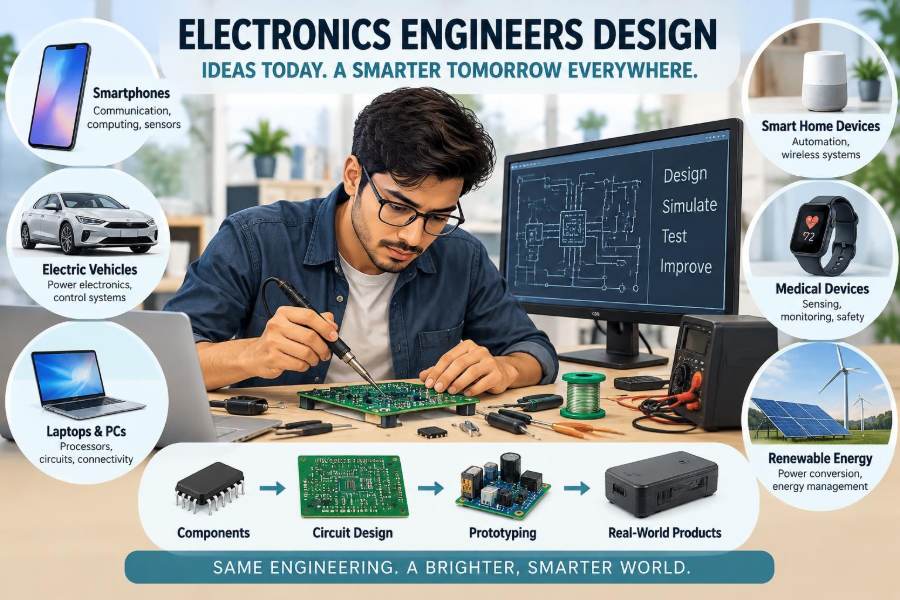

Your phone wakes you up, a coffee machine heats water to a chosen temperature, and a car quietly checks wheel speed before you pull away. These actions feel ordinary because the electronics behind them are mostly invisible.
Yet none of these products is simply “a circuit board.” Each must sense the physical world, make decisions, manage energy, communicate reliably, and continue working despite heat, noise, misuse, and aging parts.
That is the practical territory of electronics engineering. The field shapes the devices people carry, the infrastructure they depend on, and the machines that keep hospitals, factories, and homes running.
Understanding what electronics engineers actually design helps students see beyond components and helps working professionals recognize why a product succeeds or fails long before it reaches a customer.
🧭 Electronics Engineering Is System Design
Electronics engineering is the design of systems that use electrical signals and power to sense, calculate, control, store, transmit, or display information. A resistor, transistor, or microcontroller is rarely the final goal; it is a building block in a larger behavior.
An engineer designing a thermostat, for example, must connect temperature measurement to control logic, a display, user buttons, a power supply, and a switching stage for heating equipment. The useful design is the coordinated whole, not any single part.
🧱 From Component Choice to Product Behavior
A product requirement might sound simple: “measure air quality and show an alert.” Translating it into hardware requires many decisions: sensor range, calibration method, processor capability, display readability, enclosure vents, battery life, and how the device reacts to a failed sensor.
This translation from a human need into electrical and physical functions is a defining skill. Engineers constantly trade cost, accuracy, size, reliability, power consumption, and time to market.
🔋 Designing the Power Path
Every electronic product needs a safe, stable route for energy to travel from its source to each circuit. This power path may begin with a wall adapter, vehicle battery, solar panel, or rechargeable cell.
Power engineers select converters that change voltage efficiently, protect against reverse connections and overcurrent, and sequence supplies in the right order. A processor may require a tightly controlled low voltage while motors, LEDs, and radio transmitters create large changing demands on the same source.
Poor power design can cause resets, overheating, short battery life, audible noise, or permanent damage. It is one reason a prototype that works on a laboratory bench may fail in a finished product.
⚡ Battery-Powered Devices Need Energy Discipline
In wearables, wireless sensors, earbuds, and portable medical equipment, battery life is a primary design constraint. Engineers estimate current in active, idle, sleep, charging, and transmission modes rather than relying on one headline current value.
They may use low-power sensors, switch off unused circuit blocks, schedule brief radio transmissions, and choose a processor that can wake quickly. Battery chemistry, charging limits, temperature behavior, and protection circuitry also matter.
More capacity is not always the answer. A larger battery increases size, mass, cost, and charging time; reducing wasted energy can be the better system-level solution.
📡 Making Devices Communicate
Bluetooth headphones, Wi-Fi cameras, satellite receivers, industrial controllers, and smart meters all depend on communication links. Engineers decide what data must move, how quickly it must arrive, how often it can be retried, and what happens when a connection disappears.
A communication design includes more than a radio chip. It can involve antennas, filters, connectors, protocol software, error detection, security, and physical layout rules. At high frequencies, a short copper trace on a printed circuit board can behave like a transmission line rather than an ideal wire.
📶 Antennas Turn Circuits into Radio Systems
An antenna converts guided electrical energy into electromagnetic waves, and converts received waves back into electrical signals. Its size, placement, nearby metal, plastic enclosure, and ground structure affect performance.
This is why an engineer cannot always place an antenna wherever space happens to remain. A metal battery, display, cable, or user’s hand may detune it or block part of its radiation pattern. Wireless performance is therefore an electrical and mechanical integration problem.
👂 Sensors Give Products Awareness
Sensors turn temperature, motion, light, pressure, sound, position, chemicals, or magnetic fields into signals that electronics can interpret. They are central to automatic doors, fitness trackers, weather stations, robot vacuums, and safety systems.
Real sensors are imperfect. Their output may drift with temperature, vary from unit to unit, respond slowly, or pick up interference. Electronics engineers specify the sensor, condition its signal, and decide what confidence the system needs before acting.
🧹 Cleaning Up Small and Noisy Signals
Many sensor outputs are tiny compared with the electrical noise around them. An analog front end uses amplifiers, filters, bias circuits, and protection components to prepare those signals for measurement.
Consider a strain gauge in a weighing scale. The useful signal can be small, while cable movement, supply noise, and temperature changes add unwanted variation. Careful circuit design, shielding, filtering, and calibration make the reading usable.
Filtering is not a magic eraser: removing too much noise can also remove a fast event the product needs to detect. The filter must match the real behavior being measured.
🔢 Analog-to-Digital Conversion Connects Two Worlds
Physical signals are often continuous, while processors work with numbers. An analog-to-digital converter, or ADC, samples a voltage and represents it as a digital value.
Engineers choose resolution, sample rate, reference voltage, and input range based on the application. A slow room-temperature monitor and a vibration-monitoring device do not need the same approach.
The conversion process sets practical limits. If the analog signal is noisy, poorly scaled, or sampled at an unsuitable rate, more software cannot fully recover the lost information.
🧠 Embedded Systems Make Local Decisions
An embedded system is a computer built into a product for a specific function. The microcontroller in a washing machine, bike light, digital lock, or irrigation controller reads inputs and drives outputs according to programmed rules.
Electronics engineers help define the boundary between hardware and firmware. Some timing-sensitive tasks are best handled in dedicated hardware; others can be changed more easily in code. Choosing that boundary affects cost, flexibility, testing, and long-term maintenance.
⏱️ Timing Is a Functional Requirement
Not all electronics can respond “eventually.” A motor controller must react within a predictable interval, a data-acquisition device must sample at the right moment, and a vehicle safety function cannot wait for an overloaded user interface.
This is called real-time behavior. It does not always mean extreme speed; it means that a response meets a known deadline. Engineers design clocks, interrupts, task priorities, buffers, and watchdog timers to make timing behavior dependable.
🛠️ Controlling Motors, Lights, and Actuators
Outputs let electronics change the physical world. Motors move a robotic arm, valves regulate water, relays switch larger loads, and LEDs provide light or status information.
These outputs often need more current or voltage than a processor pin can supply. Driver circuits use transistors, gate drivers, isolation, and feedback to control power safely. A motor also generates electrical disturbances when switching, so protection and layout are part of the design.
🚗 Electronics Inside Modern Vehicles
Vehicles contain many electronic control units that manage functions such as engine operation, braking support, lighting, cabin comfort, displays, battery supervision, and driver-assistance sensing. These systems exchange information over vehicle networks rather than operating as isolated boxes.
Automotive electronics must tolerate vibration, electrical transients, heat, moisture, and long service lives. A consumer gadget can often restart after a fault; a vehicle function may require controlled degradation, diagnostic reporting, or a safe fallback state.
🏥 Medical Electronics Demand Clear Boundaries
Medical devices can include monitors, imaging equipment, infusion systems, rehabilitation tools, laboratory instruments, and wearable measurement devices. Their design requires careful attention to measurement accuracy, electrical safety, alarms, usability, and traceability.
Not every health-related gadget provides a clinical measurement. Engineers and product teams must be precise about intended use and validation. Where a device influences care, the consequences of false readings, missed alarms, or confusing interfaces must be considered explicitly.
🏭 Factories Depend on Rugged Control
Industrial electronics operate pumps, conveyor systems, packaging machines, programmable controllers, sensors, and machine-vision equipment. Their environment may include dust, vibration, electromagnetic interference, and large motors switching nearby.
Industrial design often favors serviceability and predictable operation over extreme miniaturization. Clear terminal labeling, replaceable modules, electrical isolation, fault indicators, and long-term component availability can matter more than a sleek enclosure.
🏠 Smart Homes Are Networks of Trade-Offs
A smart thermostat, door sensor, lighting controller, or energy monitor combines sensing, connectivity, software, and user experience. The convenience comes from coordination, but each connected feature creates questions about setup, updates, privacy, and failure modes.
A good smart-home product should remain understandable when the internet is unavailable. For example, a light switch should still provide basic local control even if a cloud service cannot be reached.
🖥️ Displays Are an Interface, Not Decoration
Displays, indicator LEDs, buzzers, buttons, touch sensors, and haptic motors communicate a product’s state to people. Electronics engineers work with industrial and user-interface teams to ensure these interfaces are electrically reliable and physically practical.
A bright screen can improve outdoor readability but shorten battery life. A warning buzzer must be audible in the intended environment without becoming needlessly disruptive. Small choices in feedback often determine whether a device feels trustworthy.
🧩 Printed Circuit Boards Are Physical Designs
A printed circuit board, or PCB, mechanically holds components and electrically connects them through copper layers. PCB design is not just drawing lines between pins; placement, return-current paths, heat flow, manufacturing limits, and service access all affect performance.
Keeping a sensitive analog trace away from a switching power stage can reduce interference. Providing test points can make production diagnosis faster. Leaving adequate spacing around high-voltage conductors can support safety and reliability.
🌡️ Heat Can Quietly Limit Performance
Electrical power that is not converted into useful work often becomes heat. Regulators, processors, power transistors, LEDs, and batteries all have temperature limits that influence their operation and lifespan.
Thermal design may use copper areas on the PCB, heat sinks, airflow, enclosure vents, temperature sensors, or power reduction under heavy load. The difficult part is evaluating the complete product: a component that stays cool on an open bench may overheat inside a sealed enclosure on a hot day.
🛡️ Protection Is Designed In, Not Added Later
Real users connect the wrong charger, drop products, expose them to static electricity, or operate them near electrically noisy equipment. Electronic designs need protection against foreseeable misuse and environmental stress.
- Fuses or electronic current limits can reduce damage during faults.
- Transient suppressors can limit damaging voltage spikes.
- Reverse-polarity protection can help when a supply is connected incorrectly.
- Isolation can separate hazardous or noisy circuits from sensitive low-voltage sections.
Protection has limits and costs. The goal is not to make a device invulnerable, but to identify credible hazards and create appropriate defenses.
📣 Electromagnetic Compatibility Prevents Interference
Electromagnetic compatibility, often abbreviated EMC, means a product should operate acceptably in its electromagnetic environment without causing unacceptable interference to other equipment.
Fast digital edges, switching converters, motors, and radios can radiate or conduct noise. Meanwhile, nearby transmitters, static discharges, and power disturbances can upset the product. Grounding, shielding, filtering, cable treatment, and PCB layout are common tools, but they work best when considered early.
✅ Verification Answers “Does It Work?”
Verification checks whether a design meets its stated requirements. Engineers measure voltages, inspect signals with oscilloscopes, test communications, exercise software, and compare behavior against specifications.
Good verification includes edge cases: low battery, extreme input values, a disconnected sensor, a blocked motor, repeated button presses, or a brief power interruption. Normal operation alone says little about how a product behaves when conditions become inconvenient.
🧪 Validation Answers “Is It the Right Product?”
Validation is different from verification. A verified device may faithfully meet an unclear or incomplete requirement. Validation asks whether the finished system actually serves the intended user and application.
For instance, a portable monitor might measure correctly on a bench but be hard to read with gloves, too slow to set up, or ambiguous when an alarm occurs. Observing realistic use reveals needs that circuit tests may miss.
📏 Requirements Keep Design Decisions Traceable
Strong engineering begins with requirements that are specific enough to test. “Low power” is a preference; “operate for the intended duty cycle from the selected battery under defined conditions” is closer to an engineering requirement.
Requirements also connect design choices to evidence. When a part changes or a fault is found, traceability helps teams identify which functions, tests, documents, and risks may be affected.
⚖️ Cost, Performance, and Reliability Pull in Different Directions
There is rarely one objectively best circuit. A lower-cost component may have less margin at temperature. A more accurate sensor may consume more power. Adding redundancy can improve fault tolerance while increasing complexity and test effort.
| Design priority | Typical question | Possible trade-off |
|---|---|---|
| Low cost | Can the function use fewer or simpler parts? | Less margin, flexibility, or service life |
| Low power | What can sleep or switch off? | Slower response or reduced features |
| High accuracy | What errors must be controlled? | More calibration, cost, or processing |
| High reliability | How does the product handle faults? | More parts and validation effort |
The engineer’s job is to make these trade-offs visible and suitable for the actual application.
🔍 Debugging Means Building Evidence
When a prototype misbehaves, guessing can waste days. Effective debugging starts by observing the fault, making it repeatable where possible, and changing one variable at a time.
Useful questions include: Is power stable? Is the clock running? Does the signal exist at the source? Does it arrive at the destination? Did hardware, firmware, environment, or assembly change? Measurement tools are valuable because they replace assumptions with evidence.
🚧 Common Early-Career Mistakes
New designers often focus on the main functional path and overlook the conditions around it. A circuit may read a sensor perfectly while ignoring connector wear, startup behavior, test access, thermal limits, or production variation.
- Choosing parts before defining measurable requirements.
- Copying a reference circuit without understanding its assumptions.
- Leaving EMC, protection, and mechanical constraints until the end.
- Testing only one prototype in one friendly environment.
- Treating documentation as separate from engineering work.
These are normal learning points, not signs that someone lacks ability. The remedy is a more disciplined design process and earlier review.
🤝 Electronics Engineers Work Across Disciplines
A successful product needs collaboration with mechanical engineers, firmware developers, manufacturing teams, test engineers, industrial designers, quality specialists, and sometimes domain experts in areas such as energy or healthcare.
Mechanical decisions can alter antenna performance and cooling. Firmware can change processor load and power demand. Manufacturing feedback may reveal that a difficult assembly step will create inconsistent quality. Clear interfaces and respectful communication are engineering skills, not administrative extras.
📚 Skills That Transfer Across Industries
Tools and component families change, but several foundations remain useful: circuit analysis, signal integrity, measurement, programming awareness, control concepts, PCB layout, documentation, and structured problem solving.
Students benefit from projects that include the unglamorous parts: selecting connectors, writing a test plan, measuring current, handling faults, and revising a board after discovering an error. Working professionals benefit from keeping these fundamentals sharp while learning the constraints of their industry.
🌍 Designing for a Product’s Full Life
Electronics design affects sourcing, assembly, shipping, repair, software support, and end-of-life handling. A tightly packed device may be compact but difficult to repair; a long-lived product may need alternatives for components that become unavailable.
Designers can reduce avoidable waste through durable connectors, sensible modularity, accessible diagnostics, efficient power use, and choices that consider service rather than only first-time assembly.
🔐 Connected Products Need Thoughtful Security
When a device communicates or receives updates, security becomes a design concern. Hardware can support secure identity storage, controlled debug access, trusted startup, and safer update mechanisms, while software implements protocols and policies.
Security is not a feature added by a single chip. It depends on realistic threat modeling, maintenance plans, sensible defaults, and avoiding unnecessary exposure. The appropriate level of protection depends on what the device controls, stores, and connects to.
🧠 The Core Idea: Design the Whole Experience
Electronics engineers design far more than schematics. They turn physical needs into systems that sense, decide, communicate, and act under real constraints.
The strongest designs account for normal use and awkward reality: low batteries, electrical noise, heat, confusing inputs, aging parts, production variation, and unexpected user behavior. They also make trade-offs deliberately rather than discovering them after release.
Whether the product is a humble charger, a factory controller, or a medical instrument, the core principle is the same: good electronics engineering connects sound circuit decisions to safe, useful, reliable behavior in the real world.
Once you start looking for that connection, everyday objects stop being black boxes and become carefully negotiated systems of energy, information, materials, and human needs. 🔌⚙️📱