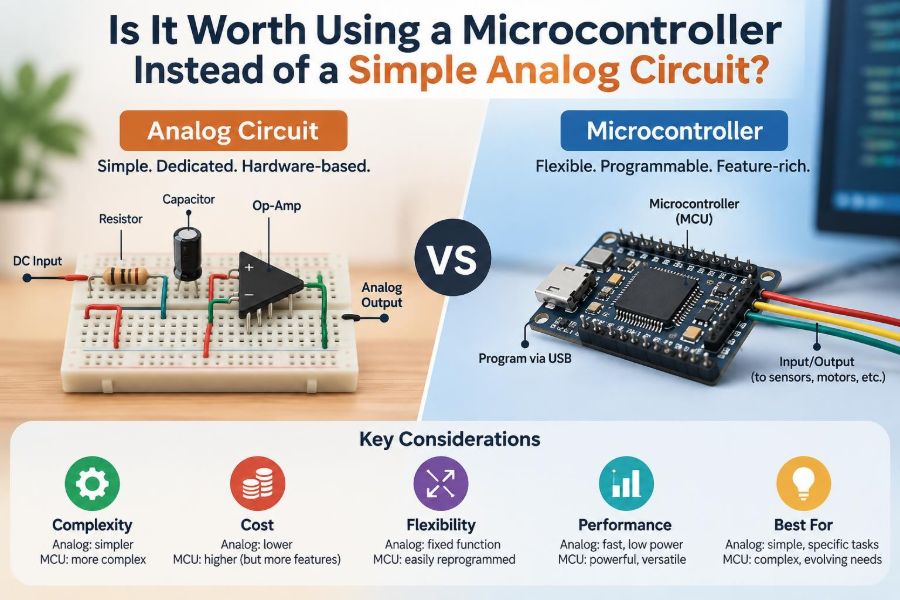

A temperature-controlled fan, a night light, a battery indicator, and a timed garden pump can all begin with the same deceptively simple question: should this be built from analog components, or should a microcontroller run it?
The modern instinct is often to add a small programmable chip. Microcontrollers are inexpensive, familiar, and able to perform tasks that once needed several dedicated integrated circuits. But a tiny program is not automatically the simplest or most reliable answer.
At the other extreme, an analog circuit can seem old-fashioned until it solves a job with a handful of passive components, starts instantly, and continues working for years without firmware, clocks, or software updates.
The best choice depends less on what is fashionable than on what the circuit must sense, decide, control, survive, and communicate. Understanding that boundary is a valuable design skill for students and practicing engineers alike.
🧭 Start With the Actual Job
Before choosing a component, describe the required behavior in plain language. “Turn a fan on when a heatsink gets hot” is a very different job from “adjust fan speed according to temperature, log faults, communicate status, and apply different limits in several operating modes.”
A simple requirement usually favors a simple implementation. A changing or multi-stage requirement may justify programmability, but only if the extra behavior provides real value.
⚖️ The Fundamental Difference
An analog circuit represents information as continuously varying voltage, current, charge, or frequency. A thermistor and comparator, for example, can convert temperature into a switching decision without executing instructions.
A microcontroller is a compact digital computer. It samples inputs, runs stored firmware, and drives outputs according to a sequence of programmed decisions. It normally needs a power supply, reset behavior, clock source, and a way to load code.
🔁 One Decision or Many Decisions?
If the whole product needs one stable threshold decision, analog is often compelling. A comparator can determine whether a sensor voltage is above or below a reference, then switch a transistor or relay driver.
When the decision depends on several inputs, changing conditions, time, or user settings, a microcontroller becomes more attractive. Its advantage is not merely “being digital”; it is that complicated logic can be changed without rebuilding the circuit.
🌡️ A Useful Thermostat Example
Consider a fan that should turn on at a chosen temperature and turn off after the temperature falls. A thermistor, resistor network, comparator, and positive feedback can form an effective analog thermostat.
The positive feedback creates hysteresis: separate turn-on and turn-off thresholds. Without it, sensor noise or a slowly changing temperature can make the output chatter around one threshold.
If the fan must instead follow a speed curve, ignore brief hot spikes, remember a fault, and transmit temperature data, firmware may be the cleaner solution.
🧩 What Analog Does Exceptionally Well
Analog circuits are particularly strong when a physical quantity must be conditioned, filtered, amplified, regulated, or compared. Real sensors and actuators are fundamentally analog even when a later stage digitizes their signals.
- Voltage regulation and current limiting
- Amplifying weak sensor signals
- Filtering noise or removing unwanted frequency content
- Generating simple thresholds and window detectors
- Driving loads with immediate hardware response
These functions do not become inherently better because a processor is nearby. Often, a microcontroller depends on analog support circuitry to perform them properly.
🧠 What Microcontrollers Do Exceptionally Well
A microcontroller is most valuable when behavior is algorithmic. It can count, sequence, calculate, store settings, interpret protocols, and apply logic that would otherwise require many logic ICs, timers, counters, and state machines.
- Reading multiple sensors and combining their conditions
- Controlling displays, menus, buttons, and user settings
- Implementing timed sequences and schedules
- Logging events or error conditions
- Communicating through UART, I²C, SPI, CAN, USB, or wireless modules
The key benefit is flexibility. A revised timing rule may require a firmware change rather than a redesigned board.
💰 Compare the Whole Bill of Materials
It is tempting to compare the price of one microcontroller with one operational amplifier or comparator. That comparison is rarely meaningful. The real question is the cost of the complete circuit around each choice.
A microcontroller may need programming access, decoupling capacitors, a reset network, clock components in some cases, level shifting, and protection. An analog solution may need precision resistors, a reference, several ICs, or component trimming.
At production volume, assembly complexity and test time also matter. At prototype volume, development time can be the larger cost.
🛠️ Development Time Is an Engineering Cost
A familiar microcontroller can produce a quick proof of concept. Reading an ADC channel and toggling an output may take little time when the development environment is already established.
But software is not free after the first demonstration. It needs design, review, debugging, programming, version control, test coverage, and maintenance. A four-component analog solution can be faster overall when its behavior is genuinely sufficient.
📏 Accuracy Is Not Automatically Digital
A microcontroller’s ADC converts voltage into numeric codes, but those codes are only as trustworthy as the reference voltage, sensor conditioning, layout, calibration, and noise environment. A 12-bit converter does not automatically provide 12 bits of usable measurement accuracy.
Likewise, analog circuits can be very accurate when designed with appropriate references, low-offset amplifiers, stable resistors, and calibration. The appropriate choice follows the required tolerance, operating range, and drift over time.
🎚️ Resolution, Noise, and Quantization
Analog signals vary continuously, while an ADC represents them in discrete steps. That limitation is called quantization. If a sensor’s meaningful change is smaller than one ADC code, the reading may appear to jump between values.
Noise can also move readings across a decision boundary. Firmware can average samples, apply digital filtering, or use a dead band. Yet an analog low-pass filter near a noisy sensor may be necessary before the ADC sees the signal at all.
⏱️ Response Time and Determinism
An analog comparator can react in a predictable hardware path, often with extremely low delay relative to ordinary control tasks. This matters in fast protection circuits, switching power supplies, and signal-conditioning paths.
A microcontroller has sampling intervals, interrupt latency, execution time, and possible software blocking. These are manageable when designed deliberately, but they are not zero. A control loop must be fast enough for the physical system it controls.
🛡️ Safety Functions Should Not Depend on Hope
For an overheating battery, overcurrent condition, or other potentially damaging event, a hardware protection path is frequently appropriate even if a microcontroller provides normal control. A comparator can disable a driver when a hard limit is exceeded.
This does not mean every product needs redundant hardware. It means the consequence of delayed, incorrect, or absent firmware must be assessed honestly. A software-controlled cutoff is not equivalent to an independent hardware cutoff if the processor can hang or misread an input.
⚡ Startup Behavior Matters
An analog threshold circuit can often become active as soon as supply conditions are valid. A microcontroller must power up, leave reset, initialize pins, and start its application code. During that interval, output pins may have default states that are unsuitable for the attached hardware.
Designers should define what every load does during startup, brownout, reset, and firmware update. Pull-up or pull-down resistors, enable pins, and external supervisors can prevent an unintended motor start or relay activation.
🔋 Sleep Current and Battery Life
Modern microcontrollers can consume very little current in carefully configured sleep modes, waking periodically or on an external event. This makes them practical in many battery devices.
However, the entire system determines battery life. Sensor bias networks, voltage regulators, indicator LEDs, radio modules, and poorly chosen pull resistors can consume much more than the sleeping processor.
An analog circuit may draw almost no quiescent current in one application, while another analog design using an amplifier and voltage reference may not. Measure or calculate the actual operating states rather than assuming either approach wins.
🧮 Timing: RC Networks Versus Clocks
A resistor-capacitor, or RC, network can create a delay, oscillator, or simple pulse. It is economical and perfectly adequate for noncritical timing such as a soft turn-on delay.
Its timing varies with component tolerance, temperature, leakage, and supply conditions. A microcontroller with a suitable clock source can offer repeatable schedules, elapsed-time measurement, and adjustable timing, although its oscillator also has a finite accuracy.
🧷 Component Tolerances Change Analog Behavior
Every resistor, capacitor, sensor, and semiconductor has tolerances. In an analog threshold circuit, these variations directly shift voltages, delays, gains, and switching points.
This is not a flaw unique to analog design; it is a normal physical design constraint. The remedy may be tolerance analysis, stable components, a calibration point, wider allowable limits, or a different architecture.
A microcontroller can compensate for some variation through calibration tables, but it cannot eliminate sensor error or a poor reference by arithmetic alone.
🧾 Firmware Creates a Different Kind of Complexity
With analog circuits, complexity is visible in the schematic: more functions usually mean more components and connections. With microcontrollers, physical hardware may look simpler while complexity moves into code and system states.
Consider debouncing a button, handling a stuck sensor, recovering after a power interruption, avoiding integer overflow, and dealing with a disconnected communication cable. These cases need explicit firmware behavior, even when the normal operation seems simple.
🐛 Failure Modes Are Different, Not Absent
Analog circuits can fail through drift, noise sensitivity, damaged components, marginal stability, or an incorrectly chosen threshold. Microcontroller systems add risks such as firmware bugs, corrupted configuration, unexpected reset causes, and peripheral configuration mistakes.
A watchdog timer can reset code that stops servicing it, but it is not a universal cure. If firmware continues running in an incorrect state while feeding the watchdog, the fault can remain.
📡 Connectivity Changes the Decision
If a device must send data, accept configuration, support a display, or join a larger control system, a microcontroller is usually the natural center of the design. Protocol handling and data formatting are digital tasks.
Even then, avoid assigning every function to firmware by default. An external analog current limit, input filter, or emergency shutdown can reduce risk and free the processor for tasks where it adds value.
🎛️ User Adjustment and Product Variants
A potentiometer makes an analog threshold adjustable, but it is a physical control with wear, range limits, and possible accidental movement. Firmware can store settings, expose menus, enforce sensible limits, and provide several modes.
This is especially useful when one hardware platform supports several product variants. Different control curves or operating limits may be selected during production without changing resistor values or board layout.
🏭 Manufacturing and Calibration
Analog products sometimes require trimming because component spread moves a critical threshold. Trimming may use a potentiometer, laser-trimmed resistor network, selected parts, or a production calibration procedure.
Microcontroller products can store calibration constants in nonvolatile memory after measurement. That flexibility is useful, but it requires a controlled programming and verification process. A calibration method must also address what happens if memory is erased or data becomes invalid.
🧪 Testing Must Match the Architecture
An analog design should be tested across supply voltage, temperature, input range, and component tolerance where practical. Checking only one nominal condition can hide a marginal threshold or oscillation problem.
Firmware-based products require both hardware and behavioral testing. Test normal operation, power cycling, invalid inputs, communication loss, configuration boundaries, and recovery from faults. The fact that code compiles says almost nothing about system-level correctness.
📐 PCB Layout Is Part of the Circuit
High-impedance analog nodes, low-level sensor traces, switching loads, and ADC references need thoughtful placement and return-current paths. A noisy motor driver sharing a poor ground path with a sensor can defeat either analog or digital logic.
For microcontrollers, place decoupling capacitors close to supply pins and avoid treating the ADC reference as an afterthought. For analog circuits, protect sensitive inputs from coupled noise and make feedback paths short and intentional.
🔀 The Best Answer Is Often Hybrid
Many robust products use analog and digital sections for their natural roles. An analog front end may filter and scale a sensor. A microcontroller may interpret that signal, run a control algorithm, and report status. Independent hardware may enforce a final safety limit.
This arrangement is not a compromise born of indecision. It recognizes that physical signals, software decisions, and fault protection have different demands.
| Requirement | Often a strong first choice | Reason |
|---|---|---|
| One fixed threshold | Comparator-based analog circuit | Low part count and immediate response |
| Several modes and adjustable rules | Microcontroller | Logic can change in firmware |
| Precise sensor measurement | Hybrid | Analog conditioning plus digital processing |
| Critical hard cutoff | Hardware protection path | Can act independently of normal code |
| Logging or communication | Microcontroller | Data storage and protocols are digital tasks |
🪜 A Practical Selection Process
Rather than choosing from habit, work through the requirement in a deliberate order:
- Define inputs, outputs, ranges, timing, and acceptable error.
- List normal states and abnormal states, including power-up and sensor failure.
- Identify any action that must occur even if software fails.
- Estimate the full component count, development effort, and test burden for both options.
- Build or simulate the riskiest part first: noise, timing, control stability, or power consumption.
- Choose the simplest architecture that meets the complete requirement with margin.
This process prevents the common mistake of optimizing only the first prototype.
🚫 Mistake: Digitizing a Signal Too Early
Some designs send a raw, noisy, high-impedance sensor output directly to an ADC and expect firmware to repair everything. Sampling cannot reliably recover information that was distorted by poor biasing, aliasing, or interference before conversion.
Use appropriate analog conditioning first: buffering, scaling, filtering, protection, and a suitable reference. The microcontroller can then work with a signal that represents the physical quantity more faithfully.
🚫 Mistake: Building a Large Analog State Machine
The opposite error is extending analog circuitry far beyond its natural simplicity. A design with numerous comparators, timer circuits, flip-flops, diode logic, and adjustment points may work, but become difficult to modify or troubleshoot.
When requirements include sequences, exceptions, user modes, or evolving rules, a small state machine in firmware may reduce total complexity substantially.
🔍 Ask About Future Changes Honestly
“We might want features later” is not by itself a reason to add a microcontroller. It can lead to unnecessary cost, software obligations, and unused hardware.
But likely, specific changes deserve weight: a known future communication interface, several customer-configurable settings, or an evolving control algorithm. Design for realistic change, not vague possibility.
📚 Learning Value for Students
Students should resist treating analog and embedded programming as competing subjects. Building a comparator, an RC timer, and a transistor driver teaches how voltage, current, saturation, hysteresis, and tolerances behave in the physical world.
Programming a microcontroller teaches state handling, timing, interfaces, data representation, and debugging. Strong engineers understand enough of both domains to decide where each belongs.
🔧 A Compact Rule of Thumb
Use a simple analog circuit when the task is local, stable, fast, and well defined: one or a few analog signals produce one predictable action. Use a microcontroller when the task involves logic, timing, communication, calculation, stored settings, or expected behavioral changes.
Use a hybrid architecture when a real-world signal needs careful analog treatment but the product also benefits from digital decisions. For protection functions, consider whether an independent hardware path is warranted by the consequence of failure.
🏁 The Core Design Principle
The question is not whether a microcontroller is more advanced than analog circuitry. It is whether its programmability solves a real problem more effectively than the added power, software, startup, test, and failure-mode responsibilities it introduces.
Likewise, simplicity is not measured by the number of visible components alone. A circuit is simple when its behavior is understandable, testable, maintainable, and appropriate for the conditions it will actually face.
Choose the architecture that meets the full requirement with the least unnecessary complexity—and let analog hardware and firmware each do the work they are best suited to do. 🔌🧠⚙️