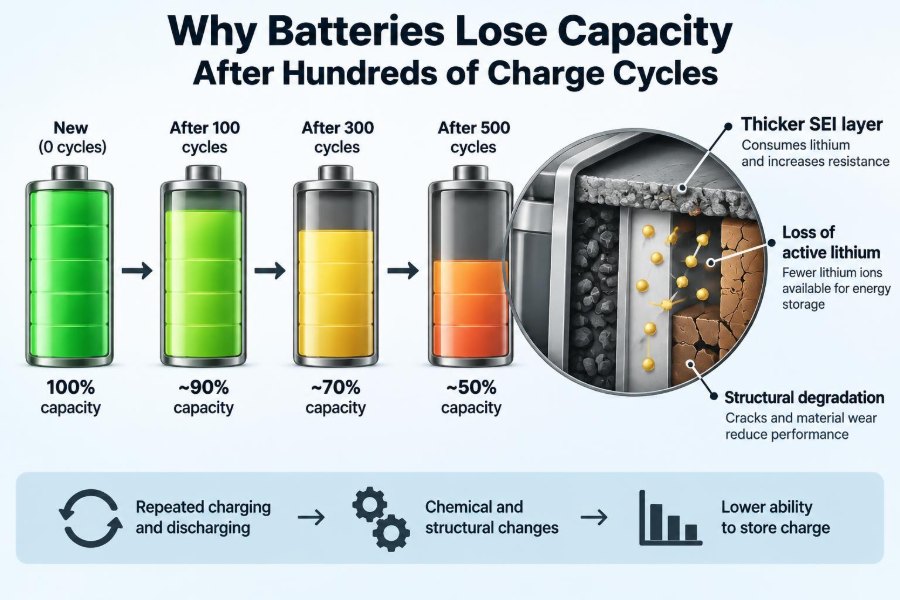

Your phone used to last through a full day. Now, after a couple of years, it may need an afternoon recharge even though you use the same apps and keep the same brightness settings. The battery has not simply “forgotten” how to charge; its internal chemistry has changed.
The same pattern appears in laptops, cordless tools, electric vehicles, backup power systems, and even industrial battery banks. Each application has a different duty cycle, but all rechargeable batteries face limits set by materials, temperature, voltage, and time.
Capacity loss matters because it affects runtime, performance, charging behavior, replacement cost, and safety margins. For engineers, it also determines how large a battery pack must be at the beginning of a product’s life.
Understanding battery aging starts with one useful correction: a charge cycle is not a single switch-like event. It is a measure of energy moved through a battery, while degradation is the accumulated result of many physical and chemical processes.
🔋 Capacity Is Not the Same as Charge Level
A battery’s state of charge tells us how full it is at a moment in time. Its capacity is the total charge it can store and later deliver under stated conditions.
A new cell may deliver a specified capacity at room temperature and a moderate discharge current. After aging, it reaches the same “100%” display indication but stores less energy, so it empties sooner.
⚡ What a Charge Cycle Actually Means
One full equivalent cycle means energy equal to the battery’s rated usable capacity has been removed and replaced. It does not require one uninterrupted discharge from 100% to 0%.
For example, two 50% discharges followed by recharging roughly equal one full equivalent cycle. Battery-management systems may count cycles differently, but this energy-throughput idea explains why frequent partial charging still contributes to wear.
🧪 The Basic Chemistry Behind Rechargeable Cells
Most portable electronics use lithium-ion cells. During discharge, lithium ions move through the electrolyte from the negative electrode, commonly graphite, toward a metal-oxide or phosphate positive electrode. Electrons travel through the external circuit and power the device.
Charging reverses that motion. Ideally, ions repeatedly enter and leave electrode structures without changing them permanently. In reality, every cycle creates opportunities for small side reactions and mechanical damage.
🧱 Electrodes Are Active Materials, Not Solid Blocks
Battery electrodes are porous composite layers. They contain active particles, conductive additives, binders, and microscopic pathways filled with electrolyte. Their useful area is far larger than their visible geometric area.
As a cell ages, some of those pathways become less effective. Particles can crack, electrically disconnect, or become coated with reaction products. Material may remain physically inside the cell but no longer participate fully in storing energy.
🛡️ The Protective SEI Layer Has a Cost
On the graphite negative electrode, electrolyte molecules react during early charging and form a thin passivation film called the solid-electrolyte interphase, or SEI. This film is necessary because it slows continued electrolyte breakdown while still allowing lithium ions to pass.
The difficulty is that the SEI can continue growing or reform after damage. Its formation consumes cyclable lithium and increases resistance, reducing both available capacity and power capability.
🔄 Why Cycling Rebuilds Interfaces
As lithium moves in and out, electrode particles expand and contract. The amount depends on the electrode chemistry and operating range, but repeated dimensional change strains particles, binders, and protective surface films.
Small cracks expose fresh surface to the electrolyte. New SEI then forms on that fresh surface, consuming more lithium. This feedback loop is one reason capacity fade is rarely perfectly linear over the life of a battery.
📉 Loss of Lithium Inventory Reduces Runtime
Not all lithium in a cell remains available for shuttling between electrodes. Some becomes trapped in SEI compounds, other reaction products, or electrically isolated regions.
This is called loss of lithium inventory. Think of it as fewer usable players in a relay race: both electrodes may still exist, but the system cannot transfer as much charge from one side to the other.
🧩 Loss of Active Material Creates Another Limit
Capacity can also fall because electrode material itself becomes unavailable. Cracked particles, dissolved transition metals, degraded binders, and damaged conductive networks can isolate parts of an electrode.
This differs from lithium inventory loss. Adding lithium would not restore a particle that has lost electrical contact. Real cells often experience both mechanisms at the same time, in changing proportions.
🌡️ Heat Accelerates Undesired Reactions
Higher temperature usually speeds chemical reactions, including unwanted ones. Heat can accelerate electrolyte decomposition, SEI growth, gas generation, and degradation of electrode surfaces.
A battery used heavily in a hot car, enclosed charger, or poorly ventilated equipment cabinet may age much faster than the same battery operated near moderate room temperature. Heat also raises safety concerns when a cell is already damaged or abused.
❄️ Cold Changes Performance and Charging Risk
Cold temperatures slow ion movement through the electrolyte and electrodes. A cold battery can appear to have lower capacity because voltage drops more under load, causing the device to reach its cutoff voltage earlier.
Charging lithium-ion cells when they are very cold is especially problematic. If ions cannot enter graphite quickly enough, metallic lithium can deposit on the negative electrode instead of intercalating into it. Manufacturers therefore impose temperature limits on charging.
🔌 High Voltage Stresses the Positive Electrode
Keeping a lithium-ion cell near its upper voltage limit increases chemical stress. At high state of charge, electrode materials and electrolyte are generally more reactive, particularly in many high-energy cell designs.
This does not mean that fully charging a consumer device is inherently wrong; devices are designed to do it. It means that long periods at maximum charge, especially when warm, can add more calendar-aging stress than storage at a moderate charge level.
🪫 Deep Discharge Has Limits Too
Very low state of charge can also be stressful, especially if a cell remains empty for a long period. Self-discharge and the small current used by protection electronics may push individual cells below their preferred voltage range.
Battery packs include protection circuits to prevent severe over-discharge, but they are not a reason to store equipment indefinitely at zero. A device that will sit unused is usually better stored according to its manufacturer’s guidance.
🏎️ Fast Charging Raises Local Stress
Fast charging requires a high current, often described by a higher C-rate. That current creates greater voltage gradients, more resistive heating, and more difficulty moving ions uniformly through porous electrodes.
Modern fast-charge systems manage these risks with temperature monitoring, controlled current profiles, and conservative limits near full charge. Even so, repeated high-power charging can be more demanding than slower charging, particularly in hot or cold conditions.
🔋 High Discharge Current Can Hide Capacity
A battery may still contain chemical energy but be unable to deliver it at the required rate. Internal resistance causes voltage sag under heavy load, and the device may shut down when voltage reaches its lower limit.
This is why a worn power-tool battery may seem acceptable while driving a light load but fail quickly during drilling. The apparent capacity depends partly on the load, not only on the cell’s stored charge.
📈 Rising Internal Resistance Changes the Experience
Aging usually increases internal resistance, the opposition to current flow within the cell. Resistance produces voltage drop during discharge and heat during charging or high-power use.
Capacity fade and resistance growth are related but not identical. A cell can retain a reasonable amount of low-current capacity while becoming unsuitable for applications that need bursts of power, such as acceleration in an electric vehicle.
🗓️ Calendar Aging Happens Without Cycling
Batteries age even when they are not used. This is called calendar aging, and it is driven largely by time, temperature, and state of charge.
A spare battery stored for a year in a warm location can lose capability without completing meaningful charge cycles. For this reason, cycle count alone is an incomplete measure of battery health.
🧮 Cycle Aging and Calendar Aging Interact
It is tempting to ask whether a battery is worn out because of age or cycles. In practice, both processes overlap. A delivery vehicle may accumulate cycle wear quickly, while an emergency backup pack may be dominated by calendar aging.
The harshest conditions compound the effects: high temperature, high average state of charge, deep cycling, and high current all increase the likelihood that degradation mechanisms will progress together.
📊 Depth of Discharge Matters
Depth of discharge is the fraction of usable capacity removed before recharging. A shallow cycle removes less energy than a deep cycle, but many shallow cycles can still add up to substantial throughput.
For many lithium-ion systems, operating in a narrower middle range can reduce electrode stress compared with repeatedly traversing the entire available range. The exact benefit depends on cell chemistry, voltage limits, temperature, and the manufacturer’s control strategy.
🧠 Battery Management Systems Set Practical Limits
A battery-management system, or BMS, monitors voltage, current, and temperature. In multi-cell packs, it may also balance cells so one weaker cell does not reach a damaging voltage limit before the others.
The “0%” and “100%” shown to a user are often buffered away from the cell’s absolute electrochemical limits. These hidden reserves trade a little usable energy for longer life, safety, and more reliable operation.
⚖️ Cell Balancing Prevents the Weakest Cell from Dominating
Cells in a series string are never perfectly identical. Small differences in capacity, resistance, and self-discharge grow more significant as the pack ages.
Without balancing, one cell might become full first during charging or empty first during discharge. The BMS must then limit the whole pack to protect that cell, making the pack seem to lose capacity sooner than its average cells would suggest.
🏭 Manufacturing Variation Affects Aging Paths
Even cells with the same label can age differently because of small variation in materials, coating thickness, electrolyte filling, formation processing, and storage history. Pack assembly and thermal design add further variation.
This is why responsible engineering uses testing and margins instead of assuming every cell will match a datasheet’s typical behavior. A single weak cell can influence the performance of a series-connected pack.
🚗 Different Battery Chemistries Trade Energy for Longevity
“Lithium-ion” describes a family, not one chemistry. Nickel-rich layered oxides, lithium iron phosphate, lithium titanate, and other designs differ in voltage, energy density, low-temperature behavior, power capability, and aging characteristics.
| Battery type | Typical strength | Common aging consideration |
|---|---|---|
| Lithium-ion, high-energy variants | Compact energy storage | High voltage and heat can be demanding |
| Lithium iron phosphate | Durability and thermal robustness | Lower voltage changes pack design requirements |
| Nickel-metal hydride | Established rechargeable technology | Self-discharge and heat affect practical availability |
| Lead-acid | Low cost and high surge current | Deep discharge and partial-charge operation can be harmful |
No chemistry escapes aging. Design choices shift which compromises are most prominent.
🧯 Lithium Plating Is a Serious Failure Mechanism
Lithium plating occurs when metallic lithium deposits on the negative electrode during charging rather than entering the graphite structure. It is more likely with cold cells, aggressive charging, high state of charge, or cells with elevated resistance.
Some plated lithium may become electrically isolated, causing capacity loss. In unfavorable cases, metallic deposits can contribute to internal fault risk. This is one reason charging algorithms reduce current under difficult conditions.
💨 Swelling Signals Gas-Producing Reactions
A swollen pouch cell or bulging device case can indicate gas generation from internal chemical reactions. Swelling is not a cosmetic issue: it can mechanically damage a device and indicates that the battery should be handled cautiously.
Do not puncture, compress, bend, or continue charging a visibly swollen battery. Follow local guidance and the product manufacturer’s instructions for safe service or recycling; damaged lithium-ion batteries should not go into ordinary household waste.
📱 Why Percentage Indicators Sometimes Seem Wrong
Battery percentage is an estimate produced from voltage, current integration, temperature, and learned behavior. Voltage alone is not enough because it changes with load, temperature, and internal resistance.
After aging, the estimate can drift if the device has not recently observed a known full or low endpoint under suitable conditions. A sudden percentage drop may reflect estimation error, voltage sag, or genuine loss of available capacity.
🔍 Capacity Testing Requires Controlled Conditions
To measure capacity properly, technicians charge a battery using the specified profile, stabilize it as required, then discharge it at a controlled current to a defined cutoff voltage. The discharged ampere-hours or watt-hours are then recorded.
A quick real-world runtime test is useful but less precise because screen brightness, workload, temperature, and peak current vary. Comparing results only makes sense when the conditions are similar.
🧰 Practical Habits That Reduce Unnecessary Wear
You cannot eliminate chemical aging, but you can avoid conditions that accelerate it. The best routine is usually simple and compatible with normal use.
- Avoid leaving batteries in hot vehicles or against persistent heat sources.
- Use chargers and cables intended for the device or compliant with its charging requirements.
- Allow a very cold battery to warm within its approved operating range before charging.
- For long storage, follow manufacturer guidance; moderate charge and cool, dry conditions are commonly preferable to full charge in heat.
- Use available charge-limit or adaptive-charging features when a device spends long periods connected to power.
🚫 Common Battery Care Myths
Modern lithium-ion batteries do not need regular deliberate full discharges to avoid a classic “memory effect.” Repeatedly draining them to zero is not a calibration ritual and can add avoidable stress.
Another myth is that every overnight charge is automatically harmful. Well-designed devices stop active charging at their target level and manage power afterward. The more relevant concern is prolonged time near full charge while warm, not the clock striking midnight.
🔧 When Replacement Is the Sensible Engineering Choice
Battery replacement becomes reasonable when runtime no longer supports the application, voltage sag causes shutdowns, charging behavior becomes unreliable, or the pack shows physical damage. In critical equipment, replacement schedules may be based on tested capacity rather than waiting for failure.
Use compatible, reputable replacement parts and follow service procedures. Packs contain stored energy and protective electronics; improvised repairs, mismatched cells, and bypassed protection circuits create risks that outweigh modest cost savings.
🏗️ Designing Products for a Battery’s Whole Life
Engineers can improve usable life with thermal paths, conservative voltage windows, accurate state estimation, cell balancing, serviceable pack design, and charging profiles suited to the cell chemistry. The best design target is not always maximum initial runtime.
A slightly larger pack operated less deeply, or a pack with better cooling and intelligent charge limits, may retain useful performance longer. These choices involve cost, mass, volume, user expectations, and the intended duty cycle.
🌍 Aging Also Shapes Sustainability
Longer usable battery life can reduce replacement frequency and delay material recovery demands. However, extending service life should never mean using unsafe or severely degraded cells.
Collection and recycling remain essential because batteries contain valuable materials and can create fire hazards if crushed or improperly discarded. Product design that allows safe removal and identification supports both repair and responsible end-of-life processing.
🎯 The Core Principle Behind Capacity Fade
Batteries lose capacity after hundreds of cycles because charging and discharging are not perfectly reversible. Each cycle can consume a little active lithium, alter electrode surfaces, strain particles, and raise internal resistance; time and temperature continue the process even when the battery is idle.
The practical lesson is not to obsess over every percentage point. Manage the big stressors: excessive heat, unsuitable charging temperatures, long hot periods at maximum charge, and unnecessary high-current operation. Let the BMS do its job, while recognizing that it cannot repeal chemistry.
A rechargeable battery is a consumable electrochemical component, and thoughtful operating conditions slow its aging rather than stopping it. That perspective helps users set realistic expectations and helps engineers design systems that stay useful for longer. 🔋⚙️🌡️