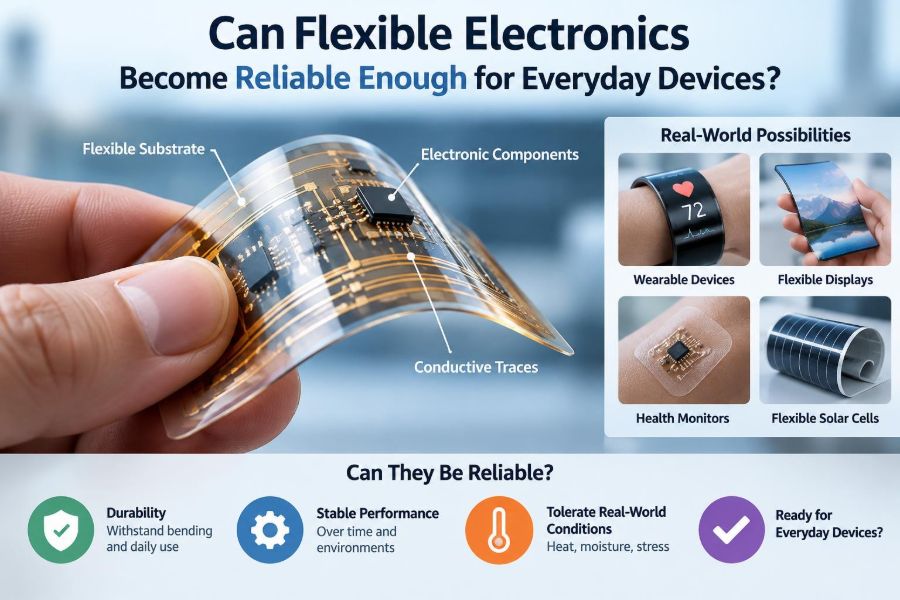

A fitness band survives thousands of wrist bends. A phone display is expected to remain flawless after being folded, slipped into a pocket, warmed by charging, and exposed to everyday moisture. A medical skin patch may need to keep measuring a signal while its wearer walks, sweats, and sleeps.
These are not simply questions of making electronics thin. They ask whether circuits, sensors, batteries, and protective layers can keep working when the surface beneath them bends, twists, stretches, or creases.
Flexible electronics already appear in familiar products, especially curved displays, wearable sensors, and flexible printed circuits inside compact devices. But everyday reliability is a much higher bar than demonstrating a flexible prototype in a controlled laboratory.
The short answer is that flexible electronics can be reliable enough for many everyday uses, but only when engineers match the materials, mechanical design, and intended motion carefully. The difficult cases are not “can it bend once?” but “can it bend unpredictably for years without losing electrical or environmental protection?”
🧩 What Flexible Electronics Actually Means
Flexible electronics are electronic systems built on substrates that can bend without permanently damaging their electrical function. A substrate is the supporting base layer, replacing the rigid glass, ceramic, or fiberglass board used in conventional electronics.
Flexibility is a spectrum. A circuit that gently conforms to a curved housing is very different from a display designed to fold sharply along the same line each day. Flexible does not automatically mean stretchable, foldable, or soft.
- Flexible: bends over a relatively broad radius.
- Foldable: tolerates repeated bending around a designed hinge or crease.
- Stretchable: elongates and returns toward its original shape.
- Conformable: follows a curved or uneven surface, such as skin.
📱 Why Everyday Devices Raise the Reliability Bar
Consumer devices are handled in ways that test equipment rarely predicts perfectly. They are dropped, squeezed in bags, left in hot cars, charged while warm, and exposed to skin oils, humidity, and dust.
A flexible sensor used once in a controlled environment may be useful even if its output drifts modestly. A smartwatch sensor, foldable display, or automotive surface control must remain predictable through many ordinary interactions. Reliability therefore includes performance, appearance, safety, and user confidence.
🏗️ The Basic Layer Stack
Most flexible electronic products are layered structures. A typical stack may include a polymer substrate, patterned conductive traces, insulating layers, active devices such as transistors or sensors, adhesive films, and an outer protective cover.
Each layer can have a different stiffness and thermal expansion rate. When the stack bends, those mismatches create internal stress. A device usually fails at its interfaces or weak points rather than because every material fails at once.
🧱 Rigid Boards Still Have an Advantage
Traditional printed circuit boards are rigid for useful reasons. Their glass-reinforced structure holds components in stable positions, their solder joints see limited movement, and their enclosures can provide robust environmental sealing.
Flexible circuits trade some of that natural stability for reduced thickness, lower weight, and geometric freedom. This is often worthwhile, but it shifts engineering effort from a simple board-and-case design toward detailed control of strain, adhesion, routing, and sealing.
📐 Bending Creates Strain
When a layered strip bends, the outer surface stretches while the inner surface compresses. The amount of deformation experienced by a layer is called strain. Excessive strain can crack a brittle conductor, separate an adhesive interface, or alter a sensitive semiconductor layer.
The smaller the bend radius, the more severe the strain near the surface. Folding a sheet around a sharp edge is therefore much harsher than curving it gently around a wrist.
A useful mental model is a stack of paper. The outer sheet travels farther around a bend than the sheet in the middle. Electronic layers behave similarly, though their different stiffnesses make the real behavior more complex.
🎯 The Neutral Plane Design Strategy
In a bent structure, there is a region through the thickness that experiences little or no tension or compression. Engineers call this the neutral mechanical plane.
Placing fragile layers near that plane can sharply reduce the strain they experience. This may involve adding balancing layers, choosing adhesive thicknesses carefully, or arranging the stack so brittle semiconductor films are closer to the mechanical center.
It is an elegant solution, but not a universal one. The neutral plane can shift as materials age, adhesives soften with heat, or the device is pressed and twisted rather than bent in an ideal curve.
🧪 Materials Determine the Starting Point
Polyimide films are widely used for flexible circuit substrates because they tolerate heat and remain mechanically stable. Other polymers may be selected for transparency, low cost, softness, or compatibility with roll-to-roll manufacturing.
Materials must be evaluated as a system. A very elastic substrate does not solve the problem if the deposited conductor is brittle, the adhesive absorbs moisture, or the cover layer scratches easily. The most fragile layer often sets the product’s real limit.
⚡ Conductors Are Not All Equally Flexible
Copper carries current efficiently and is common in flexible printed circuits. Yet thin copper traces can fatigue when repeatedly bent, particularly at corners, narrow necks, vias, or transitions into stiff component areas.
Other approaches include conductive inks, metal meshes, ultrathin metal films, and liquid-metal systems. These can improve flexibility or optical transparency, but may introduce higher resistance, more complicated manufacturing, or challenges with long-term stability.
The correct choice depends on the job. A power path for a battery has different resistance and safety needs from a low-current touch sensor trace.
🔁 Fatigue Is Usually the Long-Term Enemy
A material can survive one bend that looks dramatic and still fail after many smaller bends. This progressive damage is called mechanical fatigue. Tiny defects can grow with each cycle until a trace opens, a contact resistance rises, or a crack becomes visible.
Fatigue is strongly affected by bend radius, bend direction, temperature, surface flaws, and how consistently the movement occurs. Repeated folding in precisely the same location is particularly demanding because the damage concentrates rather than spreading across the surface.
🪢 Twisting and Creasing Are Worse Than Simple Bending
Test videos often show a device bending smoothly around a cylinder. Real use can be less orderly. A phone may twist in a pocket, a wearable may be stretched while being fastened, and a cable-like section may be pinched.
A crease is especially damaging because it creates a localized, sharp deformation. Product designers need to consider misuse patterns, not only the graceful motion shown in promotional demonstrations.
🔩 Stiff Components Create Stress Hotspots
Integrated circuits, resistors, camera modules, connectors, and batteries are much stiffer than a polymer film. Their edges become stress concentrators when the surrounding flexible region moves.
A reliable design usually creates stiff “islands” for components and flexible “bridges” between them. The bending zone should not run directly beneath a large chip or a conventional solder joint unless that region has been designed specifically to accommodate the strain.
🛤️ Trace Routing Is a Mechanical Decision
On a rigid board, route layout is largely about electrical performance, manufacturing, and available space. On a flex circuit, trace geometry also affects mechanical life.
- Curved routes generally distribute stress better than sharp 90-degree turns.
- Traces should avoid the highest-strain axis where possible.
- Wider conductors reduce electrical resistance but may resist bending more strongly.
- Gradual transitions near stiff regions reduce abrupt stress changes.
These choices need electrical and mechanical engineers working together early. Fixing a fatigued trace after tooling is far more expensive than adjusting its route during layout.
🧷 Interconnects Often Fail Before the Circuit
The connection between a flexible circuit and a rigid board, display driver, battery tab, or connector is a frequent reliability concern. Solder joints and plated holes are not naturally suited to repeated flexing.
Designers commonly keep interconnects away from moving zones, provide strain relief, and reinforce transition areas. An electronic assembly may have excellent flexible traces yet still fail because its connector peels, its solder joint cracks, or its bonding film delaminates.
🖥️ Foldable Displays Show the Full Challenge
A foldable display combines several demanding systems: a display backplane, touch sensing, optical layers, adhesives, a cover window, and a hinge. Every layer must bend predictably while preserving brightness, touch accuracy, and a smooth visual surface.
The visible crease is not merely cosmetic. It reflects a compromise among bend radius, cover-layer behavior, hinge geometry, and the need to keep strain within acceptable limits. Better hinge control can reduce stress, but it adds mechanical complexity and potential entry paths for debris.
🪟 The Cover Layer Must Protect Without Becoming Rigid
The outermost surface faces scratches, fingernails, cleaning chemicals, and impacts. Traditional glass offers excellent hardness, but thick glass does not fold readily. Very thin glass can bend, while polymer cover films can be highly flexible, but each approach brings trade-offs.
A softer cover can be more prone to surface marking. A harder cover can constrain the bend. Coatings may improve scratch resistance, yet coatings themselves can crack if their mechanical behavior does not match the layer beneath.
💧 Moisture Can Cause Slow, Hidden Damage
Water vapor can diffuse through polymers and adhesive layers even when a product appears sealed. Moisture may corrode conductors, change dielectric properties, weaken adhesion, or affect sensitive organic and electrochemical materials.
Flexible products cannot always rely on thick, rigid enclosures for protection. They often need thin barrier films, carefully sealed edges, and material combinations that remain stable across humidity changes. A pinhole or imperfect edge seal can become a long-term reliability path.
🌡️ Heat and Thermal Expansion Add Stress
Devices warm during charging, processing, and exposure to sunlight. Materials expand as temperature rises, but not all by the same amount. This mismatch can pull at interfaces and increase stress near conductors or active layers.
Thermal cycling is therefore meaningful even for a product that is rarely flexed. Combining heat with bending is more realistic still, because polymers may soften while some adhesives lose stiffness or creep under sustained load.
🔋 Flexible Power Is Still a Careful Design Area
A flexible device needs energy storage or a power connection that matches its intended motion. Thin batteries may tolerate limited curvature, but they are not necessarily designed for sharp folds, punctures, or repeated deformation in arbitrary locations.
Battery protection deserves special attention because mechanical damage can become a safety issue, not just a performance issue. Engineers often isolate the battery in a protected rigid or semi-rigid area while allowing other parts of the product to flex.
Fully deformable energy storage is an active area of development, but product claims must be interpreted carefully: a battery described as flexible may permit gentle bending during installation rather than repeated folding during use.
📡 Antennas Change When the Device Changes Shape
Wireless antennas depend on geometry, nearby conductors, and surrounding materials. Bending or placing a device against the body can shift antenna tuning and reduce radio efficiency.
This is one reason a flexible wearable is a system-level problem. A circuit can remain electrically continuous while its wireless connection becomes less consistent because the product’s shape, orientation, or proximity to skin has changed.
🧍 Wearables Have a Special Advantage and a Special Risk
Wearables benefit from flexibility because close contact can improve comfort and, for some sensors, improve measurement quality. A skin-contact patch that conforms well may reduce motion gaps compared with a rigid sensor housing.
But the body introduces sweat, motion, lotions, repeated cleaning, and user-to-user variation. The same flexibility that improves contact can also expose the device to stretching and peeling forces. Comfort and durability have to be designed together.
🩺 Medical and Consumer Claims Need Different Caution
Flexible sensors can be useful in wellness products, sports tracking, and clinical research. However, a sensor’s physical flexibility does not by itself establish the accuracy, safety, or clinical usefulness of its readings.
For health-related applications, reliable electronics is only one part of the question. Signal processing, calibration, skin contact, user instructions, and the intended use all matter. A device suitable for general trend monitoring may not be suitable for diagnosis or treatment decisions.
🏭 Manufacturing Can Create Defects Before First Use
Thin films and flexible substrates are vulnerable to wrinkles, particles, alignment errors, incomplete curing, and microscopic cracks introduced during fabrication. Some defects are obvious; others only become apparent after thermal or mechanical cycling.
Roll-to-roll processing can manufacture flexible layers efficiently by moving material through continuous production equipment. It is promising for scale, but maintaining uniform deposition, registration, and inspection across large areas is demanding.
🔍 Reliability Testing Must Mimic Real Life
A credible test plan does more than count bend cycles. It considers the expected motion, radius, speed, temperature, humidity, loading, and failure consequence for the specific product.
Useful test categories
- Bend and fold cycling: repeated motion at representative radii and locations.
- Torsion and compression: twisting, squeezing, and localized pressure.
- Thermal and humidity exposure: checking expansion, corrosion, and barrier performance.
- Drop and impact testing: assessing damage from ordinary handling events.
- Electrical monitoring: detecting resistance changes, intermittent opens, display defects, or sensor drift during stress.
Accelerated testing is valuable, but it is not a perfect time machine. Higher temperature or faster cycling may activate failure mechanisms that differ from normal use, so results need engineering interpretation.
📊 A High Cycle Count Is Not the Whole Story
Consumers often see durability expressed as a number of folds or bends. That number can be informative only if the conditions are clear. A broad-radius, carefully aligned fold in a clean test fixture is different from a sharp, off-axis fold with dust present.
Reliability should be judged through a fuller question: what motion does the product tolerate, at what location, under what environment, while maintaining which functions? A single impressive metric cannot describe every real-world failure mode.
🧠 Software Can Mask or Reveal Hardware Aging
Some flexible systems can compensate for gradual sensor drift through calibration or signal processing. Software may also identify intermittent connections, warn about abnormal charging behavior, or adapt display behavior around damaged pixels.
That does not mean software can repair a cracked conductor or failed moisture barrier. Good diagnostics are useful because they reveal degradation early, but they should complement robust mechanical design rather than excuse weak hardware.
🛠️ Design Choices That Improve Everyday Durability
Reliable flexible products tend to make movement intentional. They define where bending should occur, protect vulnerable areas, and avoid asking every layer to perform every job.
- Use a controlled hinge or bend zone rather than allowing random creasing.
- Keep chips, solder joints, and connectors outside high-strain regions.
- Provide strain relief at cable exits and rigid-to-flex transitions.
- Select barrier layers and edge seals for the expected moisture exposure.
- Test combined stresses, such as bending while warm or exposed to sweat.
- Design repairable modules where replacement is practical.
🚫 Common Assumptions That Lead to Weak Products
One common mistake is treating flexibility as a material property alone. A soft substrate does not guarantee a durable product if the conductor, coating, component attachment, or enclosure is poorly matched.
Another is designing for the ideal user. Everyday devices must anticipate uneven folding, accidental pressure, partial peeling, contaminated surfaces, and aging adhesives. The most visually striking flexible feature is not always the one that offers the best long-term user experience.
🧰 What Engineers Should Ask Early
Before choosing a flexible technology, teams should define the actual motion and consequences of failure. “The product should be flexible” is not a usable requirement.
- Where will it bend, twist, stretch, or press?
- How often will that motion occur in normal and foreseeable misuse?
- What bend radius and force can the user create?
- Which electrical functions must continue without interruption?
- What environmental exposures will occur during its service life?
- Can the product be designed so expensive or safety-critical parts stay rigid?
Clear answers prevent the project from pursuing maximum flexibility where controlled flexibility would be more reliable.
🛒 What Buyers Can Realistically Expect
For a buyer, the most mature flexible electronics are often those that bend gently or only in a deliberately engineered region. Flexible interconnects inside devices have been used for a long time because they can be protected from direct handling and given generous bend radii.
Products that require repeated sharp folding, skin contact, or flexible power storage demand more compromises. Careful use still matters: avoid forcing a fold against debris, pressing sharply on a crease, using harsh cleaning products, or continuing to use a visibly swollen or damaged battery-containing device.
🌱 Repairability and Sustainability Matter Too
Flexible laminated structures can be difficult to disassemble. Strong adhesives and tightly integrated layers improve thinness and sometimes environmental protection, but they can make screen, battery, or sensor replacement harder.
Durability is a sustainability benefit only if the product’s useful life actually increases. Designing replaceable modules, accessible batteries where feasible, and clear end-of-life handling can prevent flexibility from becoming another source of hard-to-repair electronics waste.
🔮 Where Flexible Electronics Are Most Likely to Succeed
The strongest applications are not necessarily the most dramatic ones. Flexible circuits that save space in cameras and vehicles, curved sensors that improve contact, and displays with controlled folding geometry all solve clear practical problems.
Less convincing uses are those where bending adds novelty but little functional value. If a rigid device is already durable, repairable, and comfortable, forcing flexibility into the design may introduce risk without enough benefit.
⚖️ The Core Trade-Off: Freedom Versus Control
Flexible electronics become more dependable when their motion is constrained and understood. A device can be thin, curved, and comfortable while still protecting sensitive components in stiff zones and guiding strain through durable paths.
The central engineering lesson is not that flexibility is unreliable. It is that reliability comes from controlling deformation rather than merely tolerating it. Materials, layout, hinges, barriers, packaging, and test methods must all support the same intended use.
✅ Can Flexible Electronics Become Reliable Enough?
Yes, for many everyday devices they already can. The answer is strongest when “flexible” means a well-defined curve, a protected bend region, or a conformable sensor layer rather than unrestricted folding and stretching everywhere.
Future progress will come from better barrier films, tougher conductors, improved interfaces, smarter hinge mechanics, and more realistic reliability testing. Yet the most dependable designs will continue to be those that respect physical limits instead of trying to hide them.
Flexible electronics are ready for everyday life when the product is designed around how it will move, age, and be mishandled—not simply around the fact that it can bend. That is the difference between an impressive demo and a device people can trust every day. 🔌📱🛠️