
You pack for a weekend trip: laptop, phone, watch, earbuds, and a tangle of charging bricks. The largest one may be the oldest-looking device in the bag—a conventional laptop adapter that runs warm and occupies a whole outlet.
Then you see a GaN charger advertised as smaller, faster, and more efficient. It may claim to replace several adapters at once. That sounds like a simple upgrade, but the engineering story is more nuanced than “new material equals better charger.”
A charger is a power-conversion system, not merely a box with USB ports. Its performance depends on semiconductor switches, magnetic components, thermal design, control circuitry, USB-C negotiation, cable quality, and the device being charged.
Gallium nitride has changed what designers can fit into compact power adapters. Whether that makes a particular GaN charger better for you depends on what you charge, where you use it, and how well the charger was engineered.
⚡ The Short Answer: Usually, but Not Automatically
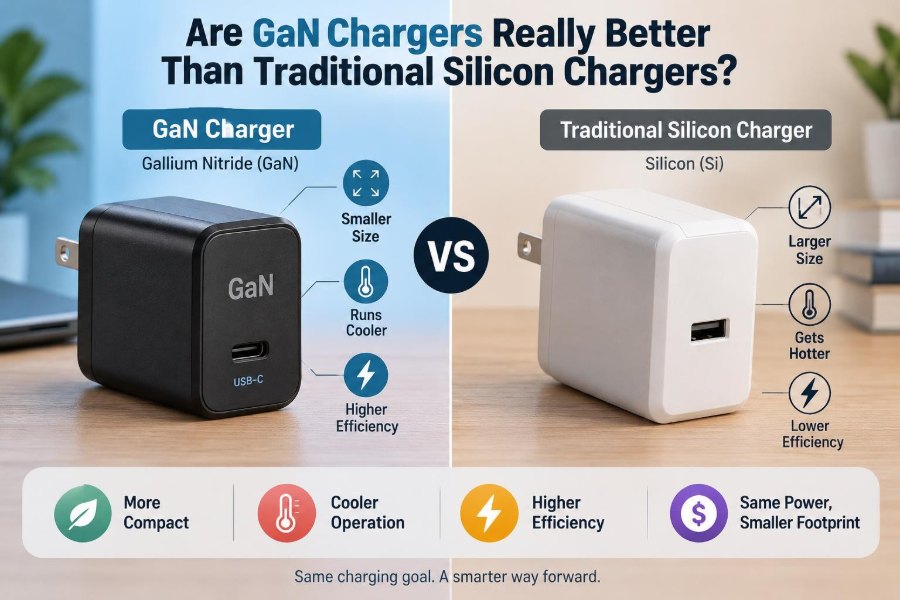
GaN chargers can be smaller, lighter, and more power-dense than comparable silicon chargers. They can also operate efficiently at high switching frequencies, which helps reduce the size of certain internal components.
But “GaN” describes a key semiconductor technology, not a complete quality guarantee. A poorly designed GaN charger can have weak thermal behavior, awkward power sharing, insufficient safety margins, or unreliable USB-C compatibility. A well-designed silicon charger can still be safe, durable, and entirely appropriate for lower-power use.
The practical conclusion is simple: GaN gives charger designers useful advantages, especially at higher power. The finished product still has to earn its place in your bag.
🧱 What a Charger Actually Does
Wall power is alternating current (AC), while phones and laptops require carefully controlled direct current (DC). A modern charger first rectifies AC into DC, then uses high-speed electronic switches to create a controlled high-frequency waveform.
A transformer provides isolation and changes the voltage. Rectifiers, filters, feedback circuits, and protection systems then deliver stable output power through a USB port or other connector.
In a switch-mode power supply, the switching transistor is central. It repeatedly turns current on and off, controlling how energy moves through the transformer. Traditional chargers commonly use silicon-based transistors; GaN chargers use gallium nitride devices in key switching roles.
🧪 What Gallium Nitride Is
Gallium nitride, usually shortened to GaN, is a compound semiconductor made from gallium and nitrogen. It is already familiar in technologies such as LEDs and radio-frequency electronics.
For power conversion, GaN is valued because it is a wide-bandgap semiconductor. The bandgap is an energy property that strongly influences how a material behaves electrically. Compared with conventional silicon power devices, GaN can tolerate stronger electric fields and switch very rapidly.
That does not mean every component inside a GaN charger is made of gallium nitride. The controller, capacitors, transformer, ports, housing, and much of the support circuitry use other materials. “GaN charger” is a useful shorthand, but it is not a full bill of materials.
🔬 Why Silicon Has Been the Default
Silicon has dominated power electronics for decades because it is mature, widely available, well understood, and supported by extensive manufacturing infrastructure. Engineers have many proven circuit topologies and reliable silicon components to choose from.
For modest-power adapters—such as a simple phone charger—silicon remains highly capable. It can deliver safe and efficient charging at a reasonable cost, particularly when physical size is not a major constraint.
GaN did not make silicon obsolete. Instead, it expanded the design space for products where compactness, high power density, and reduced losses are worth the added component and design complexity.
🏎️ The Switching-Speed Advantage
The most important GaN advantage in compact chargers is high-speed switching. A power transistor is not an ideal switch: each transition between on and off dissipates some energy. Switching more quickly can reduce the energy lost during each transition.
GaN devices also have favorable capacitance-related characteristics for fast power switching. In plain terms, they can move between electrical states with less of the sluggish charge-handling behavior that limits many conventional silicon switches.
Fast switching is not valuable simply because “faster” sounds better. It gives the designer the option to operate at a higher frequency, reduce losses in a suitable topology, or balance frequency, efficiency, electromagnetic emissions, and heat for the intended charger.
🌀 Why Higher Frequency Can Shrink a Charger
A transformer transfers energy through a magnetic core. At a higher switching frequency, it can usually transfer the required power with a smaller magnetic core and fewer turns of wire than a lower-frequency design.
Inductors and some filter components can shrink for the same reason. Since magnetic components often occupy a substantial portion of a charger’s volume, reducing them can make a high-power adapter noticeably more compact.
This is why a 65 W or 100 W GaN USB-C charger can be much smaller than an older laptop brick of similar output power. The improvement is not magic; it is a consequence of high-frequency power-conversion design.
🌡️ Efficiency Is Helpful, but Heat Still Exists
No real charger is perfectly efficient. If a charger delivers 60 W to a laptop, it must draw somewhat more than 60 W from the wall because some input energy becomes heat in switches, magnetics, capacitors, rectifiers, and wiring.
GaN can reduce important switching losses, but it does not eliminate losses elsewhere. A tiny enclosure also has less surface area to release heat, so a compact high-power GaN charger can feel quite warm during sustained use.
Warmth alone is not evidence of danger or poor quality. What matters is whether internal components remain within their design limits and whether protective circuits manage abnormal conditions. Since consumers cannot directly measure that, choosing reputable products and using them correctly matters.
📦 Power Density: The Benefit You Actually Carry
Power density means how much power a charger provides for a given volume or weight. It is the benefit most users notice first: fewer bulky adapters and more room in a backpack or power strip.
Higher power density is particularly useful when one charger replaces separate adapters for a laptop, tablet, and phone. A compact multiport charger can simplify travel without requiring every device to have its original brick.
There is a trade-off. Packing more power into less space makes thermal and mechanical design harder. Small size should therefore be treated as a convenience advantage, not as proof that one charger is universally superior.
🔌 USB-C Power Delivery Matters More Than the Label
For USB-C devices, charging capability depends heavily on USB Power Delivery, usually called USB PD. This protocol lets the charger and device communicate to select an appropriate voltage and current profile.
A charger may be physically capable of high power but unable to offer the profile your device needs. Conversely, a device will only draw the power it requests and is designed to accept; connecting a 100 W charger does not force 100 W into a phone.
Look beyond “GaN” and inspect the supported output modes. Laptops often need USB-C PD at a suitable wattage, while some phones benefit from additional protocols or programmable voltage features. Compatibility is a protocol question before it is a semiconductor question.
🧷 Understanding Voltage, Current, and Watts
Charging power is commonly expressed in watts, calculated as voltage multiplied by current. A 20 V output at 3 A provides 60 W; a 9 V output at 2 A provides 18 W.
USB-C PD can negotiate several voltage levels. Higher-power laptop charging often uses higher voltage so that the same power can be delivered with lower current. Lower current reduces resistive loss in the cable, which follows the familiar relationship that heating rises with the square of current.
The printed maximum wattage is only one part of the picture. The charger, cable, and device must all support the negotiated combination. The usable result is limited by the weakest relevant link.
🧵 Cables Can Quietly Limit Performance
A cable is not just a passive accessory. Its conductor size, length, connector quality, and internal electronic marking can determine how much current it can safely carry and what power level a USB-C system will negotiate.
At higher USB-C power levels, use a cable rated for the intended load. An under-rated, damaged, or poorly made cable may limit charging, become unnecessarily warm, or create intermittent connections.
If a new high-power charger seems slow, test it with the cable supplied with the laptop or a clearly specified cable from a reliable source. Replacing the charger before checking the cable is a common and avoidable mistake.
🔀 Multiport Chargers Do Not Always Deliver Full Power to Every Port
A multiport GaN charger may have a large total rating, such as 100 W, but that is usually the combined output budget—not a promise that every port can simultaneously deliver its individual maximum.
Manufacturers typically publish a power-allocation table showing what happens when one, two, or three ports are active. For example, connecting a second device may reduce the power available to the laptop port because the charger redistributes its shared internal capacity.
This behavior is normal. What matters is that the allocation is clear and works predictably for your devices. Read the fine print before assuming one compact charger can replace every adapter in every simultaneous-use scenario.
🔄 Why Some Devices Briefly Reconnect When You Plug In Another One
When a second device is connected to a shared-output charger, the charger may need to renegotiate power contracts. During this process, an existing device can briefly stop charging, reconnect, or show a charging notification again.
This can be inconvenient during data transfers or when powering sensitive accessories. It is not unique to GaN technology; it is mainly a consequence of how that particular multiport charger manages its output budget and USB-C negotiation.
If uninterrupted power matters, such as during a presentation or firmware update, use a dedicated laptop port, a charger designed for stable allocation, or the original adapter.
🛡️ Safety Depends on the Whole Design
Safe mains-powered equipment needs electrical isolation, spacing between high-voltage and low-voltage circuits, insulation systems, temperature control, overcurrent protection, and sound mechanical construction. The semiconductor material does not replace any of these requirements.
Quality chargers typically incorporate protections against conditions such as excessive temperature, short circuits, overload, and abnormal input voltage. Protection features are valuable, but their existence on a product listing is less meaningful than competent implementation.
Do not assume a tiny, inexpensive charger is safe because it says GaN. Avoid products with unclear specifications, questionable plug construction, loose ports, or no identifiable manufacturer information.
🏷️ Marks and Ratings Need Sensible Interpretation
Electrical markings can help identify a charger’s intended ratings, but a logo or printed claim alone is not a complete safety assessment. Requirements and certification practices vary by market, and counterfeit or misleading markings can exist.
Useful practical signals include a clear model number, input and output ratings, a traceable manufacturer, a proper plug for your region, and documentation that matches the product. Retailer reputation and a realistic warranty process are also meaningful clues.
For work equipment or installations with formal compliance requirements, follow your organization’s purchasing and electrical-safety policies rather than relying on consumer product marketing.
🔥 Thermal Throttling and Sustained Loads
Some compact chargers reduce available output power when internal temperature rises. This behavior, often called thermal derating or thermal throttling, can protect components from excessive stress during long, high-power sessions.
Imagine a 100 W charger powering a laptop that is compiling code or rendering video for hours. The charger may run under a much more demanding sustained load than it would when topping up a phone. Ambient temperature, blocked airflow, and cable losses can all affect its operating temperature.
Use compact high-power chargers in open air. Do not cover them with bedding, place them beneath papers, or leave them pressed against insulating materials while heavily loaded.
📏 Smaller Is Not Always More Convenient
A very compact charger can be ideal in a travel pouch but awkward on a crowded wall outlet. Its weight may make it sag from a loose receptacle, block neighboring sockets, or strain a vertical power strip.
Port placement matters too. A charger with downward-facing ports may be better for a wall outlet, while side-facing ports can work better on a desk. Foldable prongs improve portability but introduce another mechanical part that should feel firm and well made.
Choose the physical form factor for the place you will use it most. A slightly larger charger with better cable routing may be more useful than the smallest available model.
💻 Matching Charger Wattage to a Laptop
Check the power rating of the laptop’s original USB-C adapter or the manufacturer’s recommended input. A lower-rated charger may still charge the laptop during light work, but it can charge slowly, hold the battery level steady, or lose ground under a heavy workload.
A higher-rated compatible charger is generally fine because USB-C PD negotiation limits the delivered power to what the laptop requests. However, not every USB-C port on every laptop accepts charging, and older proprietary charging systems may not be replaceable with USB-C at all.
For a travel setup, select enough headroom for realistic use. A laptop that normally uses a 65 W adapter may be comfortable with a 65 W or higher compatible PD source, but sharing that charger with other devices changes the available budget.
📱 Phone Fast Charging Has Its Own Rules
Phones often support USB-C PD, USB PD with programmable power supply modes, or manufacturer-specific fast-charging schemes. A GaN charger can support these methods, but GaN alone does not determine whether the phone reaches its fastest advertised charge rate.
Many phones will still charge well from a basic PD charger, just not necessarily at the maximum supported speed. The phone also manages its own battery temperature and charging curve, so fast charging usually slows as the battery becomes fuller.
For phone-only charging, a quality silicon charger may be just as practical as a GaN model. The GaN advantage becomes more compelling when size or multi-device power is a priority.
🔋 Battery Health Is Mostly a Device-Control Question
People sometimes worry that a powerful GaN charger will damage a battery. With compliant USB charging systems, the device negotiates and controls charging behavior; the charger provides power within the agreed limits.
Battery aging is influenced by temperature, time spent at high state of charge, charge-discharge cycles, and the device’s battery-management strategy. Fast charging can create more heat in some conditions, but this is not a special property of GaN chargers.
Use reliable equipment, avoid charging a hot device under pillows or in direct sun, and enable any battery-care settings offered by the device. Those habits are generally more relevant to battery longevity than choosing GaN versus silicon.
📻 Electromagnetic Interference Needs Careful Design
Rapid switching creates high-frequency electrical energy that can couple into nearby circuits, cables, or radio receivers. This unwanted energy is called electromagnetic interference, or EMI.
Because GaN enables very fast switching edges, charger designers must carefully manage circuit layout, shielding, filters, grounding, and control timing. A compact charger can be efficient yet still need sophisticated engineering to keep emissions within applicable limits.
If a charger causes audible noise, radio interference, touchscreen instability, or erratic behavior with sensitive equipment, stop treating it as a minor annoyance. Test with another charger and cable, then replace the problematic unit if the pattern persists.
🎵 Coil Whine Is Not Exclusively a GaN Problem
Buzzing or chirping from a charger is often called coil whine. The sound usually comes from vibrating magnetic components or capacitors, especially when a power converter changes operating mode at light load.
GaN chargers can produce such noise, and silicon chargers can too. A faint sound in a quiet room may not indicate failure, but loud, changing, or newly developed noise—particularly alongside excess heat, odor, or intermittent charging—deserves caution.
Do not open a mains charger to investigate. Its internal capacitors and high-voltage circuitry can remain hazardous, and opening the enclosure compromises its insulation and safety construction.
🧰 Reliability Is More Than Semiconductor Lifetime
GaN power devices can be highly reliable when correctly selected and operated, but charger life depends on many other components. Electrolytic capacitors, connectors, solder joints, cables, plug mechanisms, and thermal interfaces all experience real-world stress.
High internal temperatures accelerate aging in many electronic components. This is one reason reputable designs devote considerable attention to thermal paths, component spacing, overload behavior, and derating—the practice of operating parts below their absolute limits.
A charger that remains serviceable for years is the result of system-level engineering. Material choice helps, but it cannot compensate for poor layout, inadequate cooling, or low-quality passive components.
💸 Why GaN Chargers Often Cost More
GaN power devices and the surrounding high-frequency design work can increase cost. Designers may need more careful layout, specialized drive techniques, and stronger attention to EMI and thermal behavior than in a familiar low-frequency silicon design.
At the same time, a GaN charger may replace several separate adapters, reducing the number of items you carry. That can make a higher purchase price reasonable for a frequent traveler or a desk with multiple USB-C devices.
For one device charged overnight, the economic case may be weaker. Buy the capability you need rather than paying extra solely for a technology label.
🌍 Energy Savings Are Real but Usually Modest per Charger
A more efficient charger wastes less energy as heat while it is converting power. Across many devices and long operating periods, efficiency improvements can reduce wasted electricity and heat generation.
For an individual phone charger used intermittently, the absolute energy difference may be small. The larger practical gain often comes from consolidating several adapters into one appropriately sized unit and avoiding unnecessarily inefficient or failing equipment.
Environmental impact also includes manufacturing, transport, product lifetime, and electronic waste. The most sustainable charger is not automatically the newest or smallest one; it is often a durable, suitable unit that replaces several redundant accessories and remains useful.
🧳 When GaN Makes the Most Sense
GaN is especially attractive when you need substantial power in a portable package. Students moving between campus, home, and lab; field engineers; and frequent travelers often benefit from one charger that handles a laptop, phone, and accessories.
It is also useful where outlet space is limited. A compact charger with thoughtfully arranged USB-C ports can simplify a desk, hotel room, or shared workspace.
- Choose GaN when reducing bag bulk matters.
- Choose it when you need USB-C PD power for a laptop and other devices.
- Choose it when a reputable multiport model can genuinely replace several adapters.
- Do not choose it merely because a low-power device is assumed to charge faster.
🏠 When a Traditional Silicon Charger Is Still the Better Buy
A conventional silicon charger remains sensible for low-power, fixed-location, or budget-sensitive applications. A dependable adapter that came with your device may already meet your needs perfectly.
For example, a bedside phone charger, a dedicated smart-speaker adapter, or a spare charger kept at one desk may gain little from extreme compactness. In these cases, robust construction, correct power rating, and reliable compatibility are more useful criteria than semiconductor type.
Silicon power technology continues to evolve as well. The comparison is not “old and bad” versus “new and good”; it is about selecting an appropriate power-conversion design for a use case.
🛒 A Practical Checklist Before Buying
Start with your devices rather than the charger’s marketing headline. List what you charge simultaneously, the input power each device expects, and whether you need a travel charger or a permanent desk adapter.
- Verify USB-C PD support and the required wattage for your laptop.
- Read the multiport power-allocation chart, not only the total wattage.
- Confirm that the included or planned cable supports the required power.
- Check port count, port types, plug format, size, and cable direction.
- Choose a manufacturer and seller with clear specifications and support.
- Avoid unusually vague listings or chargers with no traceable model information.
If you power specialized equipment, docks, or displays, test compatibility within the return period. USB-C is flexible, but device implementation details still vary.
🚫 Common Assumptions to Avoid
Several beliefs lead to disappointing purchases. “GaN always charges faster” is false because charging speed is negotiated and limited by the device, protocol, cable, and available port power.
“A 100 W charger gives every port 100 W” is also false for most multiport products. Total capacity must be shared, and some ports may have different capabilities.
Finally, “small means efficient and safe” is not a reliable rule. Compactness may reflect good engineering, aggressive thermal design, or cost-cutting. Specifications, build quality, and proper use remain essential.
🧭 The Engineering Verdict
GaN is a meaningful advance in consumer power conversion because it helps engineers switch power efficiently at higher frequencies. That capability can shrink magnetic components and enable unusually compact chargers with useful output power.
Its advantages are strongest at higher wattages and in multi-device travel setups. Its limits are equally clear: it cannot override USB-C compatibility, solve cable limitations, eliminate heat, or make a poorly designed charger trustworthy.
The best charger is the one with the right power profiles, credible safety and thermal design, suitable ports, and predictable behavior for your devices—not simply the one with “GaN” printed on the case.
A quality GaN charger can be an excellent upgrade when it replaces a collection of bulky adapters. Treat it as an engineering tool rather than a miracle material, match it carefully to your equipment, and it can make everyday power far more portable. 🔌⚡🎒