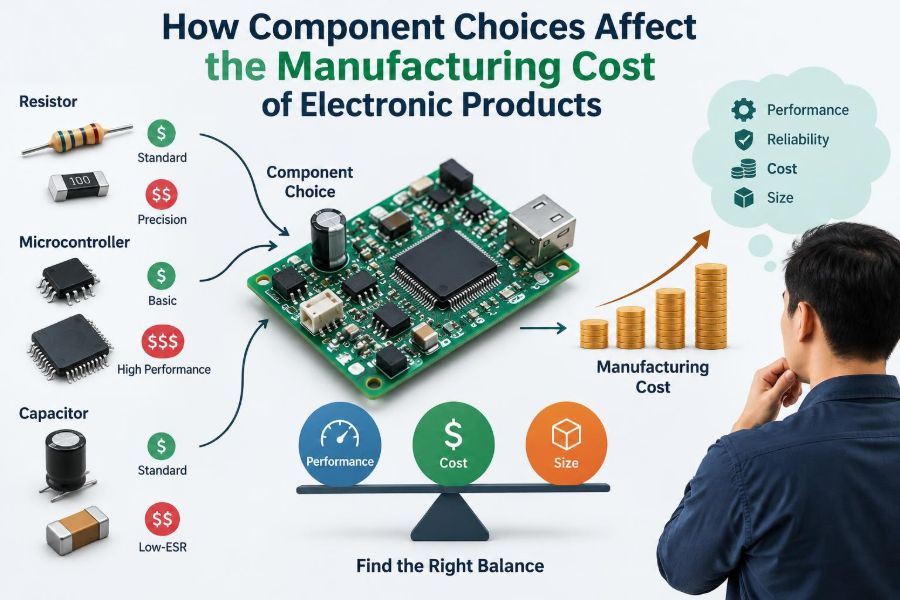

A prototype can look deceptively inexpensive. The schematic is complete, the board powers up, and the bill of materials may suggest that the product is ready for a low-cost production run.
Then manufacturing begins. A connector needs hand assembly, an inductor is difficult to source, a fine-pitch package reduces yield, and the factory has to create a custom test fixture. The finished product costs far more to build than the sum of the components on the original spreadsheet.
This is a common lesson in electronics engineering: component selection is not just about electrical performance. It shapes purchasing risk, assembly time, test effort, reliability, inventory, compliance, and the likelihood of costly redesigns.
For students, this connects circuit theory to the realities of product development. For working engineers, it provides a useful lens for making trade-offs before a design is committed to production.
💰 Manufacturing Cost Is More Than the BOM Price
The bill of materials (BOM) is the list of components required to build a product. Its extended cost is calculated by multiplying each component price by its quantity. This number matters, but it is not the manufacturing cost.
A more useful view is that the cost of a finished unit includes components, printed circuit board fabrication, assembly labor or machine time, testing, scrap, rework, packaging, logistics, and manufacturing overhead. A part that saves a few cents on the BOM can raise several of these other costs.
The central question is therefore not “What is the cheapest part?” It is “What is the lowest-risk component choice that meets the product requirements at the required production scale?”
🧾 Start With the True Cost per Shipped Unit
A product only generates value when it passes test, is packaged, and reaches the customer. Cost analysis should follow that same path rather than stopping at purchasing.
A simplified relationship is:
Cost per shipped unit = material + PCB + assembly + test + yield loss + rework + overheadYield loss represents boards or products that cannot be shipped, while rework covers the time and materials needed to repair correctable defects. Neither is fixed solely by components, but package choice, tolerances, and sourcing quality strongly influence both.
Early estimates do not need false precision. Even a qualitative comparison of “lower BOM, higher assembly risk” against “higher BOM, simpler manufacturing” can prevent an expensive decision.
📦 Component Price Changes With Volume
Component pricing is rarely a single universal number. A resistor bought in a small reel, a distributor cut tape quantity, and a large production order can have very different unit prices.
Some parts also have price breaks at particular order quantities. That can tempt a team to select a part that appears cheap at high volume even though the planned launch volume is modest.
Use the price appropriate to the actual purchasing scenario. A startup building a pilot run should not assume the same pricing available to a high-volume consumer device, and a mature product should not base its long-term model on one-off prototype prices.
🔢 Part Count Adds Cost in Several Directions
Each additional unique component introduces more than its own purchase price. It needs a library symbol and footprint, placement data, sourcing attention, incoming inventory control, and a possible failure mode.
For surface-mount assembly, a high total placement count increases machine time. More importantly, a high number of unique line items increases feeder setup and operational complexity.
A circuit with ten 10 kΩ resistors is usually easier to manage than one with ten resistor values used once each. Standardizing values can reduce procurement work, placement setup, inventory burden, and the risk of loading the wrong reel.
🧩 Integration Can Replace a Cluster of Parts
Integrated circuits often combine functions that once required several discrete components: power conversion, protection, sensing, gate drive, communication interfaces, or analog signal conditioning.
A more expensive IC may reduce the total component count, PCB area, assembly placements, and test time. It can also simplify routing and make the circuit more repeatable. In such a case, comparing only the IC’s unit price gives the wrong answer.
Integration has limits. A highly integrated device may create a single-source dependency, offer less flexibility, or require a more complex package. The right choice depends on whether the savings in surrounding circuitry outweigh these risks.
⚖️ Discrete Parts Can Still Be the Better Choice
Using discrete components is not automatically a cost mistake. Simple resistor networks, transistor stages, filters, and protection circuits can be economical when the parts are common, readily available, and easy to assemble.
Discretes are especially useful when requirements vary across product versions. Changing one resistor may adapt a voltage threshold or gain without creating a new firmware image or qualifying another specialized IC.
The danger is accidental complexity: adding individual parts until the design becomes difficult to source, place, inspect, and debug. A discrete solution should be evaluated as a system, not as a collection of individually cheap items.
📐 Package Choice Affects Assembly Difficulty
The same electrical component may be available in multiple packages. A resistor might come in through-hole, several surface-mount sizes, or an array package. Each choice changes board area, handling, inspection, rework, and manufacturing capability.
Very small passive packages can reduce PCB area and sometimes material cost, but they demand more accurate placement and can be harder to inspect or rework. Large packages are generally easier to handle but consume valuable board space.
For active devices, package selection can have an even larger effect. A package with exposed leads is usually easier to inspect than one with hidden solder joints underneath the body.
🔬 Fine-Pitch Packages Can Raise Yield Risk
Fine-pitch ball-grid array packages, chip-scale packages, and very small leadless packages can enable compact, high-performance designs. They are often necessary for advanced processors, memory, and radio devices.
However, these packages may require tighter PCB fabrication controls, more demanding solder paste printing, X-ray inspection, specialized rework equipment, or more detailed assembly profiling. Those requirements can increase cost and reduce the number of suitable manufacturing partners.
Using a difficult package is justified when it enables a real requirement such as required I/O density or high-speed performance. It is less justified when a larger, easier package would meet the same need with greater production margin.
🌡️ Thermal Performance Has a Cost Path
Heat is often treated as a reliability concern, but it is also a manufacturing-cost concern. A component that runs hot may require a larger copper area, thermal vias, a heatsink, thermal interface material, or a more expensive enclosure.
Choosing a more efficient regulator, transistor, or LED driver may cost more at purchase yet reduce heat-related mechanical parts and simplify assembly. It can also make functional testing more stable because performance is less sensitive to temperature rise.
Thermal decisions should be based on realistic worst-case operating conditions. A part that survives a short bench test may not have enough margin inside a sealed product on a warm day.
⚡ Power Components Often Drive Hidden Costs
Inductors, capacitors, MOSFETs, regulators, fuses, and connectors in power paths deserve close cost review. Their ratings influence safety margins, heat generation, board layout, electromagnetic compatibility, and available suppliers.
For example, selecting a capacitor only by nominal capacitance can be misleading. Voltage rating, dielectric type, temperature behavior, ripple current capability, and package size all affect whether it performs adequately in a switching converter.
A low-cost power component that causes unstable startup or excessive conducted noise can add debugging, filtering, and retest costs later. Power design choices should be validated as complete circuits, not isolated line items.
📏 Tolerance Determines How Much Margin a Design Needs
Every real component varies from its nominal value. Resistors have resistance tolerance, capacitors have capacitance tolerance and bias effects, oscillators have frequency accuracy, and sensors have offset and sensitivity errors.
Tighter tolerances usually cost more, but loose tolerances can force the system to use wider design margins. A timing circuit might need a more expensive controller or calibration step if its inexpensive timing components vary too much.
Specify precision only where the function requires it. Over-specifying every resistor is wasteful; under-specifying a feedback divider or current-sense resistor can cause yield failures that cost much more than the upgraded part.
🧪 Calibration May Cost More Than Precision Parts
Some products must be calibrated during manufacturing to meet accuracy requirements. Calibration can involve applying a known stimulus, measuring the response, calculating correction values, programming memory, and recording results.
In a hypothetical temperature-measurement product, a lower-cost sensor with wider error may be acceptable if a fast automated calibration is already part of the process. If calibration requires manual handling or expensive equipment, selecting a more accurate sensor may lower total cost.
This is a useful general rule: compare the recurring price of a higher-specification component with the recurring time and equipment cost of compensating for a lower-specification one.
🧷 Connectors Bring Mechanical and Labor Trade-Offs
Connectors are frequently underestimated because they appear simple in the schematic. In production, they may need manual insertion, selective soldering, screws, strain relief, mating-cycle verification, or alignment with an enclosure opening.
A board-edge connector may eliminate a cable assembly but demand tighter mechanical tolerances. A locking connector may improve field reliability but add insertion force and assembly steps. A low-profile connector may require careful handling and specialized inspection.
Choose connectors based on electrical rating, expected user behavior, assembly method, service needs, and sourcing longevity. The lowest-priced connector can be costly if it is difficult to mate consistently during final assembly.
🏭 Assembly Method Sets the Practical Component Menu
Surface-mount technology (SMT) places components directly onto PCB pads using automated equipment. Through-hole technology (THT) inserts leads through drilled holes and may use wave soldering, selective soldering, or manual assembly.
A mixed SMT/THT board can be entirely appropriate, especially for high-current terminals or mechanically stressed connectors. But every additional process may add handling, scheduling, fixtures, and labor.
Designers should discuss the intended assembly flow with the contract manufacturer early. A part that is electrically suitable may be unsuitable for a particular line, soldering process, or expected production volume.
🤖 Placement Speed Is Not the Whole Story
Automated pick-and-place machines can place many components quickly, so it is tempting to dismiss placement count. Yet feeder loading, program verification, changeover time, and exception handling still matter.
Awkward packages can slow a line more than their count suggests. Parts supplied in trays, tubes, or nonstandard packaging may require different equipment or manual loading compared with tape-and-reel components.
For a stable high-volume product, a complex setup may be acceptable. For many low-volume variants, standard package families and common reels can significantly reduce setup effort between runs.
🛠️ Design for Manufacturing Begins in the Footprint
Design for manufacturing (DFM) means designing a product so that it can be built reliably by a real manufacturing process. Component footprints are a major part of DFM.
Pads that are too small, poorly balanced, or inconsistent with the component manufacturer’s recommendations can cause solder bridges, tombstoning, insufficient joints, or placement errors. Tombstoning occurs when one end of a small passive component lifts during reflow soldering.
Use verified footprints, appropriate courtyard clearances, clear polarity markings, and sensible component orientation. These decisions cost little during layout but can prevent recurring assembly defects.
👀 Inspectability Influences Defect Cost
Automated optical inspection can check many visible solder joints, markings, and component positions. Hidden joints underneath certain packages may need X-ray inspection or electrical testing to reveal assembly defects.
Inspection is not merely a factory concern. If a defect cannot be seen or isolated easily, diagnosis and rework become slower. That affects both manufacturing cost and engineering time during production ramp.
When hidden-joint packages are necessary, plan adequate test coverage. When they are optional, the simpler-to-inspect package may provide a better total cost despite occupying more area.
🧯 Reworkability Protects Early Production Runs
Rework is the process of correcting an assembled board, such as replacing a damaged component or fixing a solder defect. It is valuable during prototypes and early builds, when issues are more likely to emerge.
Dense layouts, bottom-terminated packages, large thermal pads, and components placed too close together can make rework difficult. A technically repairable board can still be uneconomical to repair if it takes a skilled operator too long.
High-volume products should aim to avoid defects rather than depend on rework. Still, designing for reasonable access can reduce scrap during development and low-to-medium-volume manufacturing.
📈 Yield Turns Small Defects Into Large Expenses
Yield is the proportion of units that successfully pass a manufacturing stage. A component choice can influence yield through solderability, handling sensitivity, polarity mistakes, counterfeit risk, electrical variation, or thermal behavior.
Suppose two regulator options differ only modestly in purchase price. If one has a package and footprint that routinely produces more assembly defects, its apparent BOM advantage can disappear through lost boards and rework.
Yield must be observed, not assumed. Pilot builds, assembly feedback, inspection data, and production test results are more informative than an optimistic spreadsheet estimate.
🧰 Test Access Is a Component Selection Issue
Manufacturing test verifies that a product functions before shipment. Test points, programming headers, accessible signals, and controllable power domains help make this fast and repeatable.
Some component choices complicate testing. A highly integrated module can hide useful signals; a device with one-time programmable memory may require careful programming control; and a circuit with no isolation points can make failures difficult to localize.
A few extra pads, jumpers, or controlled test modes may slightly increase the board cost while sharply reducing test time. The goal is not maximum test coverage at any price, but sufficient coverage for likely defects and product risk.
🧠 Firmware and Component Variants Create Operational Cost
A component substitution can require new firmware settings, calibration constants, production test limits, labels, or regulatory verification. This is especially relevant for sensors, displays, memory, wireless modules, and power-management ICs.
Supporting several approved variants can protect supply, but it also creates configuration-control work. Production teams need a reliable way to know which firmware and test procedure applies to each assembled unit.
Dual sourcing is valuable when managed deliberately. Uncontrolled substitutions, even between apparently similar components, can create intermittent field behavior and costly investigation.
🚚 Availability and Lead Time Have a Real Price
A part that is inexpensive but difficult to obtain can stop an entire production run. The resulting cost may include expedited shipping, broker purchases, excess inventory of the remaining parts, and missed delivery commitments.
Availability changes over time, so a single distributor listing is not a complete sourcing strategy. Review whether the component is broadly distributed, offered by multiple authorized channels, and supported by a credible lifecycle outlook.
For critical parts, engineers often define approved alternatives early. Doing this before a shortage is far less disruptive than redesigning under production pressure.
🔄 Second Sources Reduce Risk but Need Qualification
A second source is an alternative supplier or part that can perform the required function. Commodity passives often have many viable alternatives, while specialized ICs may have none.
Part equivalence should not be decided from a matching headline specification alone. Package dimensions, electrical behavior across temperature, startup behavior, firmware compatibility, electromagnetic performance, and manufacturing fit may differ.
Create a clear alternate-part process. It should state what engineering checks, test changes, documentation updates, and approvals are required before an alternative reaches production.
🧭 Lifecycle Status Prevents Avoidable Redesigns
Electronic components progress through lifecycle stages, from introduction and active production to obsolescence and last-time-buy notices. A part near end of life may still be cheap and available, but it can impose a redesign sooner than expected.
Redesign cost includes engineering time, new PCB revision work, validation, tooling updates, inventory disposition, and possibly recertification. These costs are difficult to see in a unit-price comparison.
For long-lived industrial or infrastructure products, lifecycle support can be more valuable than the lowest initial price. For a short-lived product, that trade-off may be different, but it should still be conscious.
📋 Compliance Requirements Change the Component Decision
Products may need to meet environmental, safety, electromagnetic compatibility, radio, or market-specific requirements. The exact obligations depend on the product and its destination, so they should be reviewed with appropriate compliance specialists.
Components can affect compliance through material declarations, insulation ratings, flame classifications, radio certification conditions, or emissions behavior. Replacing one seemingly minor part can sometimes require renewed testing or technical review.
Maintain the required component records from the beginning. Recovering declarations and traceability documents after a product is already built can delay shipment and create unnecessary purchasing restrictions.
🛡️ Counterfeit Risk Is Also a Cost Risk
When common supply channels cannot deliver a needed part, buyers may turn to unfamiliar brokers. This can introduce counterfeit, relabeled, damaged, or incorrectly stored components into the supply chain.
Failures caused by suspect components are expensive because they can be intermittent and difficult to trace. The immediate savings from a low broker price may be overwhelmed by inspection, screening, rework, warranty exposure, and loss of production time.
Use authorized sources where practical, maintain lot traceability for critical devices, and define escalation rules before procurement is under pressure.
🏗️ PCB Area Is a Cost Lever, Not the Only Lever
Smaller boards can use less laminate material and may fit more panels, potentially reducing PCB cost. They can also enable smaller housings and lower shipping volume.
But aggressively shrinking a board may force tiny components, dense routing, expensive stackups, tighter fabrication rules, reduced test access, and more difficult thermal management. The cheapest board is not necessarily the smallest one.
Consider area in relation to the entire product. A modestly larger PCB that uses standard packages and a simpler layer count may be the more economical manufacturing choice.
🧮 Compare Options With a Total-Cost Worksheet
A structured comparison helps teams avoid arguing from single numbers. For each candidate component or architecture, record the expected effects beyond purchase price.
| Decision factor | Questions to ask | Possible cost effect |
|---|---|---|
| Material | What is the price at planned volume? | Direct BOM cost |
| Assembly | Does it need special placement or soldering? | Machine time, labor, setup |
| Yield | Is the package or tolerance sensitive? | Scrap and rework |
| Test | Can failures be detected quickly? | Fixture and operator time |
| Supply | Are qualified alternatives available? | Shortage and redesign risk |
| Lifecycle | Will the part remain available? | Future engineering cost |
This worksheet does not replace engineering judgment. It makes assumptions visible so that electrical, mechanical, manufacturing, and supply-chain teams can evaluate the same decision together.
🗣️ Involve Manufacturing and Purchasing Early
Component selection works best as a cross-functional activity. The circuit designer understands electrical requirements, the layout engineer sees physical constraints, the manufacturer understands process capability, and purchasing understands supply conditions.
Bring these perspectives together before the PCB layout is frozen. A brief design review can reveal that an alternate package, a common passive value, or a different connector avoids substantial downstream work.
Waiting until the release date to request a manufacturability review turns useful feedback into a schedule problem. Early collaboration creates options; late collaboration usually creates compromises.
🚫 Common Cost-Driven Choices That Backfire
Several patterns repeatedly create trouble in electronic product manufacturing:
- Selecting the lowest-priced component without considering assembly, yield, or supply.
- Using obsolete or poorly distributed parts because they are available for a prototype.
- Specifying extreme precision, temperature range, or package miniaturization without a requirement.
- Assuming two parts are interchangeable because their primary ratings match.
- Removing test points and polarity markings to save tiny amounts of board area.
- Choosing parts before confirming the capabilities of the intended manufacturer.
None of these choices is always wrong. They become risky when made without a documented reason and a view of their full manufacturing consequences.
✅ A Practical Selection Workflow
A disciplined workflow keeps cost decisions connected to engineering requirements:
- Define electrical, environmental, mechanical, regulatory, and lifetime requirements.
- Select parts that meet those requirements with appropriate margin.
- Check package compatibility with the intended assembly process.
- Review availability, lifecycle status, and credible alternatives.
- Estimate BOM, PCB, assembly, test, and yield implications.
- Build and inspect a pilot run under production-like conditions.
- Use results to refine approved parts and manufacturing documentation.
This process is iterative. New information from a prototype or supplier may justify changing a part before volume production, when the cost of change is still manageable.
🎯 The Core Principle: Optimize the Product, Not a Line Item
Component choice affects manufacturing cost through a chain of consequences. Price influences the BOM, but package selection influences assembly; tolerance influences test or calibration; availability influences scheduling; and lifecycle status influences the chance of future redesign.
The strongest designs balance performance, manufacturability, supply resilience, and service life. They do not chase the lowest individual part price, nor do they assume that premium components always save money.
Choose components by their total effect on a reliable shipped product, not by their unit price in isolation. That mindset turns cost reduction from a last-minute purchasing exercise into a core engineering skill.
When engineers treat every component as both an electrical decision and a manufacturing decision, products become easier to build, easier to test, and more resilient to change. 🔌🏭📈