
A workshop technician receives a control board from a small packaging machine. The machine is down, the original board is expensive to import, and the owner needs an answer quickly: repair it, replace it, or redesign a small part of the system.
A student faces a different version of the same opportunity. They have learned schematics, microcontrollers, soldering, and simulation, but are unsure how those skills become paid work beyond a conventional engineering job.
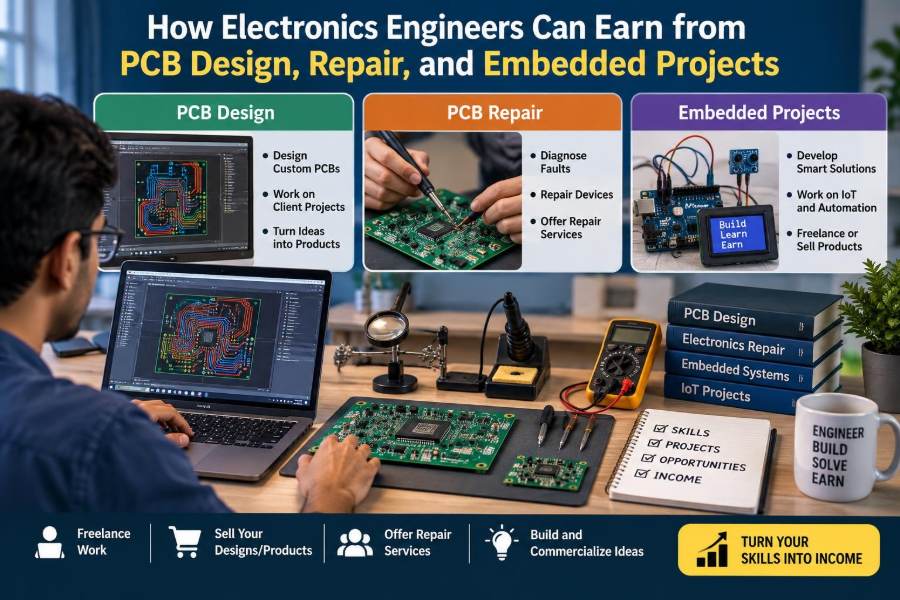
PCB design, electronics repair, and embedded development solve practical problems that businesses and individuals encounter every day. The earning potential does not come merely from owning tools or knowing a software package; it comes from reducing uncertainty, downtime, waste, or development effort for someone else.
Whether the goal is freelance income, a repair business, product development, or stronger professional experience, the most reliable path is to match technical capability with a clearly defined customer problem.
🧭 Start with Problems, Not Services
Customers rarely wake up wanting “PCB design.” They want a failed controller restored, a sensor connected to a phone, an obsolete board replaced, or a prototype prepared for testing.
Frame your offer around the result. “I diagnose and repair industrial control boards” is clearer than “I do electronics.” A specific problem statement also helps you decide what equipment, knowledge, and pricing model are needed.
🧩 Understand the Three Main Income Paths
The most common paths overlap, but they demand different workflows and carry different risks.
| Path | Typical deliverable | Main value to customer |
|---|---|---|
| PCB design | Schematic, layout, manufacturing files | A manufacturable electronic board |
| Repair | Restored or diagnosed equipment | Reduced downtime or replacement cost |
| Embedded projects | Hardware plus firmware prototype or product | A device that senses, controls, communicates, or automates |
A designer can later add firmware work, and a repair specialist may discover a market for replacement boards. Starting with one focused service, however, makes learning and marketing more manageable.
🎯 Choose a Practical Niche
Generalists can get work, but a niche makes it easier for clients to remember why they should call you. Good niches are usually defined by equipment type, customer group, or recurring failure mode.
- Power-supply and charger repair
- Arduino- or ESP32-based monitoring prototypes
- Small business automation panels
- Custom test fixtures for workshops
- Replacement boards for discontinued equipment
- Two-layer PCB layout for student teams and startups
A niche should be narrow enough to build repeatable knowledge, but not so narrow that there are no nearby customers. Local observation is often more useful than guessing at popular online services.
🛠️ Build a Trustworthy Basic Workbench
Tools should follow the work you accept. For repair, a stable soldering iron, hot-air rework station, multimeter, bench power supply, magnification, flux, and safe hand tools are a sensible foundation.
For design and embedded work, add a capable computer, PCB design software, programmer/debugger, logic analyzer where appropriate, and a small stock of common components. A scope becomes highly valuable when investigating power rails, clocks, analog signals, or digital timing.
Do not buy advanced equipment simply because it looks professional. Learn to use each instrument well, document its limitations, and charge work that genuinely requires it.
📐 Turn a Vague Idea into a Design Brief
Many project failures begin before a schematic is drawn. “Build a smart irrigation system” leaves essential questions unanswered: how many zones, what voltage, what environment, what wireless range, what safety requirements, and what happens if communication fails?
Create a short design brief that states inputs, outputs, power source, interfaces, environmental conditions, target quantity, schedule, and acceptance criteria. If assumptions remain, mark them clearly. This brief becomes the reference when a client requests changes later.
🧠 Sell Engineering Decisions, Not Just PCB Layout
PCB layout is the physical arrangement of components and copper connections on a board. It matters, but a working design also depends on sensible component selection, power architecture, protection, thermal behavior, signal integrity, and test access.
A low quote for “routing a board” can become unprofitable if the client supplies an incomplete schematic or unsuitable components. Define whether your job includes design review, schematic capture, library creation, layout, fabrication outputs, prototype support, or all of them.
📄 Define Deliverables Before Starting PCB Work
Professional PCB work ends with files that another engineer or manufacturer can understand. Typical outputs include source design files, PDF schematics, bill of materials, Gerber or equivalent fabrication files, drill data, assembly drawings, pick-and-place data, and a revision record.
Not every project needs every file, but the agreement should say what the client receives. Clarify whether component purchasing, assembly coordination, and prototype testing are separate services.
🔍 Make Design Review Part of the Service
A design review catches problems when changes are cheap. Review connector orientation, supply polarity, mounting holes, component footprints, clearances, programming access, heat-producing parts, and labels before ordering boards.
Use checklists rather than relying on memory. A simple peer review by another engineer can catch a reversed connector or incorrect footprint that the original designer has looked at too often to notice.
⚡ Design for Electrical Reality
A schematic can look correct while the physical board behaves poorly. Switching currents need controlled return paths, sensitive analog signals need careful routing, and regulators need the capacitors recommended for their operating conditions.
For higher-speed, RF, high-voltage, or safety-critical designs, experience and relevant standards become especially important. If a project exceeds your current competence, narrow the scope, seek review, or decline it. That is responsible engineering, not lost ambition.
🏭 Know What Manufacturable Means
Design for manufacturability means choosing geometries, components, and assembly methods that a real supplier can produce consistently. Tiny packages, unusual board stackups, difficult soldering access, and unavailable components may turn a promising prototype into a costly delay.
Speak with the intended fabricator or assembler early when the board is unusual. Their capability notes can influence track widths, hole sizes, panelization, finish, spacing, and documentation requirements.
🧪 Earn More by Planning Prototype Validation
A delivered PCB is not necessarily a verified product. Offer a defined prototype-validation stage: visual inspection, continuity checks, controlled power-up, rail measurement, functional tests, and a concise issue report.
For example, a sensor board may be tested across expected supply voltages and communication conditions. This does not promise that every field condition has been covered, but it gives the client evidence of what was checked and what remains uncertain.
🔧 Treat Repair as a Diagnostic Service
Repair income is often based on diagnosis as much as soldering. Replacing parts at random consumes time, risks further damage, and gives customers little confidence.
A repeatable sequence works better: inspect for physical damage, understand the circuit’s function, check for shorts, apply power safely, measure expected rails, isolate the failed section, and verify operation after repair. Record measurements and observations as you go.
🔌 Use Safe Power-Up Methods
Faulty mains-powered equipment, large capacitors, batteries, and high-energy supplies can injure people or damage test instruments. Isolation, current limiting, discharge procedures, appropriate probes, and protective equipment may be necessary depending on the equipment.
Do not offer repairs beyond your training, equipment, insurance, or legal scope. Consumer safety, medical devices, automotive safety systems, and equipment connected to mains demand particular caution. A repair that appears to work briefly may still be unsafe.
🕵️ Read the Failure Pattern
Failures often leave clues. A board that is completely dead may have a missing rail, open fuse, failed input protection device, or damaged power converter. A board that resets intermittently may have poor capacitors, unstable supply voltage, thermal stress, or a communication fault.
Symptoms are not proof. A burned component can be the victim of a downstream short rather than the original cause. Good diagnosis asks what caused the component to fail before declaring the job complete.
🧷 Handle Components and Boards Correctly
Modern boards may use fine-pitch surface-mount devices, multilayer copper planes, moisture-sensitive parts, and heat-sensitive plastic connectors. Excess heat can lift pads, damage nearby components, or create hidden solder bridges.
Practice rework on scrap boards before accepting difficult packages. Flux, correct tip selection, controlled airflow, preheating where suitable, and magnification improve results far more than force or excessive temperature.
📸 Document Every Repair
Photograph the board condition on arrival, note its model and reported symptom, list measured faults, and record replaced parts. Documentation protects both parties if the condition of the item is disputed.
It also becomes a private knowledge base. Over time, notes on common failures, equivalent components, test points, and recurring customer equipment can reduce diagnostic time without pretending that every fault is identical.
🤖 Build Embedded Projects Around a Complete System
An embedded project combines electronics with firmware: the program running on a microcontroller. Clients usually judge the system by its behavior, not by the elegance of its code or board layout alone.
A useful deliverable may include a sensor, controller, power supply, enclosure considerations, firmware, configuration method, and test instructions. Leaving one part undefined can shift risk to the final integration stage.
🌡️ Find Projects with Measurable Value
Strong embedded opportunities often involve measurement, logging, control, or alerts. A workshop may need to monitor a tank level, a small farm may need local environmental data, or a laboratory may need a custom fixture that records test results.
Start with the existing process. If someone currently writes readings on paper, checks a machine manually, or loses time locating a fault, a modest embedded system may have a clear purpose. Avoid adding connectivity merely because it is fashionable.
📡 Select Connectivity for the Real Environment
Wi-Fi is convenient where reliable networks and power exist. Bluetooth can suit nearby configuration. Wired interfaces can be more dependable in electrically noisy industrial settings, while cellular or long-range radio may be suitable for remote installations.
Each option brings trade-offs in range, power consumption, cost, security, data ownership, and ongoing maintenance. Explain these trade-offs before a client assumes that “wireless” means effortless operation everywhere.
💻 Treat Firmware Maintenance as Real Work
Firmware should handle startup behavior, invalid sensor readings, communication loss, configuration storage, and safe recovery from faults. A prototype that works only when everything is ideal is not ready for unattended use.
Version-control the code, label the firmware revision, and keep build instructions. If remote updates are included, they need careful design; a failed update can make an installed device unavailable. For small projects, a simple wired update process may be safer.
🧱 Separate Prototype Work from Product Work
A proof-of-concept demonstrates that an idea can work. A product must also be repeatable, supportable, durable enough for its use, and documented for manufacture and maintenance.
For example, a development board and jumper wires may validate a greenhouse sensor concept. They are not automatically suitable for a humid enclosure, long cable runs, electrical noise, replacement by a technician, or production assembly. Quote these stages separately.
💰 Price Scope, Risk, and Time Honestly
Pricing can be fixed per milestone, hourly, or a hybrid. Fixed pricing works best when requirements and acceptance tests are clear. Hourly billing is often safer for fault diagnosis, legacy reverse engineering, and exploratory development.
Include non-obvious work: client discussions, research, component sourcing, revisions, testing, documentation, travel, packing, and administration. A low initial price may win a job but creates a poor business if it cannot cover the full effort.
🧾 Use Clear Estimates and Change Control
An estimate should state the problem being addressed, work included, exclusions, expected milestones, payment terms, and assumptions. It should also describe what happens when a requirement changes.
Suppose a client asks for a battery-powered logger, then later requests a display, mobile app, and outdoor enclosure. These are not minor adjustments; they affect power budget, mechanical design, firmware, testing, and schedule. Document the revised scope before continuing.
🛡️ Set Boundaries on Warranty and Liability
Be precise about what you can stand behind. A repair warranty may cover the specific repair performed for a stated, reasonable period, but it cannot responsibly promise that unrelated aging components will never fail.
For designs, define the intended use and validation level. Do not imply certification, regulatory compliance, safety approval, cybersecurity assurance, or fitness for critical use unless those tasks were genuinely performed by qualified people within the project scope.
🤝 Build Trust Through Communication
Clients often cannot judge a circuit directly, so they judge clarity, reliability, and transparency. Explain findings in plain language, show the options, and report bad news early.
A useful repair update might say that the input stage has failed, replacement is possible, but another damaged section may only become visible after controlled power-up. This is more credible than promising a result before the evidence supports it.
📁 Create a Portfolio Without Revealing Client Secrets
A portfolio should show evidence of process and outcomes while respecting confidentiality. Use your own projects, permission-based work, anonymized photos, block diagrams, test setups, and short case summaries.
Describe the constraint and your approach: “Designed a low-voltage data-logging prototype with removable sensor connections and test points.” Avoid publishing schematics, code, board files, customer names, or equipment details that you do not have permission to share.
🌐 Find Work Through Relationships and Useful Visibility
Local repair shops, makerspaces, small manufacturers, agricultural businesses, maintenance contractors, student project teams, and startup communities can all produce relevant contacts. Online freelance platforms can help, but they also reward clear proposals and reliable communication rather than technical claims alone.
Share useful demonstrations: a documented repair process, a compact test jig, or a carefully explained board-design lesson. The aim is not to reveal every method for free; it is to show that you solve problems methodically.
🚫 Avoid Common Early Mistakes
New freelancers often accept unclear jobs, promise deadlines before checking component availability, omit testing time, or take on high-risk equipment without adequate safeguards. Another common mistake is giving away unlimited revisions because the original scope was never written down.
- Do not copy reference designs without understanding their limits.
- Do not substitute components based only on physical fit.
- Do not return equipment without a functional test and clear handover note.
- Do not store the only copy of project files on one computer.
- Do not confuse a demo with a field-ready system.
📈 Build Repeatable Processes Before Scaling
Consistency makes small engineering work profitable. Templates for intake forms, test reports, quotation terms, design checklists, bill-of-materials review, and project handover reduce avoidable omissions.
As volume grows, specialize tasks where appropriate. One person may focus on customer communication and requirements while another handles layout or firmware. Scale only after quality control and documentation are strong enough to prevent small errors from multiplying.
🎓 Keep Learning from Completed Jobs
Every finished project contains feedback. Compare estimated and actual time, note which assumptions failed, identify components that caused delays, and record customer questions that should be answered earlier next time.
Technical growth should follow the work you want to do. A repair specialist may study switch-mode power supplies and fault isolation; a PCB designer may deepen knowledge of electromagnetic compatibility; an embedded developer may improve testing and secure communication practices.
✅ The Core Principle: Solve a Defined Problem Reliably
The route from electronics skill to income is not a single tool, platform, or business model. It is the ability to define a real problem, set appropriate boundaries, perform competent engineering work, verify what was done, and communicate the result clearly.
PCB design creates value when it leads to manufacturable hardware. Repair creates value when diagnosis is safe and evidence-based. Embedded work creates value when the complete system behaves reliably in its intended environment. These capabilities reinforce one another over time.
Electronics engineers earn sustainably when they combine technical skill with careful scope, documented testing, honest communication, and respect for safety. Begin with a manageable service, deliver it professionally, and let each completed problem sharpen the next one. 🔌🛠️📈