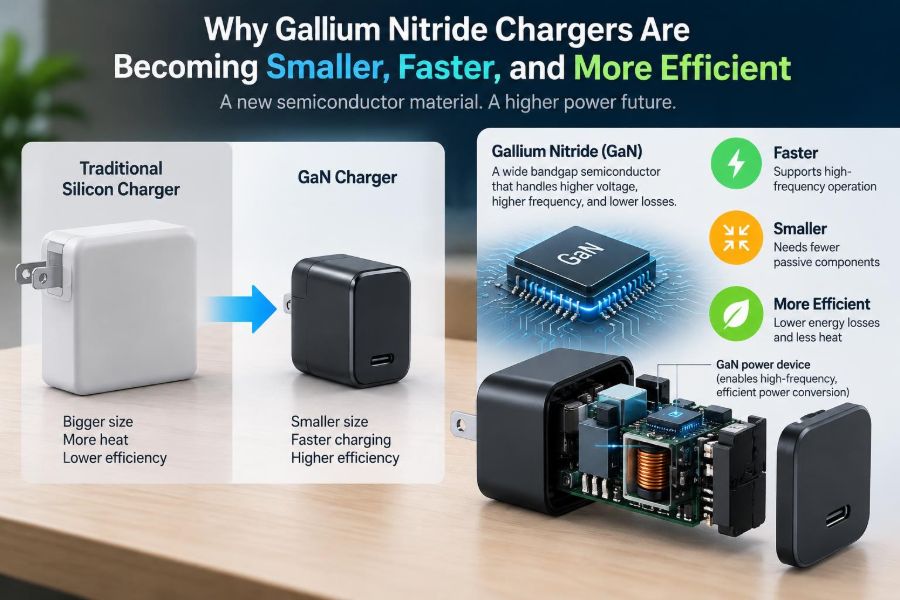

A laptop charger used to be something people tolerated rather than liked: a heavy black brick in a bag, a thick cable on a desk, and a warm lump near the wall outlet. Charging several devices often meant carrying several of them.
Now, a charger small enough to fit in a pocket may power a phone, tablet, and many USB-C laptops. The label may mention GaN, short for gallium nitride, as though it were a new charging standard.
It is not a charging standard. It is a semiconductor material that lets the power-conversion circuitry inside a charger operate differently from conventional silicon designs. That change helps engineers reduce size, improve efficiency, and deliver substantial power from a compact enclosure.
The result is useful, but not magical. A GaN charger still has thermal limits, safety requirements, cable constraints, and design trade-offs. Understanding those limits makes it much easier to choose and use one well.
⚡ The familiar problem with conventional charger bricks
Wall chargers must convert high-voltage alternating current from the outlet into carefully controlled low-voltage direct current for electronics. This process is called AC-to-DC power conversion.
Traditional silicon chargers can do this reliably, but their switching devices, magnetic components, capacitors, and heat-management provisions take up space. At higher power levels, reducing electrical losses and safely removing heat becomes increasingly challenging.
A compact GaN charger addresses the same basic task. Its advantage is that key switching components can operate at higher speeds with lower losses under appropriate conditions, allowing the surrounding circuitry to shrink as well.
🧪 What gallium nitride actually is
Gallium nitride is a compound semiconductor made from gallium and nitrogen. It has long been used in optoelectronics, including blue and white LEDs, and in radio-frequency electronics.
For power conversion, GaN is valued as a wide-bandgap semiconductor. “Bandgap” describes an energy range related to how a material conducts electricity. A wider bandgap gives the material properties that are useful for handling higher electric fields and operating at elevated temperatures.
In a charger, GaN devices usually replace certain silicon power transistors. They do not replace every component, cable, connector, controller, or safety barrier inside the product.
🔌 A charger is a compact power-conversion system
It is helpful to think beyond the word “charger.” The adapter primarily supplies regulated DC power; the battery-management circuitry in a phone or laptop controls much of the battery’s actual charging process.
A typical USB-C wall adapter includes an input filter, rectifier, switching stage, transformer for isolation, output rectification, feedback control, and USB Power Delivery communication circuitry. Each block has a different job.
GaN matters most in the fast switching stages. Yet the final size and quality of a product depend on the complete system: circuit topology, layout, transformer design, enclosure, firmware, ports, and protective functions.
🔄 Why switching is central to modern power supplies
Modern compact adapters are usually switch-mode power supplies. Instead of continuously wasting large amounts of energy as heat to reduce voltage, they turn current flow on and off very rapidly and regulate the transferred energy.
The rapid switching sends energy through magnetic components, then control circuitry adjusts the switching behavior to maintain the requested output voltage. This is far more efficient than the linear power supplies once used in some low-power equipment.
Every transition between on and off has losses, however. At high switching frequencies, those losses can become a major design concern—unless the power device is especially well suited to switching quickly.
🚀 GaN switches faster than conventional silicon devices
GaN power transistors can switch much faster than many conventional silicon MOSFETs used in comparable converter roles. They also have low capacitances, meaning less energy is needed to charge and discharge internal electrical regions during each switching cycle.
This matters because a charger may switch millions of times per second. A small loss per transition, repeated many times, can turn into meaningful heat.
Fast switching alone is not automatically beneficial. If the circuit layout is poor, high-speed transitions can create voltage overshoot, ringing, and electromagnetic interference. GaN enables speed, but careful engineering makes that speed usable.
📏 Higher frequency allows smaller magnetic parts
The transformer and inductors inside a charger transfer and store energy through magnetic fields. Their required size is strongly related to switching frequency.
When a converter operates at a higher frequency, it can transfer the needed energy in shorter intervals. Designers can often use smaller transformers and inductors for a given power level. This is one of the clearest reasons a GaN charger can be physically smaller.
An analogy is moving water with a bucket. A larger bucket moved slowly can deliver a certain amount of water, while a smaller bucket moved much more frequently can deliver a similar total amount. The analogy is simplified, but it captures why frequency can reduce component size.
🌡️ Lower losses mean less heat to manage
No charger is perfectly efficient. Some input energy becomes heat in transistors, magnetic components, rectifiers, capacitors, and wiring. The more power a charger delivers, the more consequential those losses become.
GaN’s switching characteristics can reduce losses in well-designed converters. Less lost power means less heat generated for the same delivered output, which can reduce the need for large thermal mass, metal heat spreaders, or extra enclosure volume.
“Less heat” does not mean “cool to the touch.” A small charger delivering high power can still become noticeably warm, especially in a warm room or when multiple ports are active.
📦 Power density is the real size story
The most meaningful measure is often power density: how much output power a charger delivers for a given volume. GaN helps raise power density by supporting smaller magnetics and reducing some thermal-management burden.
A 65 W adapter does not need to be large merely because it delivers 65 W. Its dimensions depend on the efficiency of the design, the operating frequency, internal arrangement, safety clearances, and permitted temperature rise.
This also explains why two chargers with the same wattage may look very different. One may prioritize the smallest possible enclosure, while another may reserve more volume for cooler operation, extra ports, or more conservative component ratings.
🧱 Silicon has not disappeared
Silicon remains an excellent and widely used power semiconductor material. It is mature, economical, familiar to designers, and appropriate for a huge range of chargers and power supplies.
GaN is not a universal replacement. In some low-power products, the cost and complexity benefits of GaN may be modest. In other power ranges or voltage classes, silicon carbide and silicon may be better fits depending on the application.
The practical question is not whether GaN is “better than silicon” in every sense. It is whether GaN provides a worthwhile system-level advantage for a particular voltage, power level, form factor, and cost target.
🏗️ GaN improves the system, not just one transistor
A GaN transistor can be small, but it does not make an entire charger small by itself. Engineers must redesign the converter around the device’s capabilities and constraints.
For example, faster switching may permit a smaller transformer, but it also demands short current paths, careful grounding, controlled parasitic inductance, and suitable gate-drive techniques. Parasitic inductance is unwanted inductance created by traces, leads, and component geometry.
The best GaN chargers are therefore examples of system engineering. Their compactness comes from coordinated electrical, magnetic, mechanical, thermal, and safety design.
🌀 Fast edges create electromagnetic-interference challenges
Rapid voltage and current changes can produce electromagnetic interference, commonly called EMI. Uncontrolled EMI may disturb nearby electronics, impair radio reception, or prevent a product from meeting regulatory emissions limits.
High-speed GaN circuits require deliberate layout and filtering. Designers manage loop areas, use carefully chosen capacitors, include input filters, control switching transitions, and protect sensitive feedback and communication signals.
A tiny charger that is electrically noisy is not a successful design. Size reduction must coexist with emissions control and immunity to disturbances from the mains supply and connected devices.
🛡️ Isolation remains essential for wall chargers
Most USB wall adapters use an isolated converter. Isolation separates the hazardous mains side from the low-voltage USB output through a transformer and associated safety design.
Small GaN chargers still need adequate creepage and clearance distances. Creepage is the distance along an insulating surface; clearance is the direct distance through air between conductive parts at different potentials.
No semiconductor breakthrough removes these requirements. A responsibly designed compact charger must preserve insulation barriers, use suitable materials, and meet the applicable safety rules for its intended market.
🔗 USB-C and GaN solve different problems
USB-C describes a connector system, while USB Power Delivery, often abbreviated USB PD, is a protocol used to negotiate power levels. GaN describes the semiconductor technology used inside some power adapters.
These technologies often appear together because USB-C PD allows a compact charger to serve many devices, and GaN makes high-output USB-C adapters easier to package. But one does not imply the other.
A USB-C charger can use silicon power devices. A GaN power supply might use a connector other than USB-C. When shopping, verify both the port and the supported charging protocol.
🤝 Power negotiation prevents a charger from forcing watts
A charger’s maximum wattage is a capability, not an amount it pushes continuously into every connected device. Compatible devices and the charger negotiate a voltage and current profile through USB PD or another supported protocol.
For example, a laptop may request a higher-voltage profile while a phone requests a lower one. The adapter supplies the profile it supports, and the device’s internal charging circuitry manages battery current and battery conditions.
This is why a high-power charger can generally be used with a lower-power phone when standards and cables are compatible. The important caveat is that unusual, damaged, or poorly implemented equipment can behave unpredictably.
📊 Wattage is only one part of compatibility
Maximum output power tells you the upper limit, but it does not fully describe charging compatibility. A laptop may require a particular USB PD voltage, while a phone may charge fastest only with a vendor-specific protocol or a particular PPS range.
Programmable Power Supply, or PPS, is an optional USB PD feature that allows finer adjustment of voltage and current within supported ranges. It can help some devices optimize charging behavior, but support varies.
| Specification to check | Why it matters |
|---|---|
| Maximum combined output | Determines total power available when several ports are used. |
| USB PD voltage profiles | Confirms that a laptop or tablet can request a suitable voltage. |
| PPS support | May affect fast-charging behavior for compatible phones. |
| Per-port ratings | Shows what each port can provide when used alone. |
| Power-sharing rules | Explains how output changes when another device is connected. |
🧵 The cable is part of the power path
A charger cannot overcome the limitations of a poor cable. USB-C cables vary in current capability, data features, construction quality, and, for higher power levels, whether they contain an electronic marker that identifies their rating.
A cable with excessive resistance wastes energy as heat and causes voltage drop. At higher currents, this can reduce charging performance or make a connector and cable undesirably warm.
Use a cable rated for the intended device and power level. For a laptop, the cable supplied with the computer is often a sensible starting point, provided it is undamaged and supports the charger’s required mode.
🔀 Multiple ports require power sharing
Many GaN chargers have two or more USB-C or USB-A ports. Their front label may advertise a large total wattage, but that figure is often not available from every port simultaneously.
Suppose a hypothetical 100 W charger can allocate most of its capacity to one USB-C port when used alone. Connecting a second device may cause the first port’s allocation to fall while the charger redistributes its available power.
Check the manufacturer’s power-allocation chart. It should state combinations such as USB-C plus USB-C or USB-C plus USB-A, rather than leaving users to infer performance from the largest number on the case.
🔁 Why devices may briefly reconnect when another port is used
Some multiport adapters renegotiate output when a new device is plugged in or removed. The first device may briefly stop charging, display a power notification, or reconnect while the charger changes its port allocation.
This behavior is not necessarily a fault, but it can be inconvenient for laptops, storage devices, or equipment that dislikes interruption. Better designs minimize disruption, yet the behavior depends on the charger’s internal architecture and power-management strategy.
If uninterrupted power is essential, use a dedicated charger or test the specific multiport model with the equipment before relying on it in a critical setting.
🔥 Why a compact GaN charger can still feel hot
High efficiency reduces waste; it does not eliminate it. Even a small fraction of lost power becomes heat inside a charger operating near its rated output.
Compact enclosures have limited surface area to release that heat. A charger may therefore feel warmer than a physically larger adapter delivering the same output, even if the smaller unit is electrically efficient.
Normal warmth is expected, but warning signs deserve attention: a burning smell, discoloration, crackling, repeated shutdowns, loose pins, or temperatures that make ordinary handling difficult. Disconnect suspect equipment and replace it rather than trying to repair a sealed mains adapter.
🌬️ Real-world surroundings change thermal performance
Rated power is commonly associated with defined test conditions, not every possible environment. Heat dissipation changes when an adapter is covered by bedding, enclosed behind furniture, pressed against a radiator, or used in a hot vehicle.
Leave the charger exposed to air and avoid placing it under cushions, blankets, clothing, or stacks of papers. This advice applies to all chargers, but compact high-power adapters have less thermal margin than a large supply with a roomy enclosure.
Some products reduce output or temporarily stop charging when internal temperature reaches a protection threshold. That response is preferable to continuing operation outside safe design limits.
🧯 Protection circuits matter as much as efficiency
A good wall charger includes protection against conditions such as overcurrent, overvoltage, overheating, and short circuits. It should also manage abnormal startup and fault conditions without exposing connected equipment to inappropriate output.
These protections are implemented through controllers, sensing circuits, firmware in some designs, and physical component choices. GaN does not automatically provide them.
When evaluating a charger, do not treat “GaN” as a complete quality certification. Look for a credible manufacturer, clear electrical ratings, proper market approvals where applicable, robust construction, and transparent documentation.
✅ Reading safety marks with appropriate caution
Compliance markings can indicate that a product is intended for a market and has been assessed under relevant requirements. They are useful, but consumers should not assume that every printed symbol is meaningful or authentic.
Practical warning signs include vague specifications, inconsistent branding, implausibly high output claims for a tiny low-cost unit, missing manufacturer information, poor plug fit, or visibly weak connector construction.
Buy from sources that provide traceable product information and realistic specifications. This cannot eliminate every risk, but it is more defensible than selecting solely by price, wattage, or a prominent GaN label.
💻 Choosing wattage for a laptop
Start with the power rating of the laptop’s original USB-C adapter or the manufacturer’s recommended USB-C input requirement. A charger rated below that value may still charge the laptop during light work, but it may charge slowly, draw from the battery under load, or limit performance.
A higher-wattage USB PD charger is generally acceptable when compatible because the laptop requests what it can use. The charger’s maximum rating simply leaves headroom.
Consider the full use case. A laptop that needs 65 W alone may benefit from a higher combined-output charger if it will share power with a phone, tablet, or portable display.
📱 Phone charging is not always fastest with any USB-C adapter
Many phones charge well from standard USB PD, and some gain their best results when a charger also supports PPS. Others use additional proprietary signaling for their highest advertised charging modes.
This does not make a standards-based GaN charger a poor choice. It means the phone may charge at a capable but lower rate if the exact preferred protocol is unavailable.
Read the phone’s supported charging specifications rather than assuming that a 100 W charger will make every phone charge at its maximum possible speed. Battery temperature and state of charge also influence charging rate.
🧳 Travel benefits extend beyond small dimensions
A single multiport GaN charger can simplify travel by replacing separate adapters for a phone, tablet, headphones, and laptop. Fewer chargers mean fewer outlet conflicts and less bulk in a bag.
Before travel, check input compatibility and plug arrangements. Many modern adapters accept a wide range of AC input voltages, but this should be confirmed on the label. A plug-shape adapter changes physical fit; it does not convert voltage or guarantee electrical compatibility.
For international use, choose a charger with a secure plug, clear ratings, and enough total output for simultaneous devices. Avoid overloading a crowded power strip or using damaged hotel outlets.
⚖️ The cost trade-off behind GaN products
GaN devices and their supporting design techniques may add cost compared with familiar silicon implementations, particularly in lower-power products where size reduction offers limited practical value.
At higher USB-C power levels, the ability to package useful power into a smaller volume can justify that cost for many buyers. The value is especially clear when one trusted charger replaces several adapters.
Still, a conventional silicon charger from a reputable maker may be the better choice if it is already compact enough, operates coolly for the intended load, and provides the required ports and protocols.
🧰 Common buying mistakes to avoid
- Buying by peak wattage alone: Check voltage profiles, PPS support, per-port limits, and sharing behavior.
- Ignoring the cable: A low-rated or damaged cable can limit a capable charger.
- Assuming every port is equal: Some ports offer different protocols or lower maximum power.
- Using the smallest model as a thermal benchmark: Very compact designs can run warm under sustained load.
- Treating “GaN” as proof of safety: Product quality depends on the complete design and supply chain.
A few minutes spent reading the output table usually prevents more frustration than comparing enclosure dimensions alone.
🔬 What engineers must optimize in a GaN design
Engineers balance multiple competing goals: efficiency, power density, conducted and radiated emissions, component stress, isolation, cost, transient response, acoustic noise, and long-term reliability.
Increasing switching frequency may reduce magnetic size but increase certain switching, magnetic-core, and EMI losses. Reducing enclosure size may improve portability but raise component temperatures. A design succeeds by finding a workable balance, not by maximizing one metric.
Reliability also depends on operating margins. Semiconductor voltage ratings, capacitor life, transformer insulation, solder-joint stress, and connector durability all matter over repeated heating and cooling cycles.
🧭 Where GaN charging technology is heading
GaN is likely to remain useful as devices demand more power through compact connectors and users expect fewer dedicated adapters. USB-C Power Delivery revisions and higher-power modes continue to influence charger architectures, cable requirements, and thermal design.
Future improvements will not necessarily look dramatic from the outside. Better control IC integration, more refined power sharing, quieter EMI behavior, improved thermal materials, and clearer user-facing labels can be as valuable as a few millimeters of size reduction.
The most helpful progress is not simply smaller hardware. It is compact power equipment that remains predictable, compatible, durable, and safe in ordinary use.
🎯 The core principle behind smaller, faster GaN chargers
GaN enables efficient high-speed switching. That can reduce switching losses and permit smaller magnetic components, which together make higher power density possible.
But the final experience comes from the whole charger: USB PD negotiation, cable capability, port allocation, thermal design, EMI control, isolation, and protection circuitry. A small adapter earns its value only when those elements work together.
For users, the practical takeaway is simple: choose GaN when compact, high-power, multi-device charging suits your needs, but evaluate the published electrical behavior rather than relying on the material name alone.
Gallium nitride makes modern chargers smaller and more efficient because it improves the switching stage, while careful system design determines whether that potential becomes reliable everyday power. 🔋⚡🧳